


A Shipment Can Be Counted. A Wardrobe Cannot.
The order is finished the first time somebody puts one on. Not when it ships, not when it lands, and not when you sign for it.
Until that moment you are holding a shipment, and a shipment is a thing that can be reconciled against a document. You can count it, lay it out, and compare it to what you approved. The moment the shirts are handed out it becomes a wardrobe, spread across a building and a hundred private drawers, and nothing in a wardrobe can be counted or compared to anything. So the hour between the cartons landing and the first handoff is the last hour the order is still an order. Spend it.
One person, one hour, three documents, before a single shirt leaves the room. Count the cartons against the packing list, then open one bag and check count, size, mark and garment in that order, then hold one shirt against the approved sample under the same light. Every problem that can still be fixed cheaply is found in that hour, and none of them get easier later.
Two polos do the work on this page. The PILLAR David Polo at $76 is the solid staple, 84 percent nylon and 16 percent spandex, four way stretch with a firm collar that holds its shape. The PILLAR Steven Polo at $76 is the print polo, 88 percent polyester and 12 percent spandex in a cooling textured knit.
Before the tape comes off
Count the cartons against the packing list and photograph every carton label before anyone cuts tape. A carton that never arrived is a freight problem with a short window, and it is the only failure in this whole sequence that is not yours to fix. Carriers answer to paper. The label photograph, the carton count and the delivery receipt are the paper, and they take four minutes to collect while the driver is still standing there.
Do this before anything is opened, because an opened carton stops being evidence. A sealed carton with a photographed label is a closed question: it was on the truck or it was not. A carton standing open on a break room table with two bags unaccounted for is an argument, and it is an argument you lose, because nobody can now prove the bags were ever inside it. Write the carton count on the delivery receipt itself rather than on a pad, and keep the photographs where the purchase order lives.
If the count matches, the freight question is closed and you can stop thinking about it for good. If it does not, stop the unboxing entirely and raise it the same day, before you know a single thing about sizes or logos. The freight clock and the production clock are different clocks, and the freight one is shorter.
While the cartons are still sealed
Put three documents on the table before you open anything: the purchase order, the packing list and the approved proof or sample. Each one answers a question the other two cannot, which is the only reason to have all three.
- The purchase order
- The only document that knows what you intended. Quantities by size, colorway, garment and logo placement, as you asked for them. Nothing further down the chain can tell you what you meant to buy, and nothing further down the chain is obliged to guess.
- The packing list
- The only document that knows what left the building. It records what was picked and boxed, which is not always what was ordered and not always what reached your dock. It is a claim, and the cartons in front of you are the test of it.
- The approved proof or sample
- The only document that knows what the mark was supposed to be. Logo size, position, thread or ink colors, and the file that was used. It is also the only one of the three with your signature on it.
A discrepancy between any two of them is a different conversation, and naming which two disagree is most of the work. Purchase order against packing list is an order entry question, settled by two people reading two numbers. Packing list against the cartons on the floor is a fulfillment or freight question. Approved proof against the shirt in your hand is a production question, and that is the slowest of the three to resolve, which is exactly why you want to find it in the first hour rather than the first week.
If you want the map of where those handoffs sit, here is the sequence an order actually moves through on our side. And if you are still deciding who gets the next program, the way to read two quotes against each other covers what to settle before any of this paper exists.
The first shirt out of the bag
Open one bag and run four checks in a fixed order: count, then size, then mark, then garment. The order is the argument, not a formality.
Count first because it is the only one of the four you can do without opening a bag, so it costs you nothing you cannot undo. Size second because a missing size is a gap in the program rather than a defect, and a gap gets handled on a different clock by different people. Mark third because it is the only thing you can hold against something you personally signed, and holding it there takes thirty seconds. Garment last because it is the least likely thing to be wrong and the hardest to argue about once it is: a knit either is the fabric on the spec or it is not, and that is a short conversation either way.
Run all four on one bag, then on one bag pulled from each carton, then stop. You are not inspecting a hundred shirts. You are testing whether the run is right, and a run is either right or wrong in a way that shows up in the first three bags. The checks read the same whether you ordered one style or three, and they read the same for the company polos we decorate as for anything else that came off the truck.
Pieces by size against the purchase order, not against the packing list. The packing list is a claim about what was sent, and you are the test of it.
Lay the size runs out and compare them to what you ordered. A short size is a gap in the program, so note it and keep counting rather than stopping the room.
Hold the logo against the approved proof. Position, size and colors, checked against a document that carries your signature rather than your recollection.
Read the tag and the hem. Fiber content, fit and finish should say the same thing on the shirt as on the page you ordered it from.
Both David colorways are worth having on the table while you do this, because black and white are the two that end up in rotation and the two a new hire gets handed. The rest of the range sits in the polo collection.
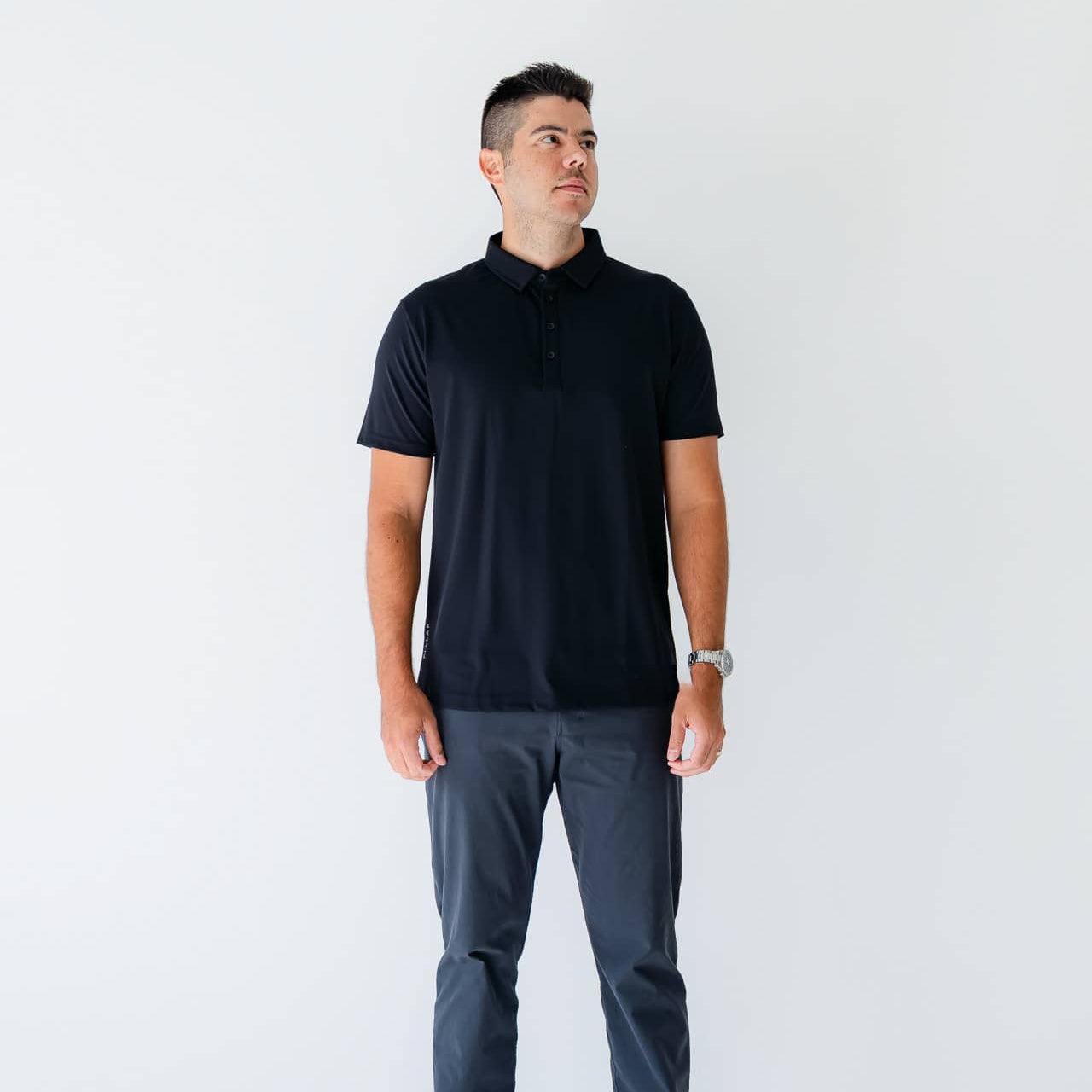
David Polo Black
84 percent nylon, 16 percent spandex. Four way stretch, sweat wicking, classic athletic fit, firm collar that holds its shape, U cut hem, pre shrunk. The solid staple, and the colorway nobody has to think about.
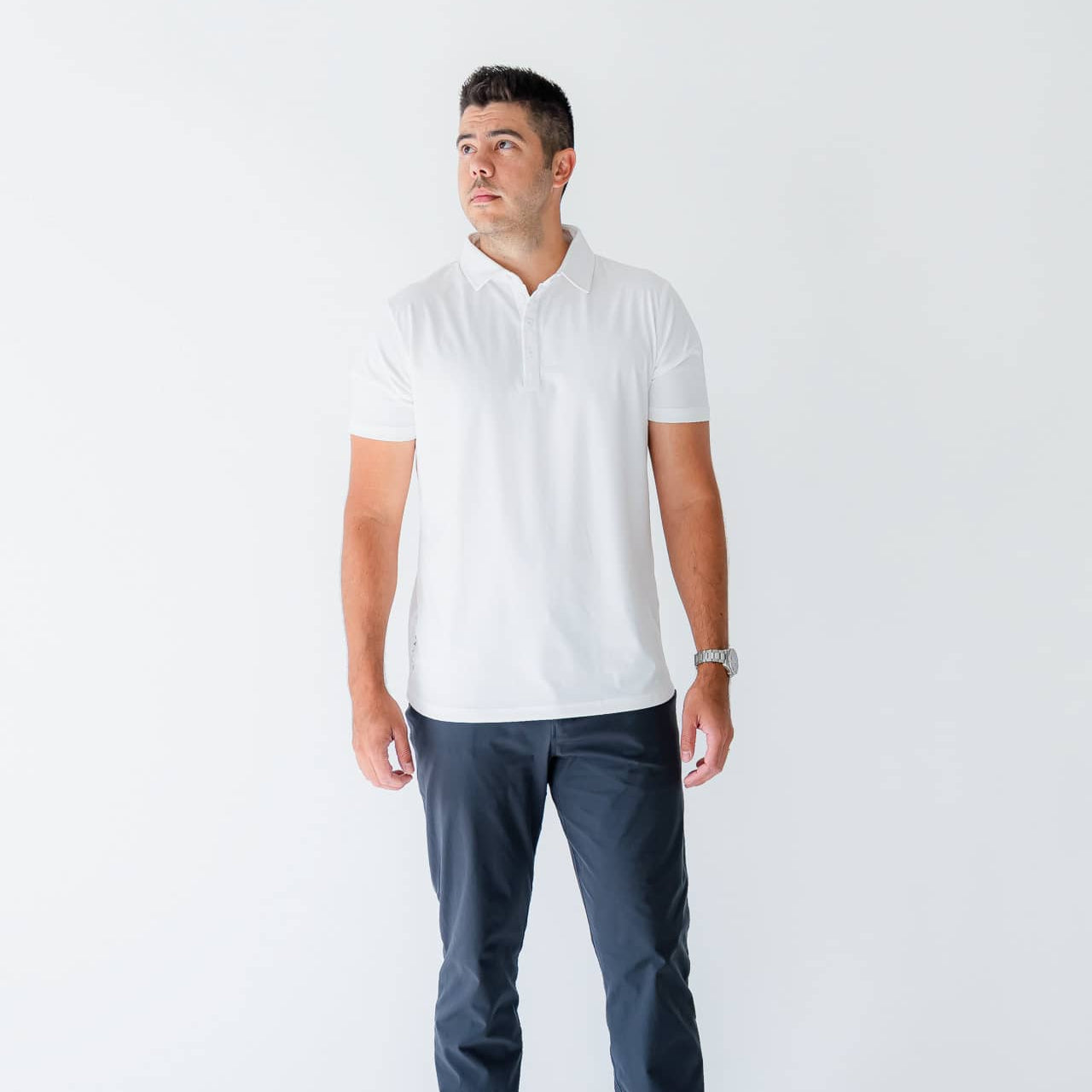
David Polo White
The same build as the black, 84 percent nylon and 16 percent spandex, pre shrunk with a U cut hem. White is the one that shows a logo most plainly, which makes it the easier colorway to check a mark against.
Black and white in the same size, added together at $152. Pick a size and the pair goes in the cart as one line.
After the count, before the handoff
Lay one shirt from the run next to the approved sample, under the same light, before anything is handed out. The sample you were told to keep is not a souvenir. It is the control.
Without it you are comparing a shirt against a memory of a screen, and a screen is backlit, color managed by nobody in particular, and looked at on a different day in a different room. With it you are comparing two physical objects on one table. That is the whole trick, and it changes the kind of sentence you are able to write: you stop saying the navy looks off to you and start saying the two garments on this table are not the same navy. The first sentence invites a discussion. The second one ends it.
Keeping that shirt is the argument the piece on what you sign before company polos are made already made, and the signature chain belongs to it. This hour is what that argument was for. The same mechanism runs from the other end as well: once a sample is approved it becomes the physical object every later run is held against, rather than a file somebody interprets, which is the point of the written standard we ask a production floor to work from. Put the sample back in a bag with the proof and the purchase order when you are done. The next reorder then starts from an object instead of a conversation.
A stack of shirts is a number you can check. The same shirts on bodies are a rumor you cannot.
The day a size turns up short
Hand out what you have in the sizes you have, do not hold the whole order waiting on a gap, and start the make up run the same day. A short size is not a defect and it does not get fixed the same way a defect does.
Holding a delivery penalizes everyone whose size did arrive and buys nothing for the people whose size did not. The gap is a quantity problem with a clock of its own, and that clock starts when a new proof is approved, not when you noticed the hole in the count. Every hour you spend deciding whether to hold the order is an hour added to the far end of that clock.
Worked through on real dates: cartons land Monday November 16 2026 and the gap is found that day. A make up run proof approved Tuesday November 17 2026 lands between Friday November 27 and Wednesday December 2 2026, which is 7 to 10 business days with Thanksgiving skipped as a business day inside the window. The window is counted in business days, so a holiday inside it moves the far end without anybody changing anything about the run.
That arithmetic also runs backward, which is the more useful direction when a delivery has to land on a fixed date. Working back from the date you need shirts in hand is the version of this to read before an order is placed rather than after it has shipped.
Seven to ten business days from the new approval
A logo run on stock garments takes 7 to 10 business days from proof approval. That is the clock for a make up run, for a second order, and for any program where the garment is a style that already exists.
The clock starts at approval. Not at the purchase order, not at the quote, and not at the email where you said the proof looked good to you. Approval is a signature on a specific proof naming a specific file, placement and color call, and until that exists there is nothing for anyone to build against. Which means the only part of the schedule you control outright is the gap between the proof arriving in your inbox and your name going on it. People lose a week there regularly, then describe it as a slow delivery.
That product is a logo run on garments that already exist, and it is the shortest path to a shirt with your mark on it. It is also the path that makes a make up run survivable: the garment is on a shelf, so the only thing being made is the decoration.
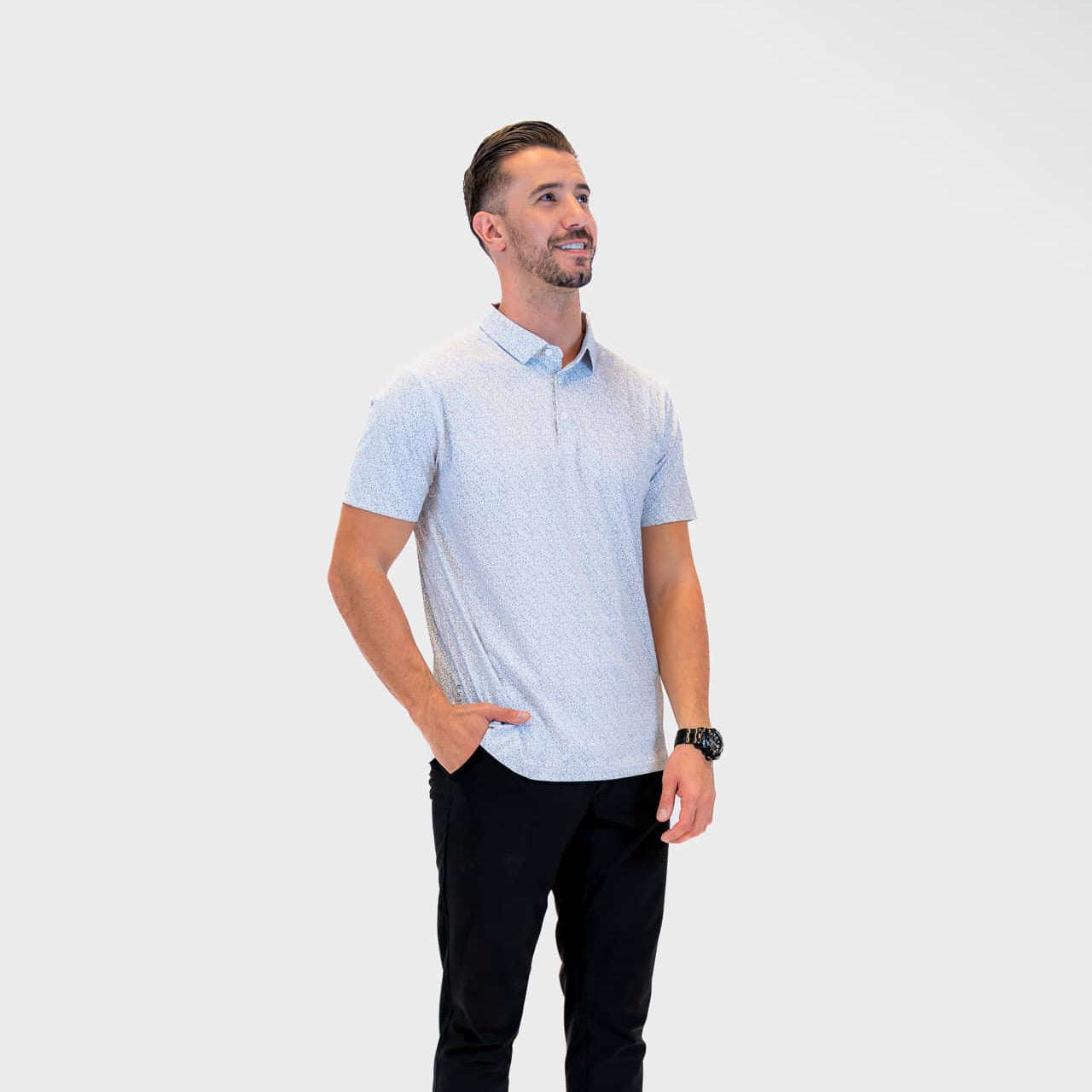
Steven Polo Brew
88 percent polyester, 12 percent spandex. A cooling, sweat wicking textured knit with four way stretch, classic athletic fit, U cut hem, pre shrunk.
This is the print polo, and a print changes what the fourth check is looking at. On a solid you are reading one color against a proof. On a print you are reading the print itself, and the Brew is the one to hold up next to your sample because a pattern makes a wrong garment obvious at arm's length.
Forty five days, when the garment itself is yours
A garment built from the fabric up runs about 45 days door to door. That is a different product from a logo on a stock shirt, and 45 days is the right number only when the shirt did not exist anywhere before your order created it.
None of that time is slack. Fabric gets made, the pattern is cut to your spec, a first article comes back for approval, and then the run goes. Each of those steps ends in a decision somebody has to make and sign, so the calendar is mostly decisions with production stacked in the gaps between them. That is also why the number is quoted door to door rather than from approval: there is more than one approval in it.
Two clocks, kept apart on purpose. 7 to 10 business days and about 45 days are not two estimates of the same thing, and asking for one number that covers both is asking to be handed the wrong one. The second clock belongs to a shirt whose fabric was made for the order, and the longer calendar buys you something at the receiving table: the approved sample on your desk is not a close reference to the run, it is the object the run was built against.
Long after anyone can fix it
PILLAR publishes no commercial laundering rating, no wash cycle count, no colorfastness grade, no abrasion result and no durability score, so none of those is a thing you can check a delivered shirt against. A vendor who hands you one of those numbers for a garment that already exists has guessed, and a number you cannot verify is not a check, it is a comfort. What you can verify is in the four checks above: the count against the purchase order, the sizes against the program, the mark against the proof you signed, and the fiber content on the tag against the page you ordered from. Everything else about how a shirt ages is learned by wearing it, which is the exact moment the order stops being an order.
An hour in, these come up.
Count the cartons against the packing list before any tape comes off, then open one bag and check count, size, mark and garment in that order. Finish by laying one shirt next to the approved sample under the same light. All of it happens before a single shirt is handed out.
Treat the day the cartons land as the deadline. A missing carton is a freight exception and carries the shortest window of anything on this page, so note it on the delivery receipt and raise it that day. A decoration question should go back with photographs before any shirts leave the room, because once they do there is nothing left to inspect.
Hand out the sizes you have and start a make up run the same day. A short size is a quantity gap rather than a defect, and holding the whole delivery helps nobody whose size did arrive.
A logo run on stock garments takes 7 to 10 business days from proof approval, so the clock starts the hour you approve the new proof rather than the day you found the gap. A garment built from the fabric up is a different product and runs about 45 days door to door.
No. A counted stack is a number you can hold against a purchase order, and the same shirts in a hundred drawers are not. Every check worth running gets harder the moment the first shirt leaves the room.
The purchase order is what you intended to buy and the packing list is what left the building. They are written by different people at different times, which is why a mismatch between those two is an order entry question rather than a production one.
The PILLAR David Polo at $76 is the solid staple, 84 percent nylon and 16 percent spandex with four way stretch and a firm collar that holds its shape. The PILLAR Steven Polo at $76 is the print polo, 88 percent polyester and 12 percent spandex in a cooling textured knit. Black and white David is the pair that covers the most ground in a rotation.
An order you checked in the first hour is an order you can repeat from paper instead of from memory. Tell us the garment, the sizes and the date the cartons have to land, and the proof comes back with a clock attached to it.
