

A Minimum Is Not a Plan
The short answer
Two numbers answer this question and the calendar picks which one is yours. If the shirts are needed inside about six weeks, you are choosing a turnaround, and the product is decorated stock: garments that already exist, embroidered with your logo, 7 to 10 business days from the day the proof comes back approved. If they are needed further out than that, you are not choosing a turnaround at all. You are choosing a product, and the one that opens up is a garment built from the fabric up, about 45 days door to door. The second question is the better one, and it is the one the vendor pages never put to you.
Reading a vendor page for what it actually answers
Every answer on the first page of search results for this question is a floor. A floor is the one number that cannot help a buyer who has time. It is built to tell a late buyer that he is late, and it tells an early buyer nothing at all.
Those pages are not wrong. They are answering the question they were asked, which is how fast, and they answer it well. Our decoration side does the same thing when somebody needs the mechanics rather than the strategy, and we lay out how an order actually moves from brief to box.
If your date is already sitting inside the lead time, you are reading the wrong post. The one you want is what gives way when a company apparel order gets compressed, which is this post's mirror image.
A floor also quietly reframes what spare time is for. Read enough of those pages and you come away believing that time is insurance against a rush fee. Insurance is something you hold. Slack is something you spend.
Working toward a window instead of a date
The date you should be counting back from is usually not a date at all. It is a window, and the number that matters is the day the window opens.
Company apparel is rarely worn once at a fixed hour. It gets worn across a season, a quarter, a run of client meetings, a stretch of site visits. A window has an opening day and a closing day, and the last acceptable arrival is the opening day, not a date you picked because it felt safe. Pick the comfortable date and you have given the slack away before deciding what to do with it.
Take a real one. The wear window opens Monday April 5 2027 and closes Friday May 14 2027. The last acceptable arrival is Monday April 5 2027, the day the window opens. Count back ten business days from that day, skipping weekends and US federal holidays, and you land on Monday March 22 2027. That is the proof approval date for decorated stock. Count back forty five calendar days from the same arrival day and you land on Friday February 19 2027. That is the date a garment built from the fabric up has to be underway.
Both dates come off one arrival day. Only one of them was ever on the table for a buyer who asked how fast. A collection tied to a milestone is where this planning gets its clearest run, and there is a case like it in our own write up on planning a milestone collection.
Spare time on a calendar is not insurance against a rush fee. It is slack, and slack buys things a short clock will never put in front of you.
Spending the slack on three things a short clock will not sell you
Extra time buys three things and not one of them is speed. They are all decisions, and each one is available only to a buyer whose arrival day is far enough out to make it.
The product tier itself
A garment built from the fabric up exists as an option only for a buyer who has the calendar for it. It is not a faster or slower version of decorated stock. It is a different thing to buy. Most buyers never find out it was available, because they asked how fast instead of asking what was possible. Polos are where that happens most often, and the polo side of what we decorate runs on the same two clocks.
A sample in your hands before the run
With slack, the approval happens on a garment somebody can hold, in the room, instead of on a proof on a screen. That is the whole of the difference and it does not need any more explaining than that.
A color decided rather than selected
On a short clock you pick from the colors the catalog happens to stock. On a long clock the color is a decision. We have already argued why no stock polo arrives in your brand color and there is no sense re-running it here. The practical version: if your brand color is not already sitting on a shelf somewhere, the only thing that puts it on your people is a calendar.
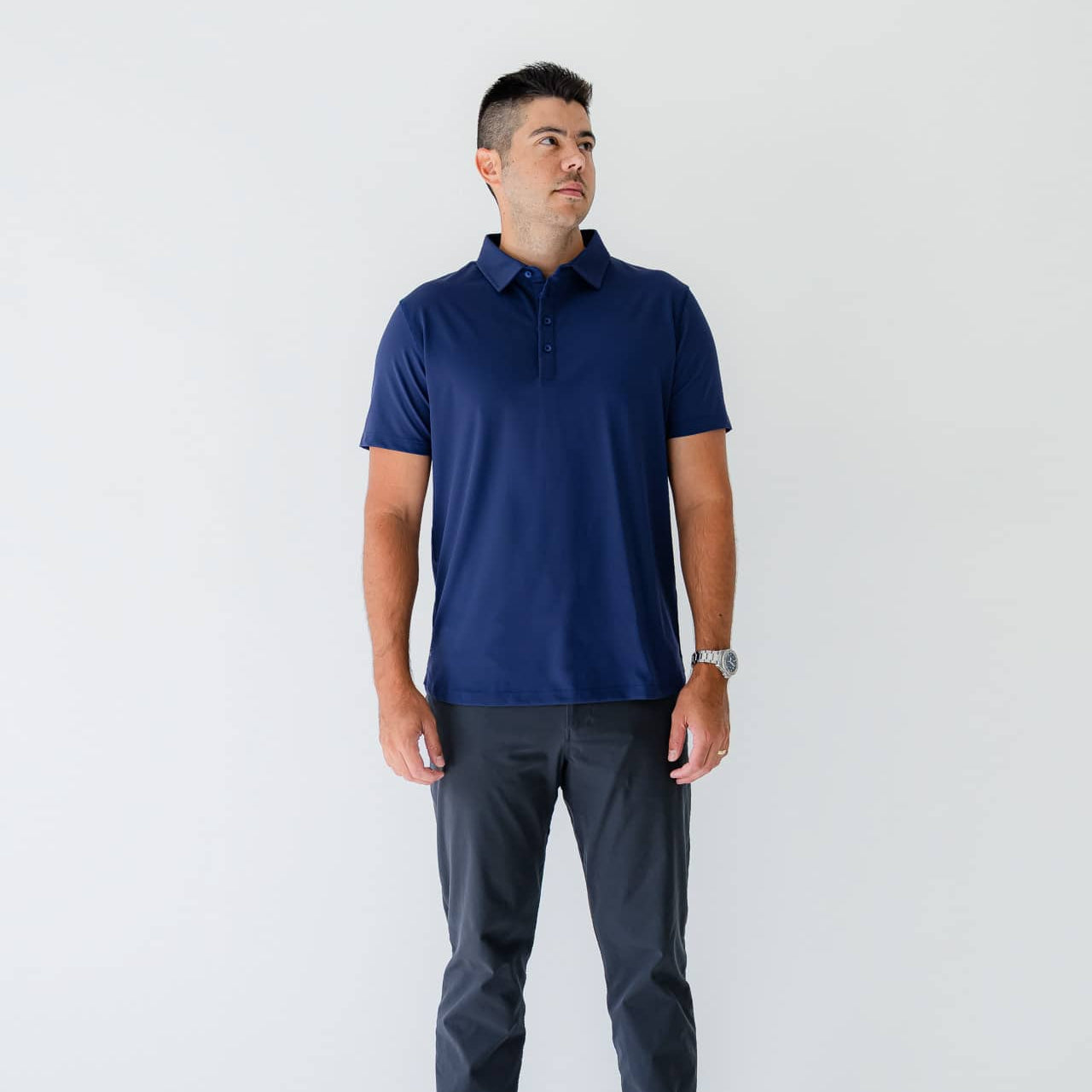
The three colorways on this page are the stock positions of one garment. The rest of the men's polo collection works the same way, which is exactly the point of the color beat above.
Navy
$76.00
84 percent nylon, 16 percent spandex, four way stretch, sweat wicking, classic athletic fit, firm collar that holds its shape, U cut hem, pre shrunk.
Navy is the safe stock position, which is the whole reason it is worth knowing whether you had a choice. If navy is right, the short clock is fine. If it is close but not yours, that gap is what the long clock is for.
Expecting a long clock to hold a price
Extra time does not make a decoration run go faster once it has started. It does not hold a price and it does not keep a stock garment in stock. PILLAR publishes no price hold window and no stock guarantee, so this post will not give you one.
Locking the garment early and leaving the count open
Lock the garment and leave the quantity alone. The garment is the long decision and the count is the short one, and a roster that is still moving is not a reason to postpone the first choice. We make that case in full in what a brokerage with an open roster should order.
Running the two clocks side by side
There are two clocks and they are not two speeds of the same thing. They belong to two different products, and one number quoted for both is the mistake this whole post exists to correct.
The first clock belongs to a mark added to garments already on a shelf. The garment exists before you call. Production starts the day you approve the proof, and the figure that belongs to it is 7 to 10 business days from that approval.
The second belongs to a shirt whose fabric and color start as a spec. Fabric specified, woven or knit, dyed, cut, sewn, decorated and finished. That run is about 45 days door to door, and it is a separate purchase rather than a slow version of the first one.
| What you are buying | What starts the clock | How long | What it is right for |
|---|---|---|---|
| Decorated stock. A mark added to garments that already exist. | The day the proof comes back approved. | 7 to 10 business days from proof approval. | A window that opens inside about six weeks, and a colorway you are glad to take as the catalog stocks it. |
| Built from the fabric up. Fabric specified, woven or knit, dyed, cut, sewn, decorated and finished. | The day the spec is committed. | About 45 days door to door. | A window that opens further out, a brand color no catalog stocks, and a fit and collar you want set on your own terms. |
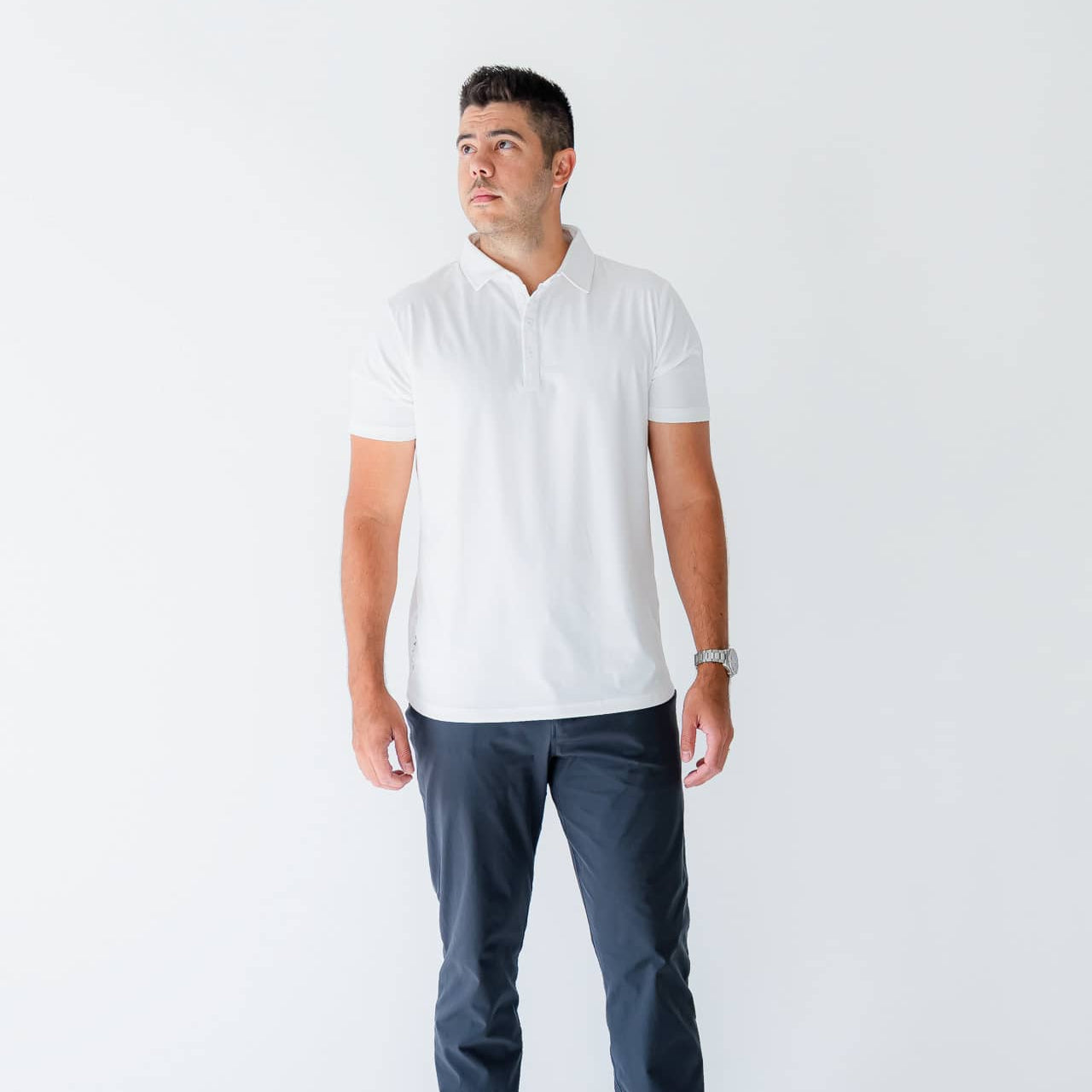
White
$76.00
84 percent nylon, 16 percent spandex, four way stretch, sweat wicking, classic athletic fit, firm collar that holds its shape, U cut hem, pre shrunk.
White is the daylight shirt. It is the one that reads cleanest on a floor, at a table, in a photograph taken by somebody who did not ask first.
Black
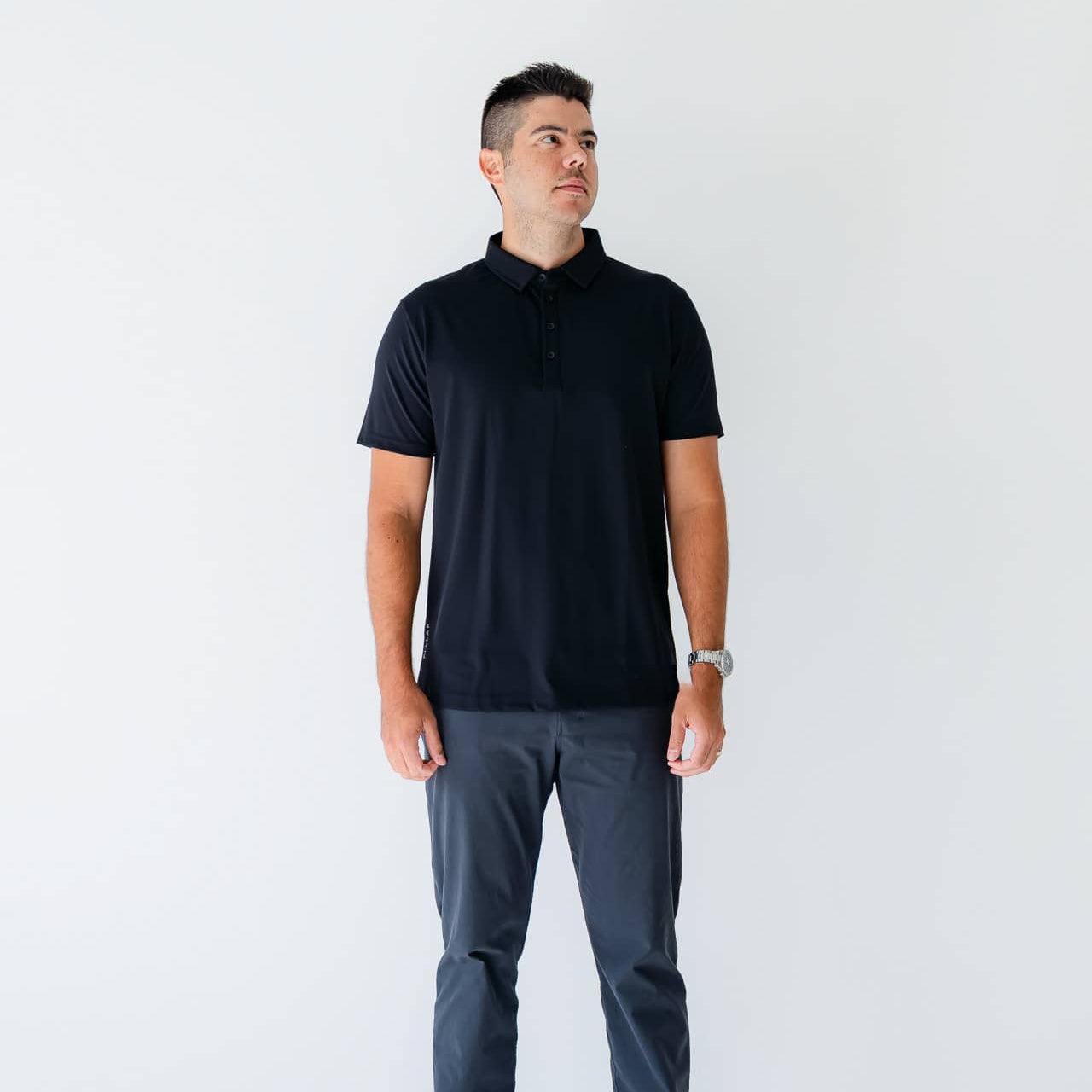
$76.00
84 percent nylon, 16 percent spandex, four way stretch, sweat wicking, classic athletic fit, firm collar that holds its shape, U cut hem, pre shrunk.
Black is the shirt for the end of the day, when the same people are in a different room and nobody wants to change. Same garment, same collar, same stretch. The only thing that moved was the hour.
White and black, six sizes, one click
These are the two colorways a program usually ends up running: one for the floor and one for the evening room. Buying them together is how most people get there anyway, so here it is in a single step. $152.00 for the pair.
Answering what comes next
How far ahead should I order company apparel?
Far enough ahead that you are choosing a product rather than a turnaround. Inside about six weeks you are picking a turnaround and the product is decorated stock, which runs 7 to 10 business days from proof approval. Further out than that, a garment built from the fabric up becomes available, at about 45 days door to door.
What date should I count back from?
The day the wear window opens, not the day you think of as the deadline. Apparel is usually worn across a stretch of time rather than at one fixed hour, so the opening day of that stretch is the last acceptable arrival. Counting back from a later date you picked because it felt safe is how buyers give away time they already had.
How long does decorated stock take?
7 to 10 business days from proof approval. The clock starts the day the proof comes back approved, not the day you first called, and the garments themselves already exist before any of that begins.
How long does a garment built from the fabric up take?
About 45 days door to door. That covers fabric specified, woven or knit, dyed, cut, sewn, decorated and finished, which is why the figure has nothing in common with a decoration turnaround on stock garments.
Does ordering early lock in my price?
No. PILLAR publishes no price hold window and no stock guarantee, so this post will not give you one. Extra time buys you choices about the product, not protection on a price or on the availability of a stock garment.
If I have time, what should I decide first?
The garment. That is the long decision and it sets everything downstream, while the quantity is the short one and can wait on a roster that is still moving.
Bring the window, not the deadline
Tell us the day your wear window opens and what has to be worn in it. If that day is far enough out, you get both clocks on the table and a product to choose between, rather than a single number and a rush.
