


Should the year go on your company apparel?
A logo has no expiry date. Put a year under it and you have just given the shirt one.
That is not a styling question. A date is the only piece of artwork on a garment that sets a lifespan, and the moment it goes on, two commercial decisions have been made for you: how many you order, and how often you pay to set the artwork up again. So here is the ruling before any of the reasoning. Put the date on the thing people keep. Leave it off the thing people wear.
- What a date actually does
- It sets a lifespan. A logo can be run again in any year, a date can only be run again in its own, so a dated order is a closed order with nothing held back.
- When it earns its place
- On a milestone, a finisher's piece, a trip, a cohort, or anything you want to age out on purpose, such as a sponsor name or a campaign.
- What to order either way
- Order the undated piece deep, because it is the only thing in the order you can buy again: the PILLAR David Polo at $76.00, in black for the standing program and in white when you want the mark to be the only thing on the shirt.
Under the logo
A date is artwork, not decoration, and that is the whole reason it costs you something every year.
A logo gets set up once and run again. The file is approved, the stitch path is settled, and every order after that is a repeat of a known thing. A date breaks that arrangement. Change the number and you have changed the artwork, which means a new layout, a new placement decision, a new proof and a new signature on it, annually, for as long as the program runs. Nothing else on the garment behaves this way. Thread color does not expire. A left chest placement does not expire. A year does, on a schedule you cannot negotiate with.
If you are going to carry that cost every twelve months, carry it cleanly, which starts with the file a date has to arrive in before it can be stitched, because a number set in the wrong weight or crowded too close to the mark is the version you will be looking at on every chest in the building until next year's proof.
A name on a shirt behaves differently, and we ruled on names separately, where the object is a person rather than a year. A name is bought one unit at a time and it follows someone out the door. A date is bought once for the entire run and it retires the whole run at the same moment. Different object, different consequence.
On a keepsake
On a keepsake, put the date on, because the date is what the garment is for.
A commemorative piece is not apparel with a number added to it. It is a record with a shirt attached. Take the year off a 25th anniversary piece and you are left with a logo shirt that somebody has to explain at the door. The honest case for a date is strong in three situations, and it is worth knowing which one you are in before anyone starts arguing about placement.
A milestone the garment exists to mark. Twenty five years, a first championship, a building that opened. The date is the content rather than a decoration, and a version without it is a shirt about nothing in particular.
A finisher's piece, a trip, a cohort. The wearer earned a specific one and would not want a generic one. The date is what makes it theirs instead of a size in a box.
Sometimes you want the garment to age out. A sponsor name, a campaign, a product that will not exist in two years. Dating it is how you stop it walking around after it stopped being true. Think of a sponsor whose agreement ends in December, or a product line being renamed: the shirt outlives the fact, and that is a quiet problem on somebody's back at a trade show. A date is the cheapest way to put an end on something you already know will end.
If none of those three describes the order in front of you, you are holding a program garment, and the next ruling is the one that applies.
Against a program garment
On a program garment, leave the date off.
A program garment is anything a person will put on again next Tuesday without thinking about it. Staff polos, a uniform layer, the client gift that is good enough to earn a place in a real rotation. These are the pieces you want to buy again, and a dated garment has no second order. You cannot reorder 2026 in 2027 and have it mean anything, so a dated run is a closed run: you buy it for the people who will be in the room, and you hold nothing back for the hire who starts in February. The undated piece is the opposite. It is the only thing in the order you can buy again, which is exactly why it is the one you order deeper and keep ordering.
Our decoration side already prints the short version of this, a single line sitting under a list of things to skip in the packing list we wrote for a dated company trip: leave dates off the layer so it can be worn next year. That line is right, and it never takes up why. Here is why. A date does not merely age the garment. It ends the reorder, and it hands you a fresh proof every time you want the same shirt again.
There is a related question about whether batch two looks like batch one, and we took that up in a post on how closely a reorder matches. This post sits upstream of it, on whether there is a batch two at all. Two pieces in the polo range are built for the reorder rather than for the moment.
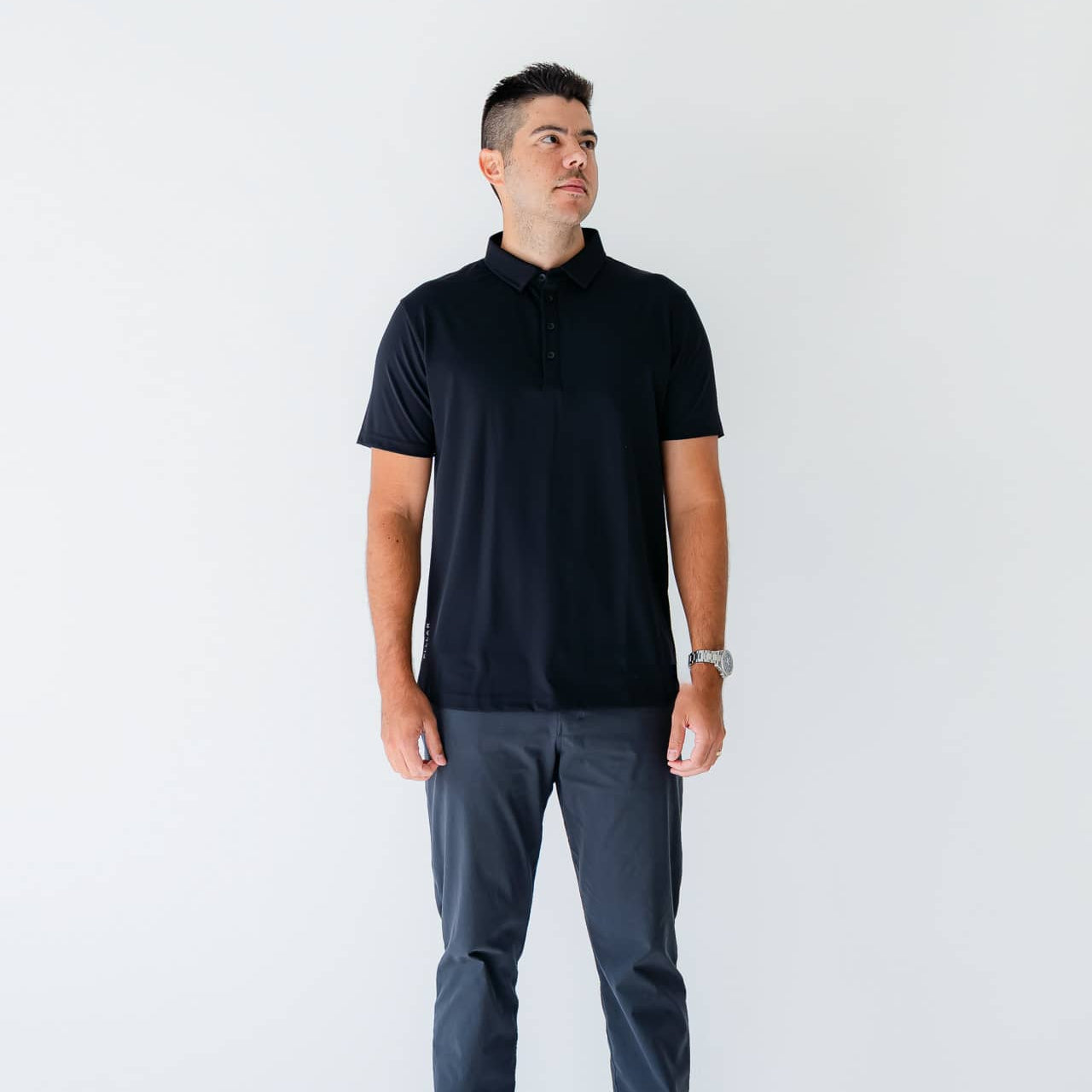
David Polo, Black
The program polo, the one you can order again in March without explaining anything to anybody.
84 percent nylon, 16 percent spandex, four way stretch and sweat wicking. Classic athletic fit, a firm collar that holds its shape, U cut hem, pre shrunk.

Alec Crew, Black
The layer with the longest life in the order, which is exactly why a year under the mark is the most expensive thing you can put on it.
No fabric content is published for this garment, so we will not state one. It is a crew neck layer, and that is as specific as we can honestly be.
Inside six weeks
Inside six weeks, the only dated garment that is possible is a stock garment with a mark added to it.
Logo embroidery on stock garments runs 7 to 10 business days from the day you approve the proof. Business days, and from proof approval, not from the afternoon somebody emailed over a logo. That is the clock that makes a dated giveaway possible at six weeks out, and it is the only clock that does. The work is putting a mark on garments that already exist, which is why the garment itself never sits on the critical path. It is already on a shelf. The artwork is the only thing still being decided.
Work backward from the event and the arithmetic turns unforgiving quickly, because the event does not move. Count back from the date on the invitation to a proof approval date, count back again to the day artwork has to be submitted, and then look honestly at how many people in your building have to say yes before that happens. If you want the longer version of that math, we wrote one on how far ahead to place a company order.
Beyond the forty fifth day
A garment built from the fabric up runs about 45 days door to door, so it cannot carry a date for an event six weeks out.
Those 45 days cover cloth and trim made to your own spec, print, custom finishing, private label and freight. It is the right product for a uniform program you intend to run for years and the wrong product for a dated piece on a short fuse. Anyone who quotes you a build on that clock and a dated event inside six weeks is quoting the wrong product, and when a schedule like that collapses, the thing that gets cut is never the date. It is the garment.
So never take one number for both. Ask which product a number belongs to before you write a deadline into anyone's calendar, because the two clocks are not interchangeable and a date is the one piece of artwork that cannot be added late.
Before the proof
The real deadline on a dated job is the proof approval date, not the event date.
On an undated order the proof is close to a formality and it comes back in an hour. On a dated order it is the thing people sit on, because somebody always wants to argue about the year: whether it reads 2026 or the season, whether it belongs under the mark or on a sleeve, whether the event name has earned a second line. None of that is a design problem. It is a schedule problem, and it eats the same days production needs. Knowing the order of operations a dated job runs through is worth more here than on any other order you will place, because every step behind the proof is waiting on a number that is still in dispute.
The fix is unglamorous. Name one decider before artwork goes out, by name, with the authority to approve a year without calling a meeting about it. Then put the proof approval date on the calendar as the deadline.
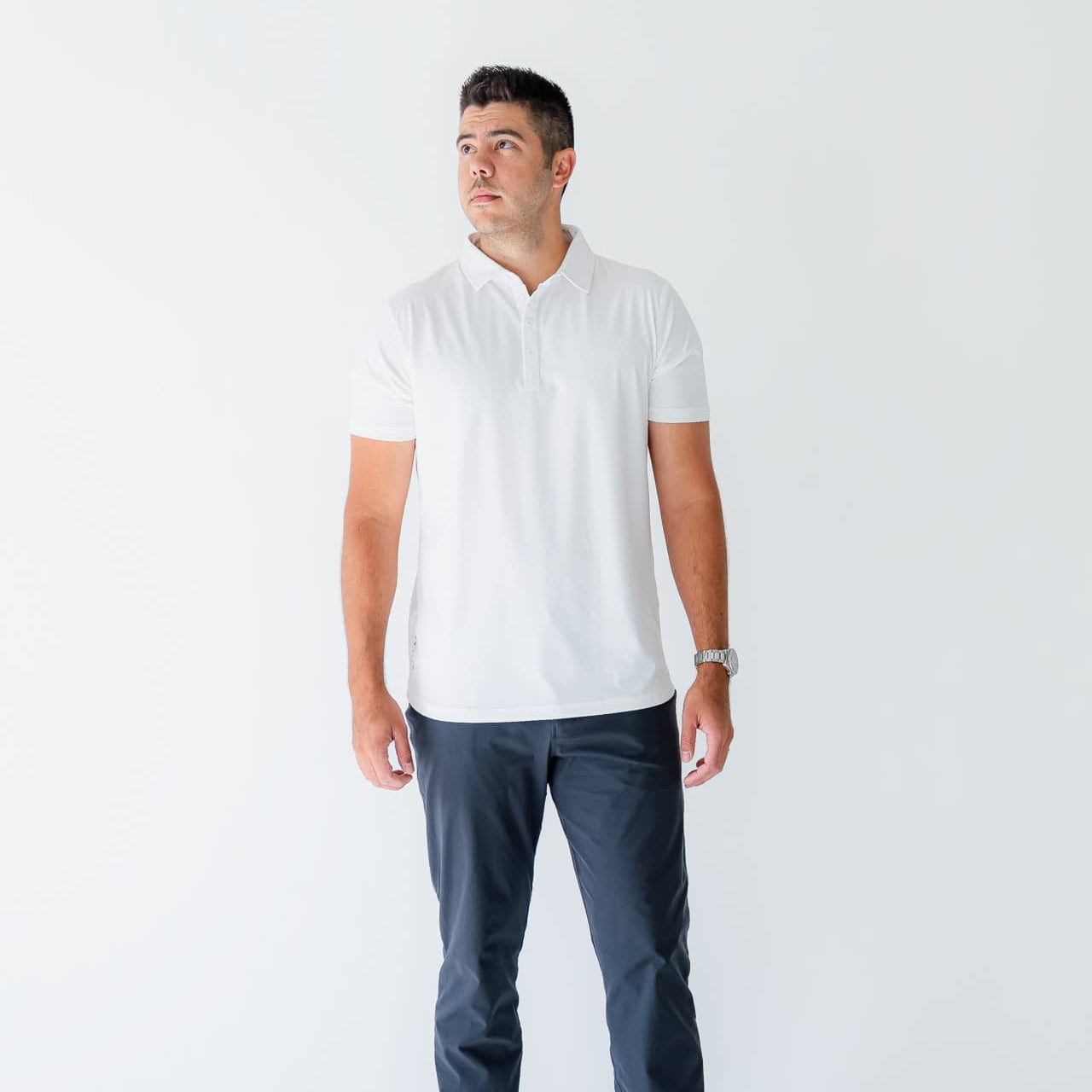
David Polo, White
The blank page of a company apparel order. Nothing on it dates, so everything you put on it is a choice rather than an accident.
84 percent nylon, 16 percent spandex, four way stretch and sweat wicking. Classic athletic fit, a firm collar that holds its shape, U cut hem, pre shrunk.
David Polo in white with the Alec Crew in black, $161.00 together. One mark, two weights, and both of them reorderable next spring. The crew also runs Extra Small and the polo does not, so the bundle starts at Small.
In the drawer by spring
By the following spring the dated shirt is already out of rotation, and nobody decided that.
Two shirts, same logo, same cut, same color. One carries a year under the mark and one does not. They do not have the same future. The dated one is the first thing to get passed over in the drawer the next April, not because anyone retired it, but because it announces that it is old. The undated one is still in the rotation and gets worn to a client meeting. No meeting, no memo, no policy. The drawer does the sorting. Which means a company that dates its staff apparel is buying the same garment more often and calling it a refresh.
There are other reasons a shirt stops getting worn, and we took those up in a post on the reasons a company shirt sits unworn. A date is different from every one of them, because it is the only reason you choose on purpose. Anything in the full range for men can be bought again next March. A year under the mark is the single thing that takes that option off the table.
Without a number
Three numbers would make this post more persuasive, and we are not going to print any of them, because we do not have them. There is no percentage of dated garments that get worn a second year; nobody measures it, and any figure you find quoted is somebody's guess wearing a lab coat. There is no rule about which anniversaries are worth a garment, because that is your company's judgment and it rests on things nobody outside the building can see. And there is no figure for what re-proofing a date costs or adds to a timeline, because it depends on the artwork and on how fast your own people sign off, which is the part we do not control.
What replaces all three is one word written on the order. Decide at the brief, not at the proof, whether the garment is a keepsake or a program. Write the word down where the quantity goes. Then let it pick the artwork, the depth of the buy and the clock, and the argument about the year never has to happen in the room at all.
