


What to Do With Leftover Company Apparel
A stack of shirts nobody has worn is sitting on a shelf somewhere in your building. It is not surplus. It is a record of the sizes you guessed. So here is the ruling before the argument: hold the ends of the size run for new hires, issue the spares instead of storing them, retire any shirt carrying a mark you no longer use, and order the next run deep in the middle and thin at the ends, because logo embroidery on stock garments comes back in 7 to 10 business days from proof approval and a size you can reorder is a size you do not need to stockpile.
- Shirts that fit nobody
- Hold the smallest and the largest for new hires. Do not store the middle.
- Spares bought at a break
- Issue them now. A worn shirt is marketing. A stored shirt is a cost.
- A retired color or mark
- Out of rotation. Never into a customer's hands.
- The next order
- Deep in the middle, thin at the ends, then reorder. Decorated stock garments run 7 to 10 business days from proof approval.
In the closet behind the door
Count what is left and write the sizes down, because that list is the only honest record of how the first order was placed. Nobody keeps the order form. Everybody keeps the box. The pile is not a storage problem and it is not a procurement failure either, it is a decision that was made at the quote and is only now visible.
Counting a shipment against the packing list the day it lands is a separate job, and it is covered in checking a shipment the day it lands. One distinction worth drawing now so it does not muddy the rest: a drawer holds shirts somebody was given, a closet holds shirts nobody was given, and why a shirt somebody owns still goes unworn is a different problem with a different fix. This post is about the closet.
At the quote, before anything was printed
The extra shirts were bought at the quote, before anything was printed. Decoration gets cheaper per piece as the count goes up, so one more shirt always looks close to free at the moment you are signing. It is free on the invoice. It is not free in the closet.
This is worth naming out loud rather than tiptoeing around, because our own decoration side has it priced out at every quantity, and the argument on that page is the correct one: rounding the count up to just under a break lowers the total you pay. Both things are true at the same time. Rounding up is a question about the bill, and the closet is a question about the sizes. So round up into the sizes that move, never evenly across the run. The quantity break is an invitation to buy more of what people wear, not a reason to buy one more of everything.
Across the two ends of the size run
Leftovers concentrate at the two ends of the size run, not across it. The middle of the curve goes out on day one, because that is where the people are. What is left is the smallest size and the largest, and both of them were ordered to make the curve look complete on the order form rather than because somebody asked for them. Read the shelf and you can see the shape of the mistake.
| What is left | Why it was ordered | What to do with it now |
|---|---|---|
| The ends of the run | A full curve looked complete on the order form | Hold it for new hires, who arrive at every size |
| Spares over the headcount | One more piece looked close to free at the break | Issue them this quarter, then reorder rather than restock |
| The second color | Two colors were ordered so people could choose | Issue one, retire the other at the next order |
| Anything carrying the old mark | The brand changed and the shirts did not | Out of rotation entirely, and never to a customer |
Two garments worth ordering deep in the middle, both from the polo collection:
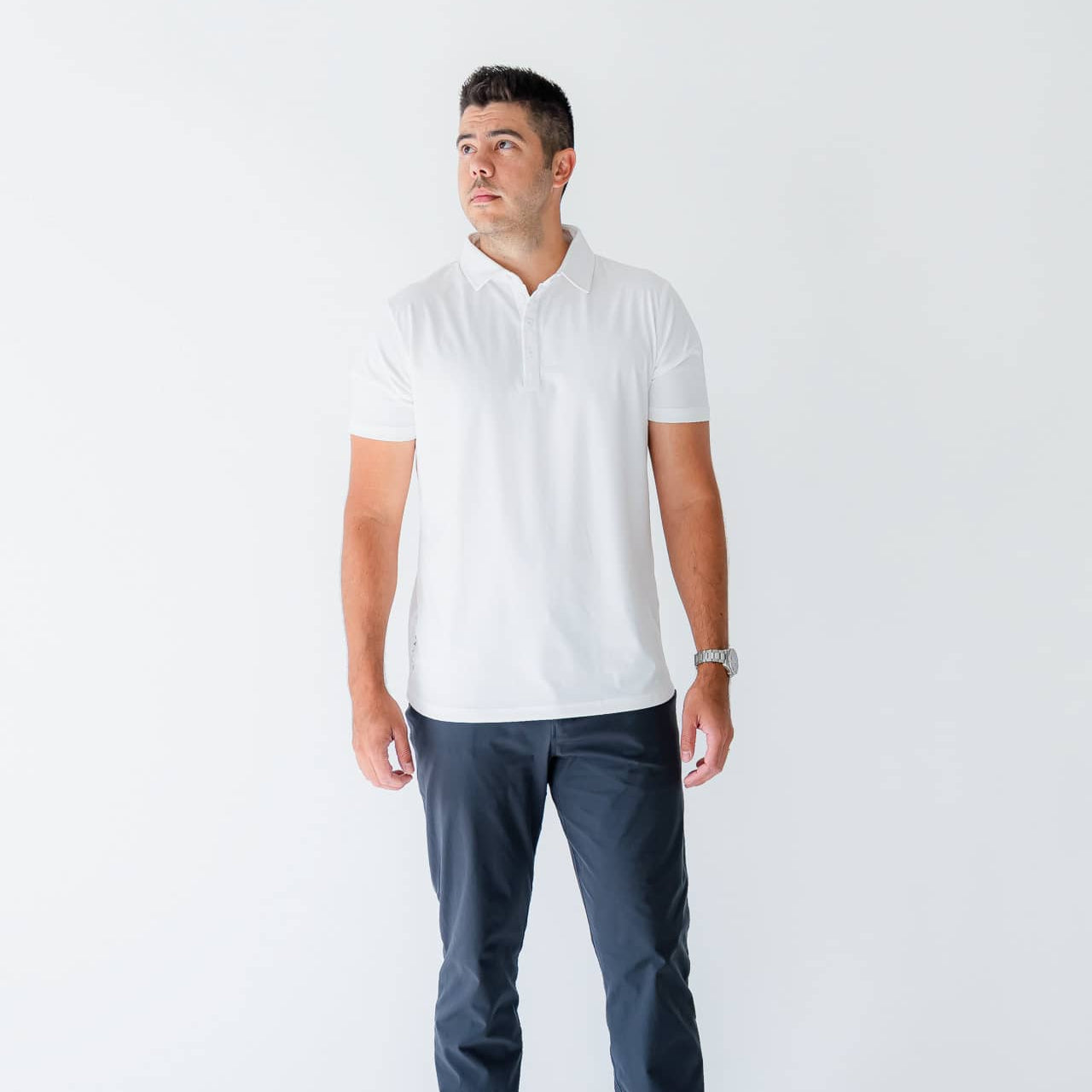
The size run every company orders, and the one the ends get cut from. Sweat wicking nylon stretch, a firm collar that holds its shape, a U cut hem, pre shrunk so the size you buy is the size you keep. 84 percent nylon, 16 percent spandex.

The layer a lead or a host wears over the same shirt, so one shirt still covers the whole team. Black, Small through XXL.
On a dozen people for three weeks
A wear test is the one mechanism that stops a full curve being committed before anybody has reported a size. Put the candidate garment on a dozen people for about three weeks and the fit problems come back as a conversation instead of as a box. That is the whole trick, and it is the step most buyers skip because the quote is sitting there waiting for a yes.
Our own walk through of running candidate garments on a small group first, trialed on a dozen people before the whole company, lays out how to run it without stalling the order. What it catches first is not durability. It is which size people ask to swap into, which is exactly the information an order form cannot supply and exactly the information that decides whether the ends of your run get worn or shelved.
Between the proof and the tenth business day
A single size comes back in 7 to 10 business days from proof approval, which makes stockpiling a choice rather than a necessity. That is the clock for a stock garment embroidered once the proof is signed, and the clock starts at approval, not at the purchase order. Ordering a year of a size up front buys nothing you cannot buy again on short notice.
There is one case where you do have to commit up front, and it is worth stating plainly: a garment woven to a spec you set runs about 45 days door to door, because the fabric is being built rather than pulled from a shelf. If that is the program, plan the quantity properly and accept the lead time. Before you lean on a reorder either way, read whether a second run matches the first, since dye lots are the real limit on topping up a color later. And if the apparel is tied to a date, how far ahead to put the order in is its own question.
Out of the box and onto somebody
Get the garment onto a person, and do it this quarter. A shirt that is being worn is marketing and a shirt in a box is a cost, which reframes the whole disposal question: the answer is almost never a bin, it is a body. New hires arrive at every size, and that is precisely what the ends of the run are for, so hold the smallest and the largest and issue everything in between now.
Widen who counts as a recipient before you widen where the shirts go. Contractors, seasonal staff, the people at the front desk, anybody standing in front of a customer. On donation, PILLAR has verified nothing about what any organization will or will not accept, so we will not point you at a recipient. And anything carrying a mark you no longer use comes out of rotation entirely and never reaches a customer, because a retired mark walking around on a stranger is worse than an empty shelf.
Under the layer that does not go stale
A layer program leaves less behind than a shirt program does. People keep a vest or a crew, wear it away from work, and reach for it in weather a polo cannot cover, so the piece stays in rotation long after the shirts have been replaced. The size math is friendlier too, because layers run wider at both ends and the extras get absorbed instead of stacked.
When the shirt itself is the program and it is being decorated for a whole roster, the same rule holds: depth in the middle, restraint at the ends, and a layer over the top for the people who are hosting.
The widest size run PILLAR offers on a layer, Extra Small through XXXL, so the extras get absorbed by somebody rather than stacked on a shelf.

David Polo White plus Kevin Vest Black, total $154.00. One size, both pieces, straight to the cart.
Past the edge of what we will rule on
Three questions sit outside what we will answer, and we would rather hand them back than guess. Whether you can require somebody to pay for a shirt or hand it back when they leave belongs to their own employment agreement and to an employment attorney, not to us. How many shirts each person needs, and what buffer belongs on top, goes to the Pillar Post piece on sizing a company polo order, which owns that question properly. How to treat donated or written off goods on the books goes to your accountant.
And one thing about everything above it. PILLAR has run no study on leftover company apparel, and we will not publish a number we have not measured. What you have read here is what we have watched happen across company orders, stated as opinion, which is the honest form for it. The two clocks in this post are the only figures we stand behind, and they are quoted because they are ours to quote.
Around the questions buyers keep asking
Issue them. Hold the smallest and the largest sizes for new hires, move the spares onto people this quarter, and take anything carrying a mark you no longer use out of rotation. A shirt that is being worn is marketing and a shirt in a box is a cost.
Because those sizes were ordered to make the curve look complete, not because somebody asked for them. The middle of the run goes out on day one. The ends sit on the shelf until somebody arrives who needs them.
Round up into the sizes that move, not evenly across the run. Decoration does get cheaper per piece as the count goes up, and our own decoration side makes the correct argument that rounding up to just under a quantity break lowers the total on the bill. The bill and the closet are two different questions, so put the extra pieces in the middle of the curve where they will be worn.
Anything carrying the mark you use today should go onto somebody who works there instead. PILLAR has verified nothing about what any organization will accept, so we will not point you at a recipient. A garment carrying a retired mark comes out of rotation entirely and never reaches a customer.
Logo embroidery or printing on stock garments runs 7 to 10 business days from proof approval. The clock starts when you approve the proof.
It is cheaper on the bill and more expensive on the shelf. A year of the middle sizes will go out and a year of the ends will sit, and since a size comes back in 7 to 10 business days from proof approval you can reorder instead of stockpiling.
Send the roster and the sizes you want held back, and the run gets quoted around the people who are going to wear it.
Request a quote Book a call