

Can you put two logos on one company shirt?
You are signing the invoice for this run. Someone at the other company decides whether the artwork on it is allowed to exist. That is the whole shape of a two logo order, and it is why a job that looks like a normal apparel order starts behaving like a negotiation. You have a headcount, a date and a budget. You also have a stranger with a veto.
Decide whose garment it is before you decide anything about the artwork. One company owns the garment. That company pays for it, picks the cut and the color, holds the quantity and carries the risk if the run comes back wrong. The other company is a guest on it. If you cannot say out loud which company owns the shirt, you are not ready to order, and no amount of artwork discussion will fix that.
- Can you do it
- Yes, and it is routine. Two marks on one garment is ordinary work. The ordering is the part people get wrong, not the decoration.
- Who decides the artwork
- Both companies, in writing, before a proof. Your brand standards govern your mark. Theirs govern theirs. Nobody else has a say worth having.
- When the clock starts
- At proof approval, and a two logo proof needs two approvals. Nothing downstream moves until both signatures land.
- How many to order
- A co-branded run is a shallow run. Buy for the people who will be in the room, not for the storeroom.
Your mark and theirs
Everything else on this order is yours. The cut is yours. The color is yours. Your own mark is yours, down to the thread color. The quantity is yours and the date on the invoice is yours. Add a second company's mark and you have handed one approval to a stranger, on their calendar rather than yours, over a garment you are paying for. A logo you do not own is the only thing on a company garment that somebody outside your company can veto.
That is what separates a partner logo from every other decoration decision you will make this year. We have already ruled on whether a date belongs on company apparel, and a date is content you own. It expires on a schedule you can read a year in advance, which means you can decide what to do about it before you order. A second company's logo is not content you own at all, and it expires when a relationship does. Nobody can tell you in advance when that will be, including the people in the relationship.
So treat the partner mark as the one line item on the order with an external dependency attached, and sequence everything else around it. Pick the garment while you wait. Lock the headcount while you wait. Do not let the garment decision sit behind the artwork decision, because the artwork decision is not on your desk.
Your deadline and their calendar
You can only put on a garment what the other company sends you, in the form they send it. A logo pulled off a website is not a production file. It is a small compressed picture of a logo, and a picture of a logo is what comes back on the fabric. What goes down cleanly is vector artwork with the real colors named, and that file usually lives with one person at the partner company who is not the person who signed the partnership. Our decoration side sets the requirement out plainly, because a partner's logo has to arrive in a form that can be stitched.
The gap between the marketing contact and the person who actually holds the file is where weeks go missing. Nobody is obstructing you. The request simply sits in an inbox belonging to somebody whose quarter has nothing to do with your event. We settled who holds the files behind your company apparel when the mark is yours. This is the case where the artwork is not yours to hold, and the difference is the whole post.
- Who holds the file
- You do, or we do on your behalf. Either way it is reachable today.
- Who approves it
- Your own chain, inside your own building, on a timeline you can push.
- Who can change it
- You can, at proof stage, and again on the next order if you change your mind.
- What happens when the relationship ends
- Nothing. Your mark is still your mark and the garment still works.
- Who holds the file
- One person at the partner company, and you may not know their name yet.
- Who approves it
- A brand team you have never met, in a queue you cannot see or hurry.
- Who can change it
- They can, at any point, and a change on their side restarts your proof.
- What happens when the relationship ends
- The garment retires with the deal, whether or not you have worn it out.
Ask for the file on the day you agree the partnership, not on the day you place the order. The request is one email and it costs you nothing to send it early. Waiting until the garments are picked costs you your date, and your date is the only thing on this job that cannot be reordered.
One garment and two owners
Two marks, one owner. The company that pays owns the garment and every decision on it except the other company's mark. The guest gets one thing, their mark, on their terms. That asymmetry is not rudeness, it is the thing that keeps the order moving, because an order with two owners has no tiebreaker and an order with one owner and one guest has an obvious one. Say it in the first meeting, in plain words, before anyone opens a drawing.
Once that is settled, pick the garment for the room it will be worn in. A booth, a client floor, a joint event and a golf day are four different rooms and they do not take the same piece. Our polo collection is where most co-branded corporate orders start, because a polo reads as company apparel without anybody having to explain it. Two garments below cover the two cases that come up most: the piece that has to look right every day, and the piece that has to fit everybody on the list.
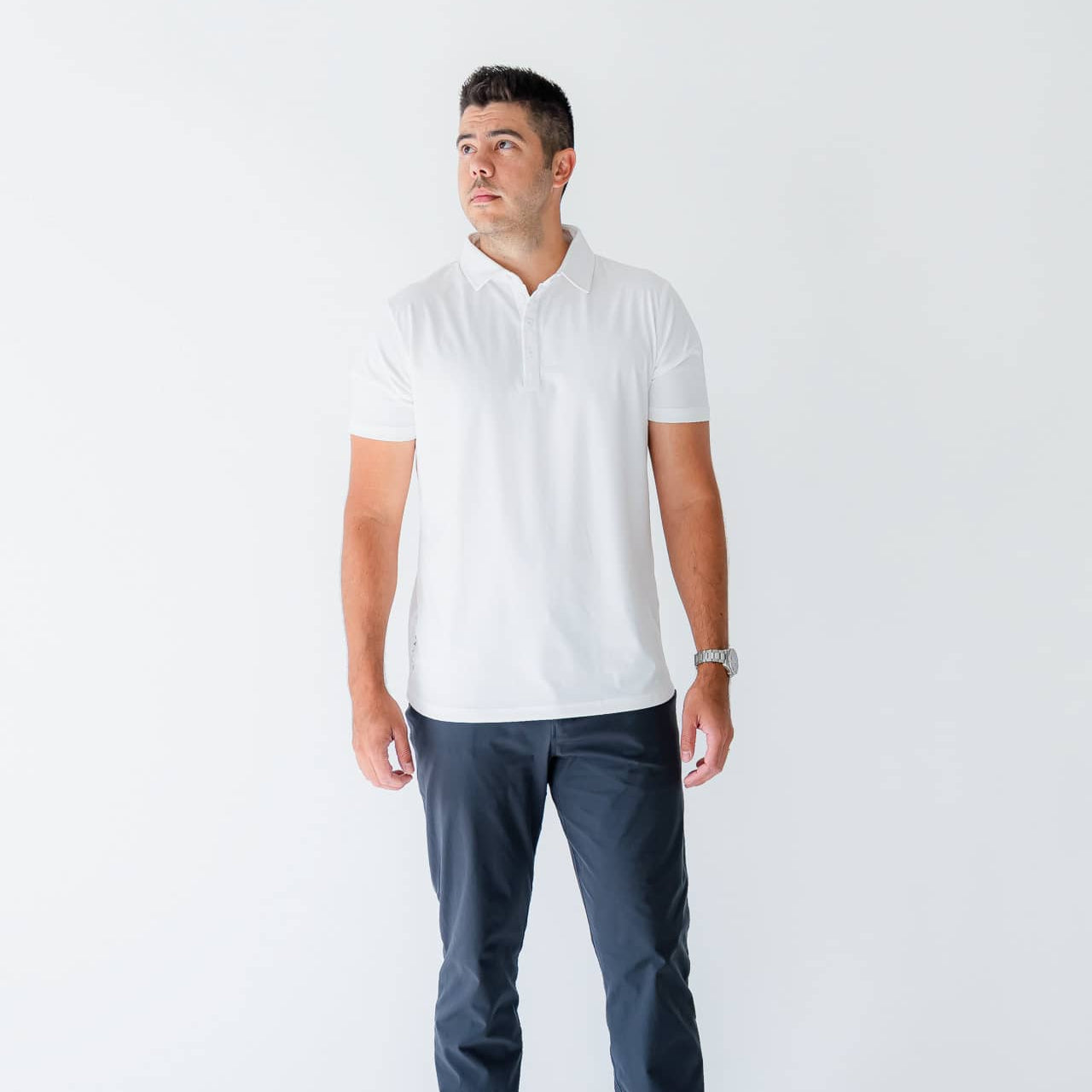

Everything on that shirt moves when you say so, except the one mark you went out and asked for.
A proof and a second signature
A proof with two marks on it needs two approvals. The second one runs on a brand team you have never met, inside a queue you cannot see, against priorities that have nothing to do with your event. Your date is not their date. Everything downstream of the proof starts when both signatures land, not when yours does, and that single fact reorders the whole schedule.
Inside one company the chain is knowable. We have already settled who approves a company apparel order when the order is yours alone: a name, a budget holder, a signature. A two logo job bolts a second chain onto that one, outside your building, with no service level you can hold it to and no escalation path that belongs to you. On our decoration side we wrote down what to check before anybody signs a proof, and on a two logo job that checklist gets run twice by two companies who are each looking for something different. That piece argues for one signer rather than a group vote, which is right, and a two logo order does not break the rule so much as double it. One signer at your company, one signer at theirs, and nobody voting at either.
Three habits make the second signature behave. Send the proof to both companies in the same hour, so neither side is waiting on a version the other has already seen. Name one person at each end who can say yes without asking upward. Put the deadline on the approval rather than on the delivery, because the approval is the only date that controls anything.
Seven to ten days and forty five
Two clocks, and both of them start at proof approval. Logo embroidery on stock garments runs 7 to 10 business days from proof approval, because a mark goes onto garments that already exist and the only new work is the decoration. A garment built from the cloth up runs about 45 days door to door, because the cloth itself is made to your spec, and that clock also starts at proof approval.
On a one logo job you control when either clock starts. You approve the proof on Tuesday and Tuesday is day zero. On a two logo job you do not control day zero at all, which means the honest way to plan is backward. Take the event date, subtract the production window you need, and the number you land on is not a delivery deadline. It is the day both signatures have to be in hand. Write that date down and treat it as the real one.
If the date is tight, take a stock garment and the 7 to 10 business days. If the piece matters more than the calendar and you have the 45 days, build it from the cloth up and let the partner mark land on something worth keeping. Either way, the paperwork should be done before the clock is allowed to matter, which is the argument we make in what you sign before company polos are made.
The deal and the drawer
A single logo shirt retires when the company decides. A co-branded shirt retires when a relationship does, and nobody sends a memo about that. There is no announcement, no cutoff and no return process. One quarter the shirt is a statement and the next quarter it is an awkward question in a hallway, asked by somebody who read the two marks and assumed they still meant something.
The shirt does not know the deal ended. It keeps walking around announcing a relationship that stopped, in front of exactly the people you would rather not explain it to. That is the real reason to buy a co-branded run shallow. Order for the people who will be in the room: the team working the booth, the staff at the joint event, the named handful on both sides who actually appear in front of customers together. Depth is the part you regret, because depth is how a finished partnership stays in circulation for another two years.
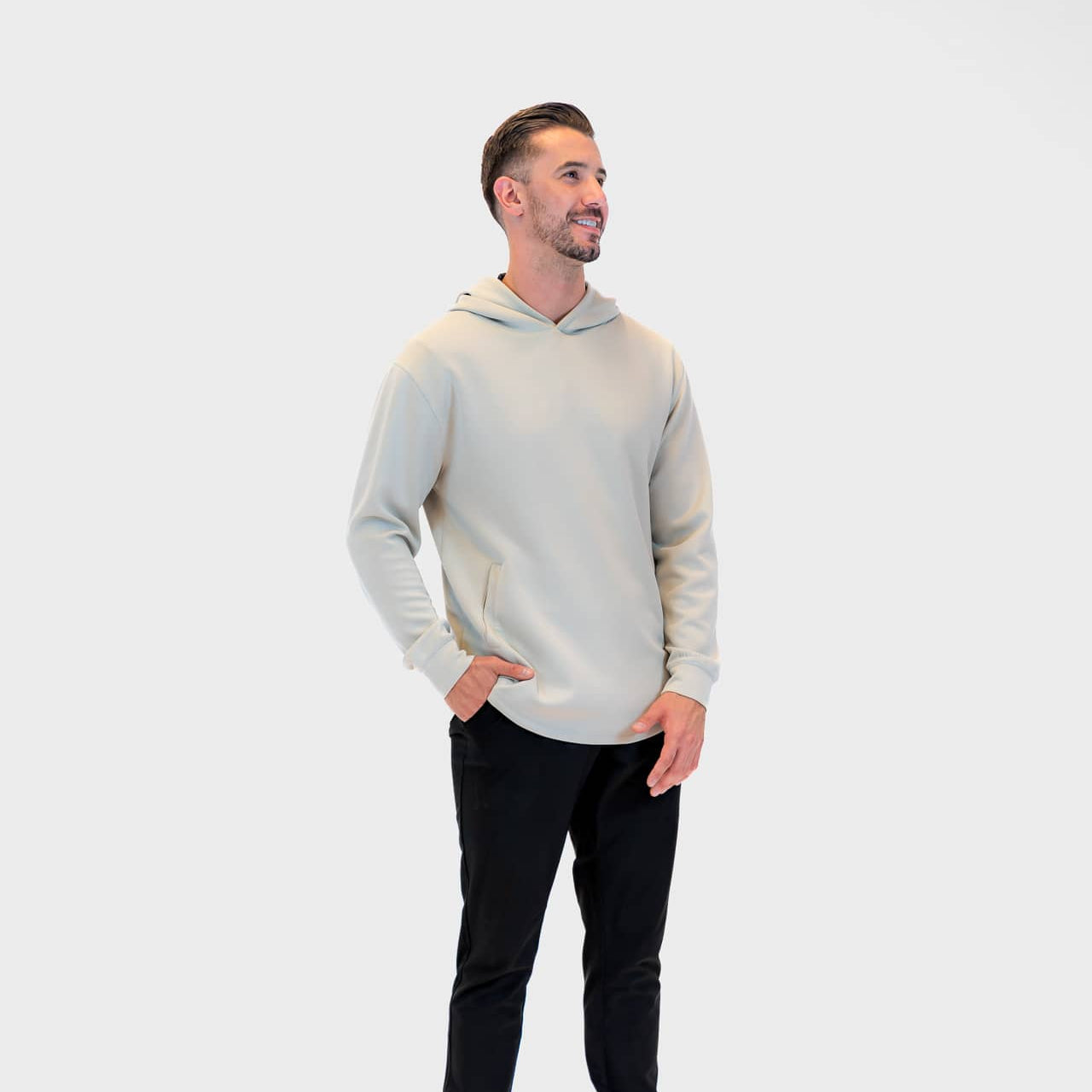
There is one exception worth buying, and it is the piece somebody keeps for reasons that have nothing to do with the deal. A hoodie gets worn on a Saturday by a person who was never thinking about the partnership. It survives the end of the relationship in a closet instead of in a box.
What we will rule and what we will not
We will not tell you which logo goes where on the garment. We will not give you a size ratio between the two marks, and we will not rule on whose name comes first. Those three answers already exist and they are not ours to give. Both companies have brand standards, in writing, and those documents are the only ones with any authority over a mark. Ask the partner for theirs before anything is drawn, read yours again while you wait, and let the two documents meet before a proof exists. A vendor who rules on another company's mark placement with confidence has guessed, and the guess will be found out at the second signature.
If the question turns out to be a rights question rather than a layout question, it belongs in the agreement between the two companies and not in a conversation with us. What we will rule on is the order itself: who owns the garment, when the clock starts, how deep to buy, what has to be in hand before a proof goes out and which garment carries two marks without looking crowded. Bring us two sets of standards and a date and the rest is ordinary work.
Two logos and the questions that follow
Yes. Two marks on one garment is routine work. What takes the time is getting both companies to approve the proof, not the decoration itself.
That is answered by the two companies' brand standards, not by us. Ask the partner for theirs before anything is drawn. If the two documents disagree, the answer belongs in the agreement between the companies.
Logo embroidery on stock garments runs 7 to 10 business days from proof approval. A garment built from the cloth up runs about 45 days door to door. Both clocks start at proof approval, and a two logo proof needs two approvals before either one starts.
Vector artwork with the real colors named. A logo saved off a website is not a production file. Ask for it on the day you agree the partnership, and ask for the person who holds the file rather than the person who announced the deal.
Fewer than you would order of your own. Buy for the people who will be in the room at the event or in front of the customer. A partnership ends on a date nobody writes on a shirt, and the leftovers are the part you regret.
One person at each company who can say yes without asking upward. Send the proof to both in the same hour, and treat the day both signatures land as the day production starts.
Yes, on the same terms as any partner mark. The sponsor's standards govern their mark, you own every other decision on the garment, and you should buy the run shallow because the sponsorship has an end date and the polo does not.
Tell us the event, the headcount and whose garment it is, and we will come back with a route both companies can sign.
