

The Shirts Are Yours. The File Might Not Be.
Sign for the last carton and the shirts are yours. Whether the file that made them is yours was never put to you as a question.
A branded apparel order delivers two things. The first is a box of garments, and that one is settled on the packing slip. The second is a set of records that produced those garments: the artwork that actually went to production, the stitch path an embroidery machine reads, the color somebody approved against a physical dip, the sample every later unit gets measured against, and on a build from the fabric up, the pattern. Those records decide whether your next order matches the last one, costs what the last one cost, and can be placed where you want to place it. So ask which of them travels with you before the first order rather than after the third. What locks a program to one vendor is never the shirt. It is the file.
The garments are yours outright. The records that made them are a separate question, and the useful version of that question is simple: which of those records leaves with you, and in what format.
What you own outright
The garments you paid for, and the logo file you supplied. Neither of those is in dispute, and neither of those is the thing that makes your second order match your first.
What you may not own
The production ready rebuild of your artwork. The digitized stitch file. The approved color record. The approved sample and the written spec that goes with it. The pattern and label tooling, on a fully custom build.
What to ask before you order
Which of those five is released to you, which stays on the production side, who inside your company holds your copy, and where it lives. Get the answer in writing before the first run.
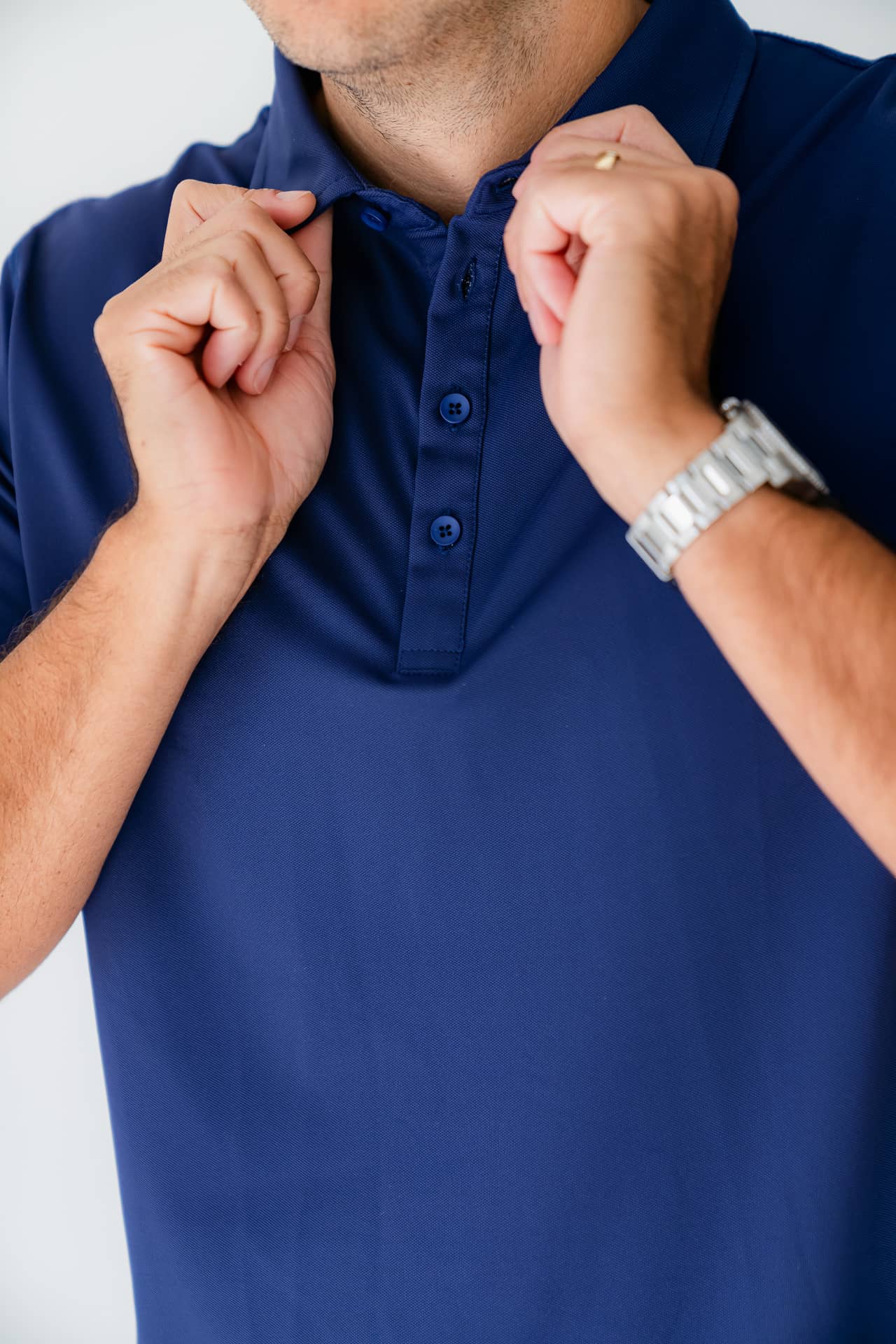
Collar detail, David Polo. On decorated stock the collar belongs to the catalog that sells the body. On a build from the fabric up it is drawn to a spec you approved, and that difference changes which records are worth asking for.
The shirts are yours the moment you sign for them
Nothing on this page is about the box. You paid for the garments, you took delivery, and they are yours to hand out, store, ruin or replace.
The reason to keep reading is that the box is the smaller half of what the order produced. Every garment that came off the line came off it because somebody turned your logo into a set of production instructions and then held those instructions steady across the run. Those instructions are objects. They sit in files and on shelves, they have names, and each one of them can either be with you or not be with you when you place the next order.
That is the whole argument. Not that anybody is hiding anything, and not that you have a problem. Only that a buyer who knows the five records by name can ask for them at the point where asking is free, which is before the first purchase order. Asked later, the same question arrives after the answer has already been set by default.
The clean way to see the split is to ask what a second order needs from you. It does not need the first box of shirts, which is already out on people. It needs the instructions. From the second order onward, the working value of an apparel program sits almost entirely in the half of it that never arrived in a carton, and that half is the half nobody signed for.
The logo file you sent is still yours
The file you emailed over is yours and stays yours. The file that went to production is a different object.
A logo drawn for a website or a business card is not built for a needle or a press, so what goes into production is a rebuilt version of it: paths closed, strokes converted, text handled as shape rather than font, small elements opened up so they survive at garment scale, and the whole thing separated into the pieces a decoration method needs. That rebuild is derived from your artwork, and it is also a piece of work somebody did. Those two facts sit next to each other, which is exactly why it belongs on your list of questions instead of your list of assumptions.
Ask for the production ready version in its native layered format, not only a flattened export, and ask for it at the same time you hand over the original. If you want to shorten that conversation, read what a production ready logo file has to contain first, then send something that already clears the bar. PILLAR Prints and Embroidery, our decoration side, publishes the requirements and the setup fee on that page, and the fee is worth understanding as a mechanism rather than a line item: it pays for the rebuild, and the rebuild is an asset. We also laid out the preparation side in more detail in our piece on getting a logo file ready for company embroidery.
Keep both versions on your side, labeled, and keep them in the same place. The original is what a designer works from the next time your brand moves. The production build is what a decorator works from the next time you order. Only one of those two gets created during an apparel order, and it is the one you did not commission and may not think to ask for.
The stitch file belongs to whoever built it
This is the record to ask about first. It has no line of its own on the packing slip and no shelf of its own in the warehouse.
An embroidery machine does not read a logo. It reads a stitch path, and somebody builds that path by hand from your artwork. They decide fill direction across every shape, how much underlay goes down before the top stitching so the mark does not sink into the knit, how heavy the outline runs, where to pull and where to push so the fabric does not distort, and how small your tagline can go before the letters close up and turn into a smear. Those decisions are judgment, and they are made once.
Then every later order inherits them. The second run looks like the first because the same stitch file ran again. Change the file and the mark changes, which is the mechanism behind a reorder that looks almost right next to the first one. That makes the stitch file the single most reusable object in the program, and it is the one with no physical form at all.
So ask three things. Can we receive a copy of the digitized file. What name is it archived under on your side. Can it be released on request later, without a new build. A yes to all three means your mark is portable. Anything else is worth knowing now rather than at reorder.
Shirts wear out. People move on. The file that made them does neither.
Before you commission anything, it helps to have a reference garment in hand that you already like, because a spec written against something real beats a spec written against a description. A firm collar is easier to write into a spec once you have had one in your hands.
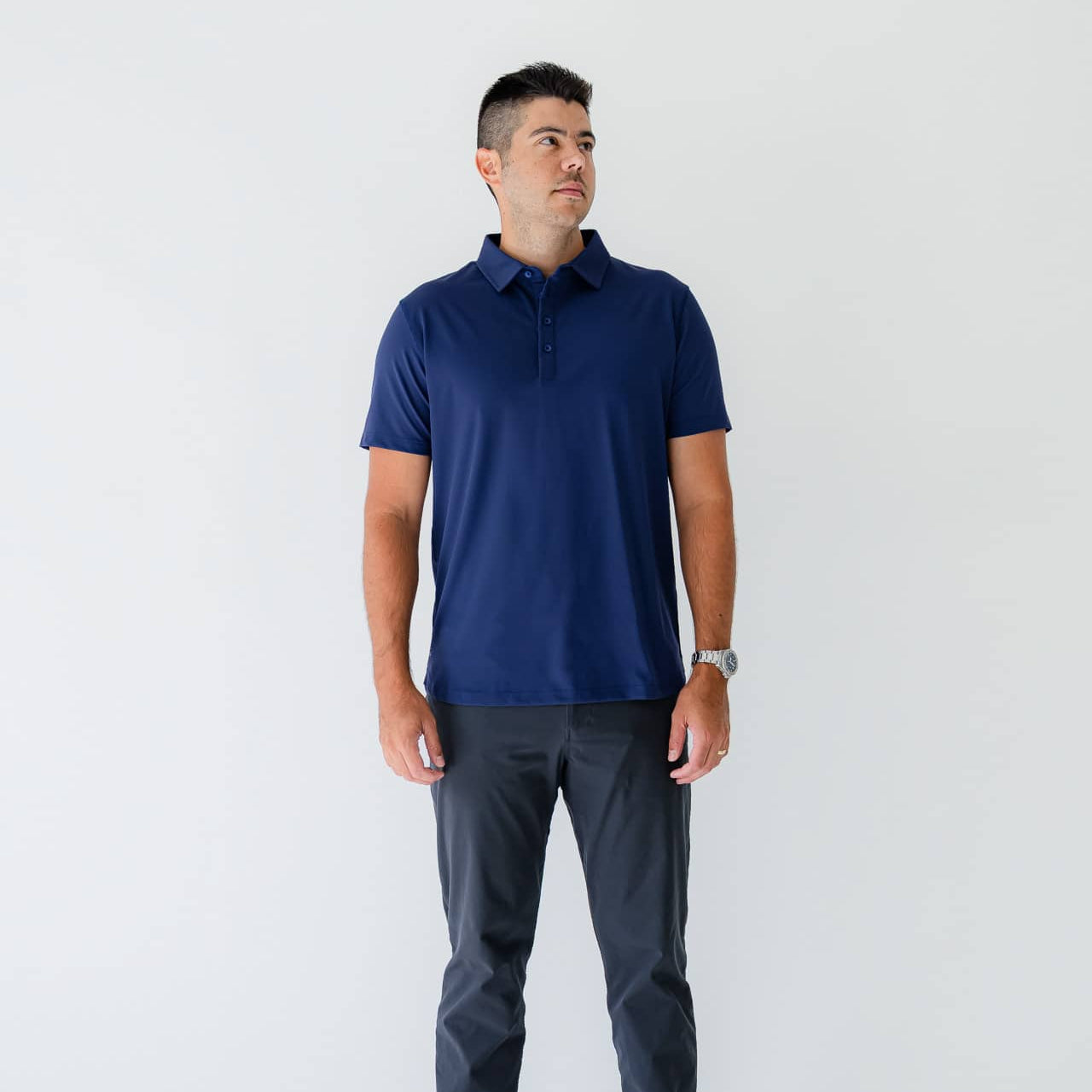
$76.00
84% nylon and 16% spandex with four way stretch, sweat wicking, cut to a classic athletic fit with a U cut hem and pre shrunk. The collar is firm and holds its shape, which is the property worth writing into a spec, because a collar that has gone soft makes the mark sitting on it look soft too.
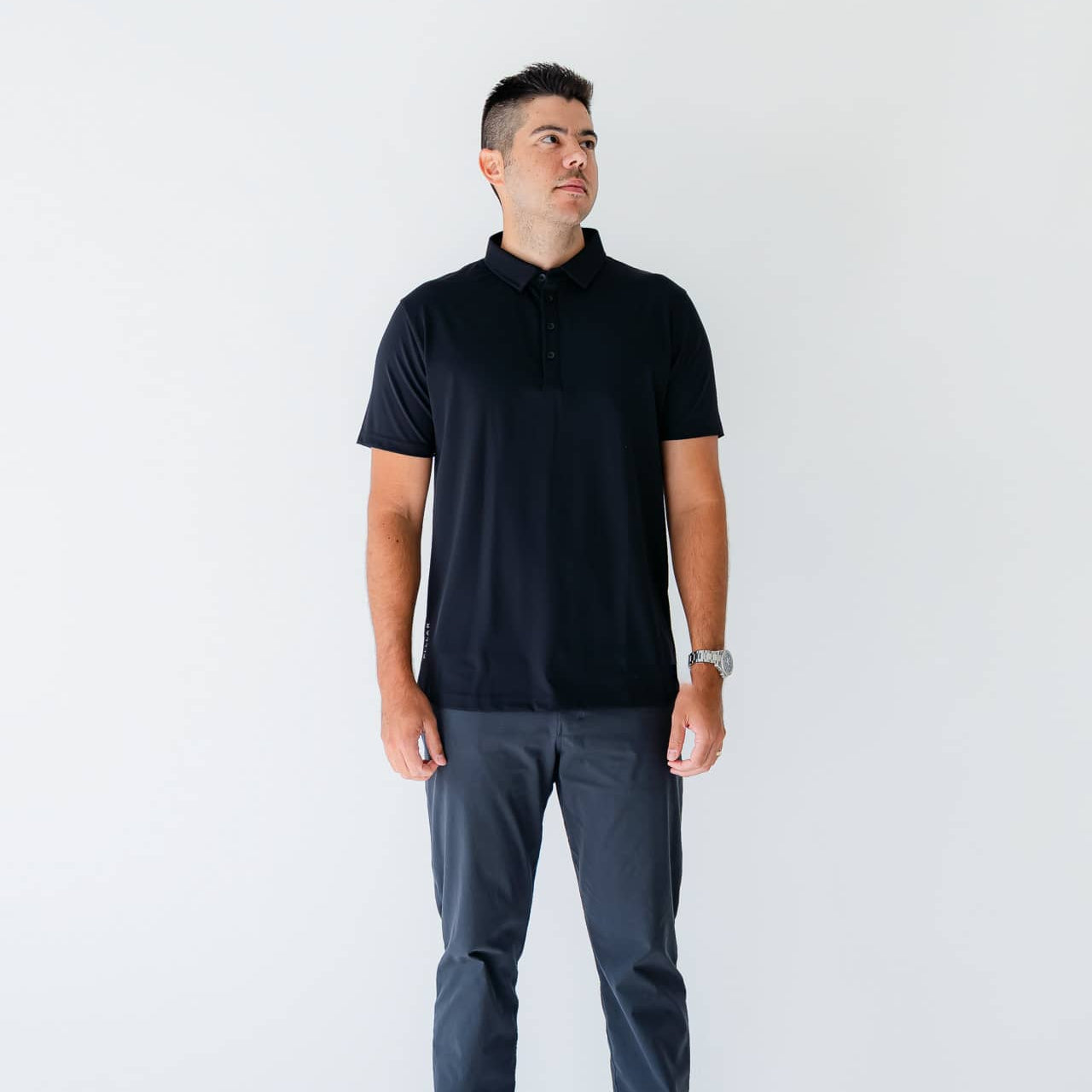
$76.00
The same construction as the Navy in black, which is the harder ground to decorate well. A dark body is where underlay and outline weight stop being technical details and start being the difference between a mark that reads and a mark that disappears into the knit.
There is a David Polo in white at $76.00 as well, and white is the useful one to hold next to a color record, since a mark that is correct on white is not automatically correct on navy. The rest of the range sits in the men's polo collection.
A color standard is nobody's until somebody writes it down
A color is only a record when it has been measured and approved in writing. Until then it is a name, and a name is not a measurement.
Pantone references, hex values and the words navy, charcoal or sand all describe an intention. The record that a later run can be held to is different: a measured standard, tied to a physical dip somebody looked at and approved, with the approval captured in writing by a named person. That is the object you want in the file. Ask whether the approved standard is recorded against the physical dip, who signed it, and whether you can have a copy of both the measurement and the approval.
Keeping that record findable over several years is a separate discipline, and we already wrote it up, so here is the handoff rather than the repeat: our piece on who inside your company should keep which record covers custodianship and how a program drifts from one year to the next. Read that one after this one and the rest of this page gets shorter.
The approved sample is yours only if you kept it
Ask where the approved sample physically is, and if the answer is a shrug, you do not have one.
A drawn proof shows intent. The pre production sample is the object every later unit gets measured against, and the written spec beside it is what turns that garment into a standard instead of a nice shirt in a drawer. The spec is the sheet that says what the sample is: the body, the fabric, the fit, the decoration method, the mark scale, the placement that was approved, the trim, the labeling. One without the other is weak. A sample with no spec cannot be described to anybody; a spec with no sample cannot be checked against anything.
We published our own walk through of what to check before you sign a sample, and it argues that a sample has to be seen in hand, in daylight and in the light of the room it will actually be worn in, on real people rather than on a hanger, and that one named approver should send a single written approval rather than a thread of partial yeses. For the shape of what you are approving in the first place, our article on the four objects that travel under the word sample separates them out.
Then keep the sample. Not in production, not in a box somewhere, but at your office, tagged, with the spec sheet attached to it. A record nobody can find is the same as a record you do not own.
The pattern is yours when the spec was yours
Which record matters most depends entirely on which product you bought, and this is where the two paths separate.
Buy decorated stock and the garment is somebody else's catalog item. There is no pattern to own, because the body was designed, graded and manufactured as a product you selected rather than specified. Your durable assets on that path are the stitch file and the color record, and they are durable precisely because the garment is not. A catalog body can change or be discontinued, and when it does, the mark and the color standard are what carry over to the next body. These are the mechanics behind the polos we put company marks on, where the body is a known quantity and the decoration is the part being built.
Buy a garment built from the fabric up and the list inverts. The pattern was drawn to your spec, the fabric was woven or knit and dyed to a color you approved, the neck tag and trim were made for you, and nobody can discontinue your style, because it is not in anybody's catalog. On that path the pattern and the spec are the assets, and the question to ask is whether a copy of the graded pattern and the label artwork is released to you. Our comparison of stock blanks against a build from the fabric up walks the decision itself. For context on what the custom path can produce: fabric woven or knit to spec and dyed to an exact color, all over print from original repeat patterns, embroidery including chest crests, sleeve hits, chenille and 3D puff, applied graphics in reflective, tonal and metallic heat transfer, private label neck tags, trim and detail work, headwear, and packaging with branded insert cards and name level kitting. Past work includes AO, the WM Phoenix Open and Progressive Roofing.
| What it is | Why it matters on the next order | What to ask for |
|---|---|---|
| The supplied artwork | Your original file is the starting point, not the thing production reads. If the rebuilt version is not with you, the rebuild work starts over wherever you go next. | A copy of the production ready artwork in its native layered format, not only a flattened export. |
| The digitized stitch file | Built once by hand and inherited by every later order. It is the reason the second run looks like the first, and the reason a reorder can look almost right. | A copy of the stitch file, the name it is archived under, and confirmation that it can be released later without a new build. |
| The approved color standard | A color name describes an intention. The measured standard is what a later run can actually be held to. | The measured standard tied to the approved physical dip, in writing, with the name of whoever approved it. |
| The approved sample and its written spec | The physical garment later units get measured against, plus the sheet that says what that garment is. | The sample itself, kept at your office, with the spec sheet attached and one named approver on the written approval. |
| The pattern and the label tooling | Only exists on a build from the fabric up. On decorated stock there is nothing here to own, because the body is a catalog product. | On a custom build, a copy of the graded pattern plus the neck tag and trim artwork. |
The quarter zip is the other half of a company apparel program, and it is the piece where a mark gets asked to sit on a heavier, more structured ground than a polo gives you.
$98.00
A layer for the part of the year when a polo alone is not enough, and a heavier ground than a polo chest. Scale is the decision that matters here rather than anything else: a mark sized for a polo chest can read small on a zip placket layer, and that scale choice is exactly the kind of thing that should be settled on an approved sample and written into a spec, so the next order does not quietly reinterpret it.
Three sizes are available right now.
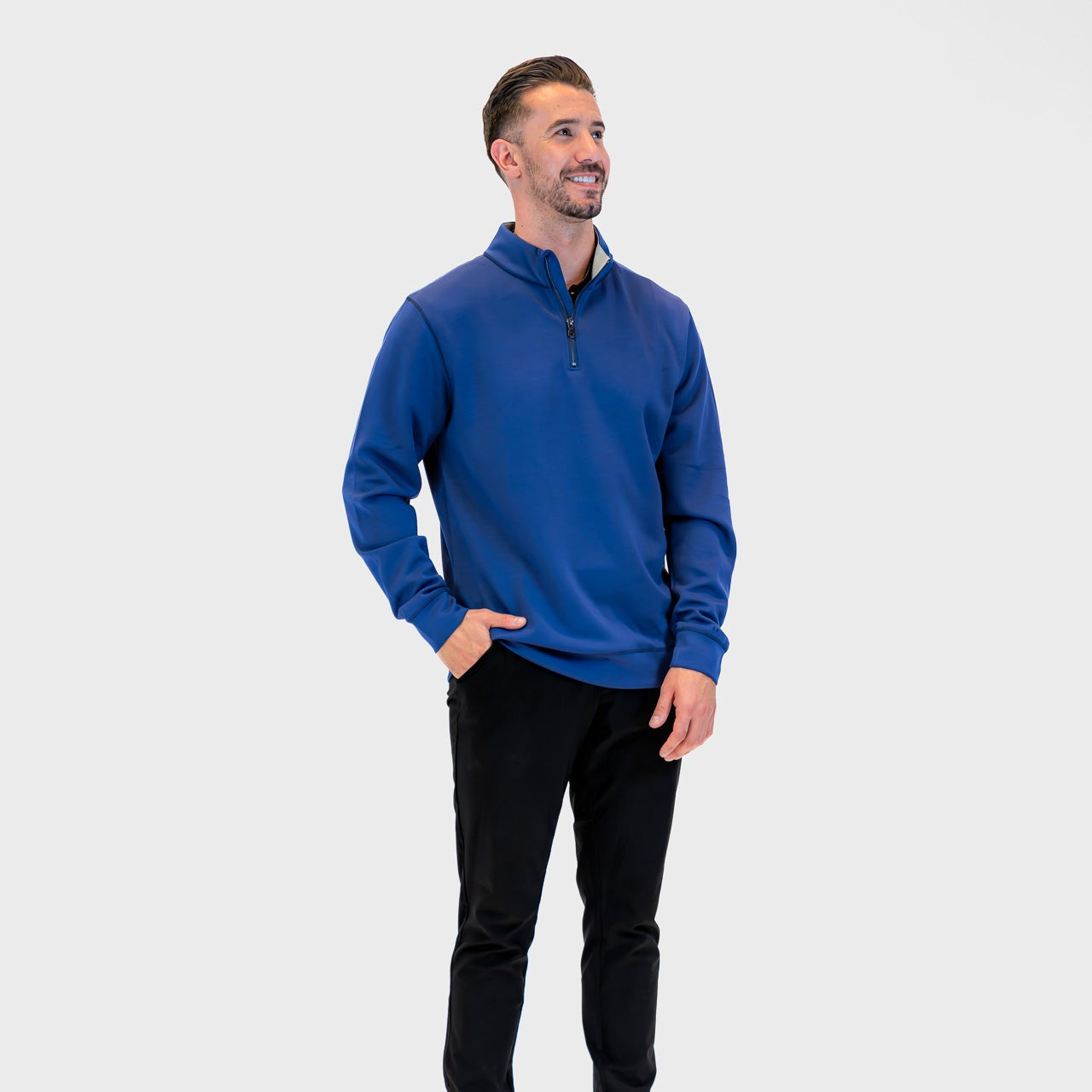
The David Polo in Navy and the Alec Quarter Zip, together
The polo and the layer over it, which is the pair worth having in hand when you are writing a spec for both. $174.00 for the two pieces, and no discount is implied, the total is simply the two prices added. One click adds both in your size. Small, Medium and Large are the sizes where both pieces are available.
The lead time belongs to the product, not to the promise
There is no single turnaround for company apparel, because the two paths are two different manufacturing problems. Ask for the number that belongs to the product you are actually buying, and treat any number quoted before proof approval as an estimate rather than a clock.
For logo embroidery or printing on stock garments, plan on 7 to 10 business days from proof approval. The clock starts when you approve the proof, not when you send the artwork and not when the purchase order clears, which is why the artwork and approval steps earlier on this page are the ones that actually move a delivery date. The body already exists, so what is being built is the decoration, and that is the whole scope of putting your mark on stock garments.
For a garment built from the fabric up, plan on about 45 days door to door. That number covers more steps because more is being made: the fabric knit or woven and dyed to your approved color, the pattern cut and graded, the sample made and approved, the run produced, the labeling and packaging applied, and the whole thing shipped. It is the price of owning the style rather than renting it, and it is what you are buying when you commission a garment whose pattern is yours.
These answers belong in writing before the first run
Put the five questions in an email, send them before the first purchase order, and keep the reply. That is the entire action item, and it costs nothing at that point in the process.
Three things this page deliberately does not do, because doing them would be worse than useless.
It does not read your paperwork
Whatever your existing paperwork already says, it says. Nobody can tell you what your documents say without reading them, and this page has not read them. Ask the question of the people who wrote them, in writing, before the next run.
It does not speak for anybody else
We are not going to characterize what another supplier releases, archives or holds back, because we do not know and a confident answer would be invention. Put the five questions to them directly and compare the written replies.
It does not give a legal opinion
Ownership of production records starts as a buyer's question, which is the version you can act on today. Anything beyond that belongs with somebody qualified to give the reading, and a confident ruling from anybody who has not read your paperwork is a guess.
Here is the practical version. Before the first order, ask for the production ready artwork, the stitch file, the measured color standard with its approval, the approved sample with its spec, and on a custom build the pattern and label artwork. Name one person inside your company who holds all of it. Then place the order. The program you can move, repeat and hand to a successor is the one where those five answers were written down while you still had leverage to ask for them.
What to ask before you place the order
Who owns the digitized stitch file for my logo?
Ask before the first run and get the answer in writing. The stitch file is built by hand from your logo, it is made once, and every later order inherits it. The three questions worth asking are whether you receive a copy, what name it is archived under, and whether it can be released later without paying for a new build.
Is the logo file I sent the same file that goes into production?
No. The file that goes into production is a rebuilt, production ready version of what you sent, with paths closed, type converted to shape and small elements opened up so they survive at garment scale. Your original stays yours. Ask for the rebuilt version in its native layered format, not only a flattened export.
What records should I ask for before placing a company apparel order?
Five. The production ready artwork, the digitized stitch file, the measured color standard with the written approval attached, the approved sample and its written spec, and on a build from the fabric up, the pattern and the label and trim artwork.
Does it matter whether I bought decorated stock or a fully custom garment?
It changes which records are worth having. On decorated stock the durable assets are the stitch file and the color record, because the garment body is a catalog product you selected rather than specified. On a build from the fabric up the pattern and the spec are yours, and the style cannot be discontinued out from under you.
How long does a company apparel order take?
It depends on the product. Logo embroidery or printing on stock garments runs 7 to 10 business days from proof approval. A garment built from the fabric up runs about 45 days door to door, because the fabric, the pattern, the sample and the labeling are all being made rather than selected.
What if the records exist but nobody at my company can find them?
Treat that as the same problem as not owning them. Name one custodian inside the company, have the files and the approved sample stored where that person can produce them, and record what each file is. A record that cannot be produced on request does not protect your next order.
The file is the only part of this you cannot reorder.
Tell us what you are ordering and what you want to own at the end of it. We will put the artwork, the stitch file, the color standard and the sample spec in writing before anything goes to production, and production starts the day you approve the proof.
