

Branded Apparel for a Staffing Agency: Specs for Sites You Do Not Own
The rules this shirt has to pass were written by somebody who does not work for you. That single fact changes the order, because the spec you sign has to clear a rulebook you have never read, held by a man whose name is nowhere on your purchase order.
An ordinary company apparel order answers to one document, written in the building where the shirt will be worn. A staffing agency's order answers to as many documents as it has clients. You wrote none of them and you have to clear all of them. Everything below follows from that.
Spec a staffing agency's shirt to the strictest rule across every site you place into, then put that spec in front of the people who can reject it before anything goes into production.
Logo embroidery or printing on stock garments runs 7 to 10 business days from proof approval. A fully custom shirt built from the fabric up runs about 45 days door to door, with production alone taking 30 to 35. We will put the garment, the stitch file, the proof, the color and the dates in writing. Whether a collar is required on your client's floor is an answer only your client has.
Approver
A man who does not work for you will decide whether this shirt is allowed.
That man is usually a site supervisor or a safety officer at your client. He has no line in your budget and no signature on your purchase order, and he will never learn what the run cost. He still sets the hardest line in the whole order. If nobody asks him in advance, he sets it at the gate, with your worker standing there holding a lunch bag.
That is an expensive place to find out. A rejected shirt is not a complaint, it is inventory. The box goes back on the shelf, the placement starts in whatever the worker already owns, and your account manager spends a week apologizing for a decision he made with the best information anybody gave him.
So show the approver first. Send the garment spec and the mark at the size you intend to stitch it, and ask for a sewn sample to be looked at by the person who can say no. Our decoration side published what to look at on a sample before anybody signs it, and the list works the same way when the person signing is your client rather than you. Only the order of operations changes. You are not approving a shirt for yourself. You are collecting a yes out of a building you do not control, in writing, while the run can still be changed for free.
Ask for that yes in the same thread as the spec. One document, one answer, one place to point when somebody new takes over the site.
Intersection
The strictest site on your list will write the spec for all of them.
Let it, and spec the whole program to that one site. A shirt that clears one client and fails the next is not a uniform, it is two uniforms, and two uniforms means two stock positions, two reorder points and a judgment call your dispatcher has to make before the first shift of the day. That is the worst possible hour to be making apparel decisions.
Workers move. A placement can shift sites inside a week, and nobody is going to re-kit a man because the new building thinks differently about collars. Spec to the intersection of every rule you place into, not the average of them. The intersection is smaller and less interesting than what you would buy for yourself, and it is the only spec that survives contact with a client list.
The rules that actually turn up fall into four kinds.
A collar is required
Some sites will not take a crew onto the floor in a crew neck. It is the cheapest rule in the set to satisfy and an easy one to discover only after the goods have landed.
A color is reserved
Colors get assigned inside a building. One for the client's own staff, one for visitors, one for a particular trade. Your shirt has to miss all of them, and the list is local.
Another company's mark
Some sites restrict whose logo may appear at all. Remember which company you are in that building. Yours is the outside mark, not the house one.
What may go over it
Outdoor and cold weather placements bring a rule about layers, and the layer decides whether anybody sees your mark during the shift at all.
We cannot tell you which of those apply at your clients. Nobody outside those buildings can. What we can do is hold one spec steady across a whole program once you know, which is the same discipline the field crew polo piece argues for on a single site, scaled up to a client list.
Refusal
Any vendor who answers your client's rulebook for you will be guessing.
Confidence is the tell, and the honest split runs straight down the middle of this order. There are two columns in an order like this. One of them is ours and we will put it in writing. The other belongs to people we have never met, in buildings we have never entered, and the only honest response there is a question back to you.
| What we put in writing | What only your client's people can answer |
|---|---|
| The garment spec, named by fabric, fit and finish | Whether a collar is required on that site |
| The stitch file, and the mark at a stated size | Which colors are reserved in that building |
| A proof you approve before anything is made | Whether another company's mark may appear on the floor |
| A ship date and a delivery date, as two separate dates | What layer is permitted over the shirt |
| The color held against a Pantone on a named material | Whether anything on that site has to be high visibility |
A vendor who moves a row from the right column to the left has not learned something you do not know. He has guessed, and you will find out whose guess it was at the gate. Ask any apparel supplier which column a question lives in before you ask him to answer it, and notice who hesitates honestly.
Our print shop sets out how an order moves from brief to proof to production, so you can see which commitment lands at which step and who is holding it. If you want the same picture from the paperwork side, what a signature on a polo order actually covers walks through it line by line.
Garment
One polo will have to clear every door you place people through.
So start with the shirt that has the fewest arguments against it. The David Polo is 84 percent nylon and 16 percent spandex with four way stretch, it wicks sweat, it is cut in a classic athletic fit, the hem is a U cut and it arrives pre shrunk. The collar is firm and holds its shape, which matters more in staffing than anywhere else. A collar is the kind of rule that gets written down rather than assumed, and a collar that has gone soft by the end of a shift reads as no collar to the man enforcing it.
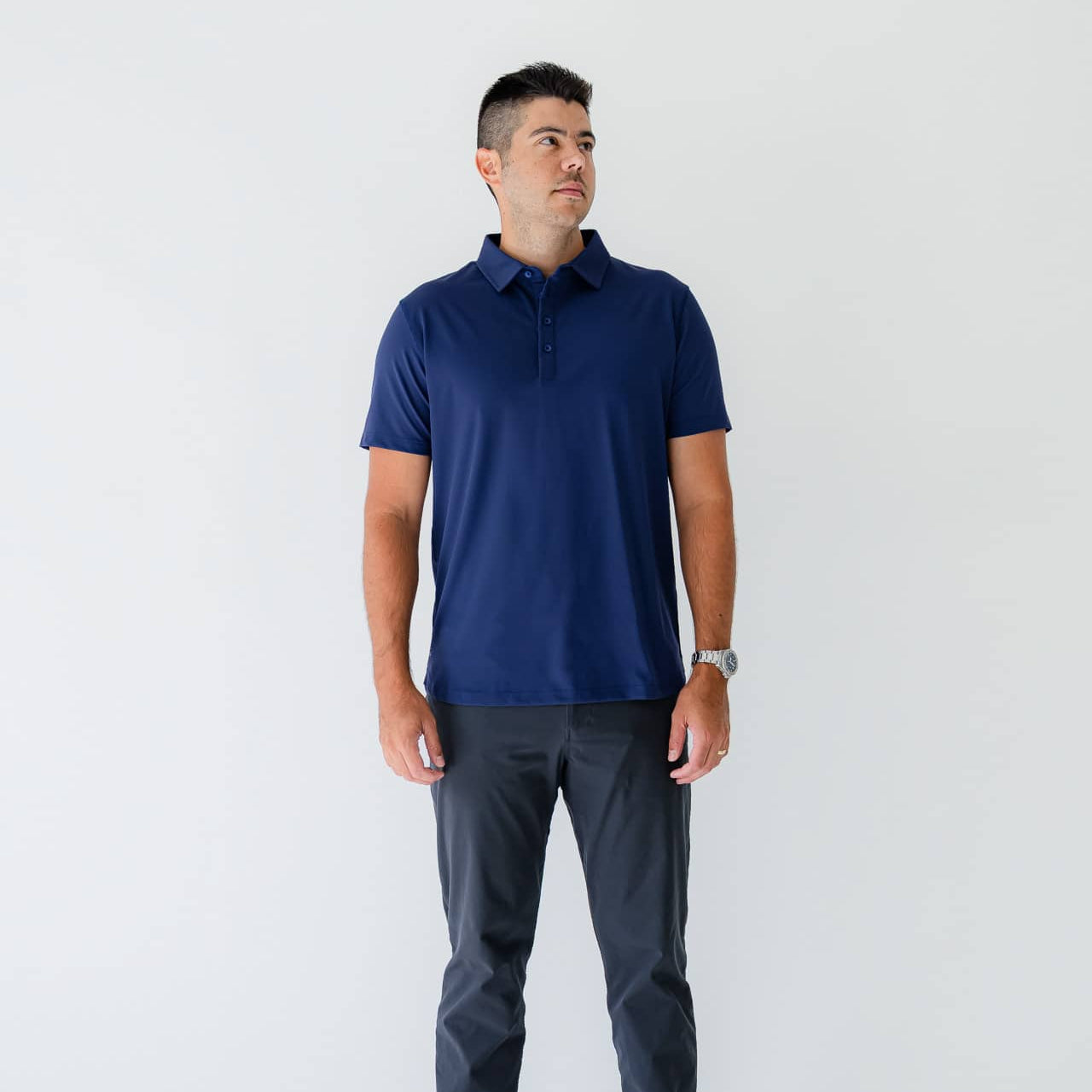
David Polo Navy
$76
Navy is the safe place to start. It collides with the fewest house colors, it does not wear a long day on its face the way a lighter shirt does, and it takes a stitched mark without a fight.
84 percent nylon and 16 percent spandex. Four way stretch, sweat wicking, pre shrunk, classic athletic fit, U cut hem, and a collar that holds its shape through the shift.
The polo program we put together for crews is built on this shirt, embroidered with your logo. That is the whole mechanism for a first run.
Comfort is not a soft concern in a staffing program, it is a compliance concern. The shirt your worker will not wear is a shirt your client never sees, and we have written about why the company shirt stays in the truck. A placement who is hot, restricted or self conscious in the garment will find a reason to leave it at home, and then you are running a uniform program on paper only. Stretch and wicking are what keep that from happening in a warehouse in summer. If you need a second color in the program before you order, the rest of the polo lineup is here.
Presence
The shirt will stand in for your whole company on a floor you never walk.
This is the part of the purchase that gets priced wrong. Your client oversees the person day to day. He runs the schedule, he hands out the work, he decides whether the placement is going well. You are not in the room. You are represented by one object, worn by somebody who takes direction from somebody else.
On a site you do not control, the shirt is the only credential anybody checks.
That reframes the spend. Branded apparel in staffing is usually sold as a recruiting line, as though the shirt existed to make the agency attractive to workers. The people who see it most are the client's people, and they are the ones who decide whether the contract renews. It is an account retention purchase. Price it against the value of the account, not against the cost of a hire, and the number you can justify changes completely.
Which is why the mark has to survive being one of two on the floor, sitting next to a client's own site branding. Scale is the first decision and method is the second. A mark sized for a cap does not hold on a knit polo, and a mark sized for a banner swamps the shirt and starts to look like a trade show giveaway. Embroidery gives you a hard, dimensional mark with edges that hold through a work week. Applied graphics in reflective, tonal or metallic heat transfer give you a flat mark where the artwork wants flat. Chest crests, sleeve hits, chenille and 3D puff are all available, and the choice is an argument about how the artwork is built, not a rule we hand down.
Our decoration side handles the proof, the placement and the production schedule. Past work includes AO, WM Phoenix Open and Progressive Roofing.
Layer
A cold morning will put a layer over the mark you paid for.
Decide the layer at the same time as the shirt, not after it. On outdoor placements the layer is most of what anybody sees, and a jacket covers the chest, so your agency disappears for the day and you are back to being a name on an invoice. If you place people on yards, docks, roofs or anywhere with a gate and a wind, the layer is part of the uniform decision rather than an accessory to it.
A vest is the answer that keeps the mark visible and the arms free. That is the entire argument for it, and it is enough of one. The shirt keeps doing its job while the worker stays warm enough to do his.
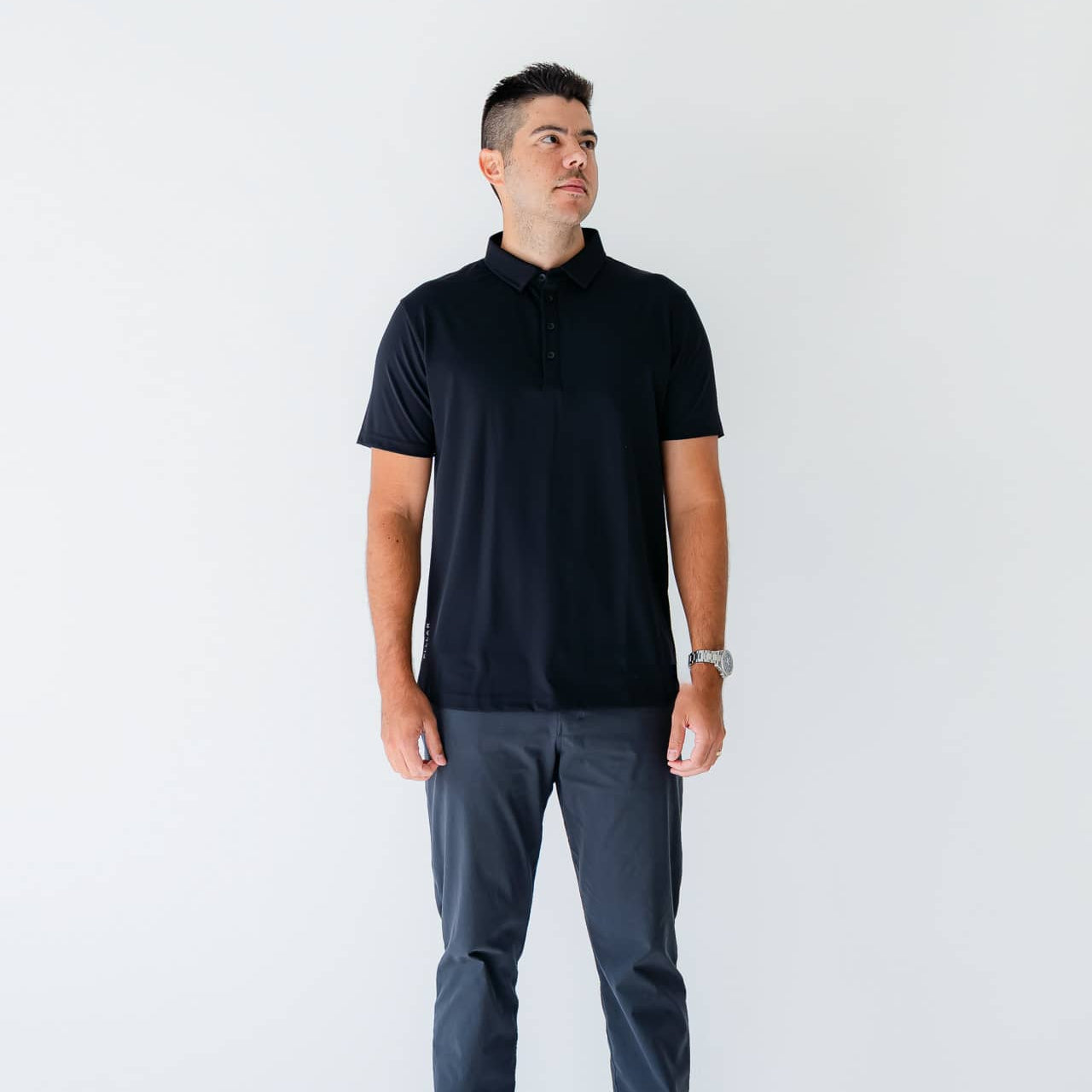
David Polo Black
$76
The same shirt, the same spec. Black is the natural second color to keep on the shelf, and it reads as uniform rather than apparel.
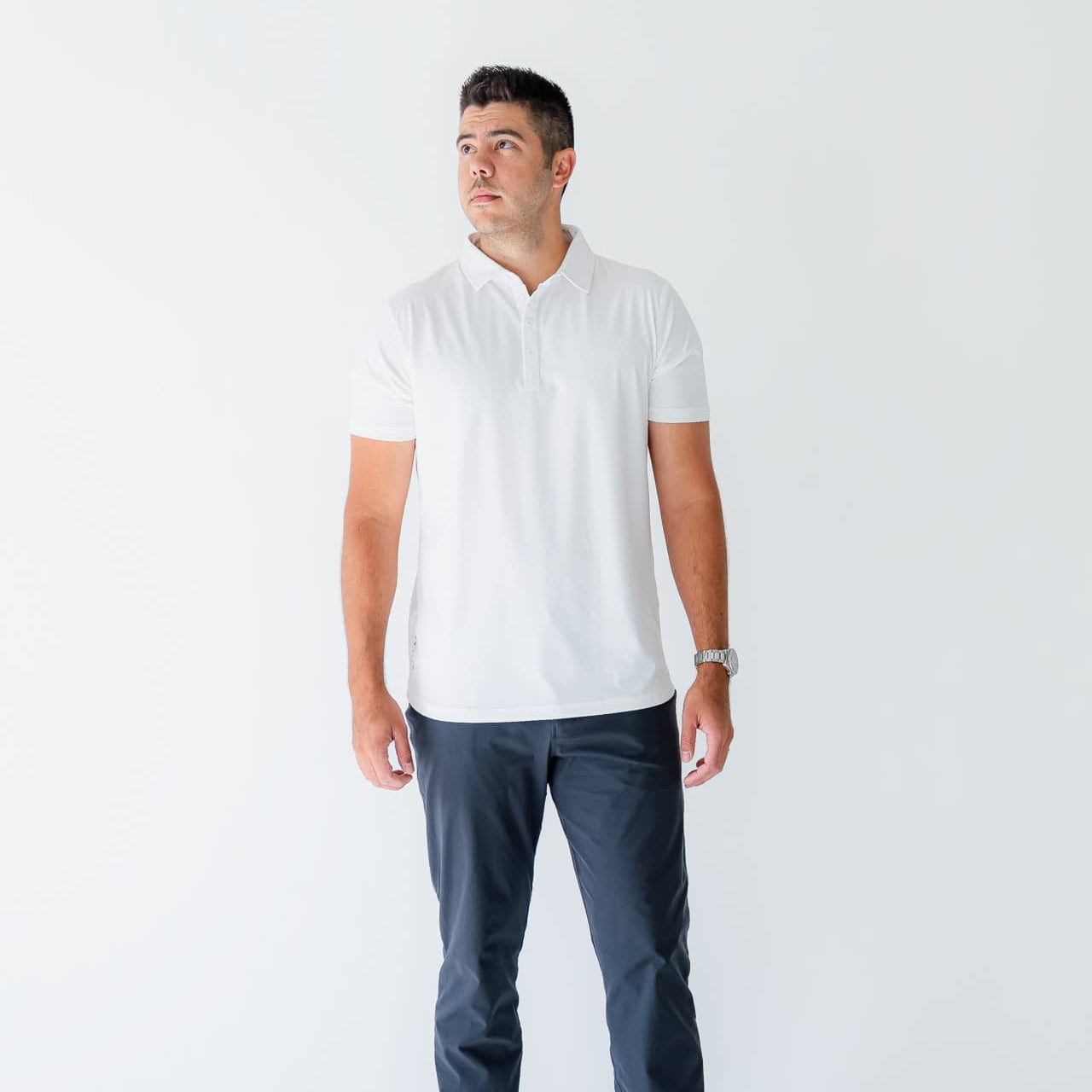
David Polo White
$76
White holds a stitched mark with the most contrast behind it. Keep it for indoor and client facing placements and let the darker shirts take the dirty work.
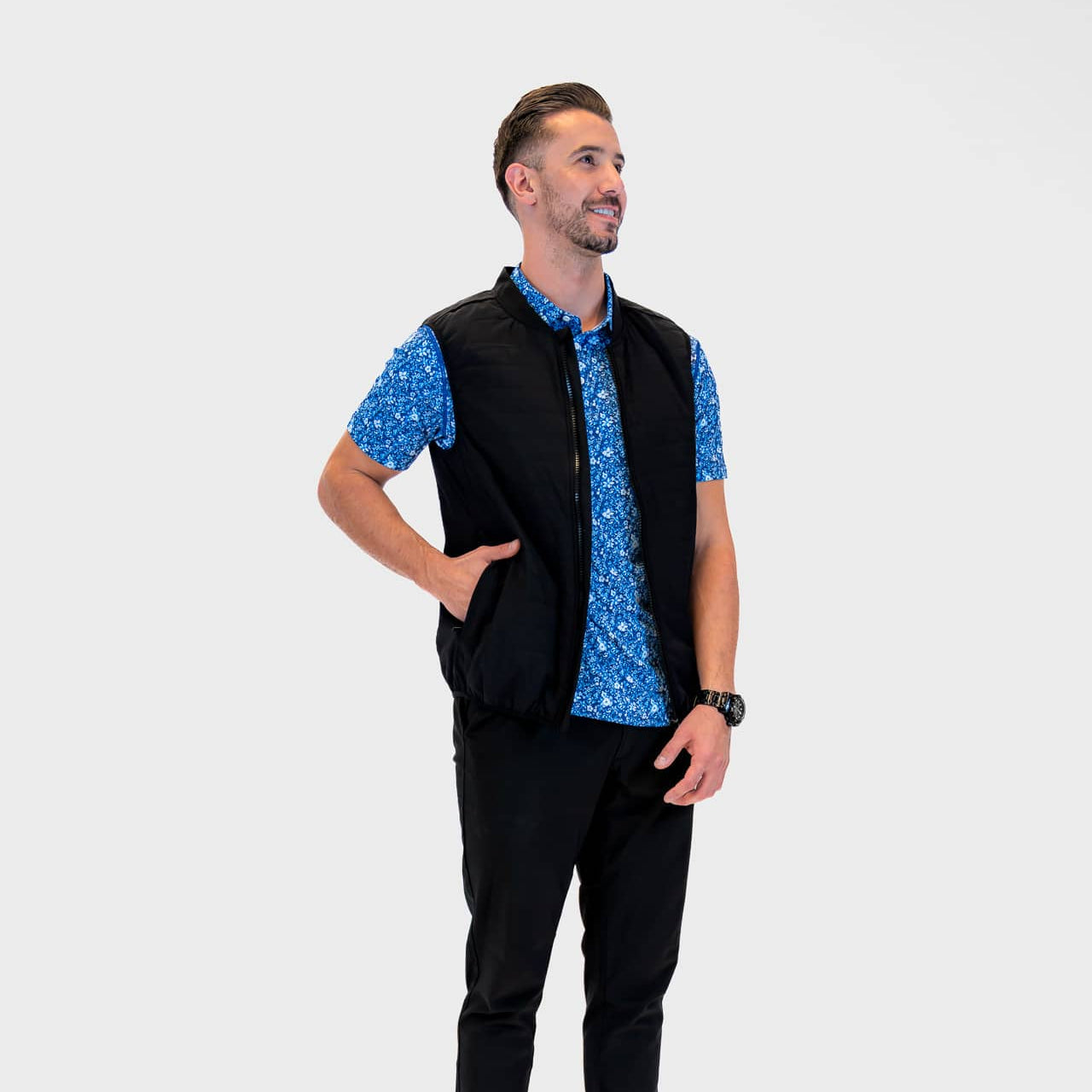
Kevin Vest Black
$78
The layer that leaves the chest mark visible and the arms free. That is what you are buying and it is the only thing a layer has to do here.
Black and White run on the same spec as Navy, which is what you want when one client reserves a color and takes your first choice off the table in that one building. Keeping a second color on the same garment is not a compromise, it is how you answer a local rule without starting a second program.
The placement kit, $154.00
David Polo Navy and Kevin Vest Black, added together in one click.
This is the pair because the polo is the shirt people get placed in and the vest is the layer that does not hide it, so the agency stays visible when the temperature decides otherwise. Pick a size.
The pair stops at XXL because the vest does. XXXL is available on the polo on its own.
Clock
Embroidery on a stock polo will run on the shorter of the two clocks.
Logo embroidery or printing on stock garments is 7 to 10 business days from proof approval, and the words from proof approval are doing the work in that sentence. The clock does not start when you ask for a quote, when you send artwork, or when the purchase order clears your accounting system. It starts when you approve the proof. Production starts the day you approve it.
For a staffing agency that is usually the right route. Placements arrive in batches and contracts begin on somebody else's schedule, so being able to put a logo embroidered onto garments already on the shelf and have it moving on a short clock is worth more than a perfect shirt that lands after the account has already started.
The slow part of this clock is almost never the stitching. It is the loop in front of it. Artwork, a stitch file, a proof, and in your case a client's yes, which is the one step no vendor can hurry on your behalf. Run the client approval and the proof side by side rather than one after the other, and name one person at your agency who is allowed to approve, so the proof does not sit in a shared inbox while three people wait for each other.
The second clock is longer, and it buys something the first one cannot.
Program
A second year of placements will argue for a shirt of your own.
Fully custom, built from the fabric up, runs about 45 days door to door, and production alone accounts for 30 to 35 of those. You commission it once and you live with it for a long time, which is exactly the trade a settled client list is in a position to make.
A shirt built to a spec of your own from the yarn forward earns that clock in three situations. When a reserved color at a major client forces an exact shade nothing on a shelf will match, custom fabric woven or knit to spec and dyed to that color solves a problem no decoration can touch. When you want the garment to be yours rather than a decorated blank, private label neck tags, trim and detail work and an all over print from an original repeat pattern get you there. And when you want the box itself to do some work, packaging with branded insert cards and name level kitting turns a delivery into an onboarding.
That last one matters more in staffing than in almost any other vertical. Your onboarding is the only hour of the placement you actually own. The worker walks into a building you do not control immediately after it, and what he carries in with him is the shirt, the fit and whatever impression the handover left. A box with his name on it is a cheap way to make that hour count.
How many shirts each worker needs is a separate question with a real answer, and we worked it out in our piece on shirts per employee. Settle the spec against your strictest site first. Count second.
Questions staffing buyers ask
How do we get a client site to approve our shirt before we order it?
Send the garment spec and the mark at its stated size to the site supervisor or safety officer who runs that floor, and ask for a sewn sample to be looked at in person before production starts. Put the request in the same email as the spec so there is one document to answer. A site that signs off on a sample will not reject the same shirt at the gate, and a site that objects will usually tell you exactly which rule is in the way.
How long does a staffing agency uniform order take?
Two clocks, and they belong to two different products. Logo embroidery or printing on stock garments runs 7 to 10 business days from proof approval. A fully custom shirt built from the fabric up runs about 45 days door to door, with production alone taking 30 to 35. Proof approval is the start line on the shorter clock, so the part you control is how fast the proof comes back.
Can you tell us whether our client requires a collar or bans a color?
No, and neither can any other apparel vendor. Collar rules, reserved colors, rules about other companies' marks, layer rules and high visibility requirements are written by the people who run that site, and they can differ between two buildings owned by the same client. We hold the spec, the color against a Pantone on a named material and the dates. Your client holds the rulebook.
Should every placement wear the same shirt even when the clients are different?
Yes, as long as you spec to the strictest rule across every site you place into. One shirt that clears every door is a uniform. Two shirts that each clear half your sites is a stockroom problem, because a worker can move sites inside a week and nobody wants to re-kit him for it.
Is branded apparel worth it when the client supervisor runs our people anyway?
That is the reason it is worth it. The client watches the work and you are represented by one object on his floor. Treat the shirt as an account retention line rather than a recruiting line and the math changes, because the people deciding whether to renew your contract see it every shift.
How many shirts does each worker need?
That depends on shift length, laundry access and how often the worker moves between sites, and it is worth answering on its own rather than guessing at order time. We wrote a separate piece on shirts per employee for exactly that reason. Decide the count after the spec clears your strictest site, not before.
Easier to approve once than to re-spec at every site.
Send us the garment, the mark and the kinds of sites you place into. We will put the spec, the proof, the color and the dates in writing, so you have one document to hand your clients instead of an argument at a gate.
We answer the garment, the mark and the dates. The site rules stay with your client, where they belong.
