

Six Days a Year Is Still a Spec
A firm should order one polo, in one ground, with one small embroidered mark, in a garment that would sit on a retail rack without the logo on it, plus one layer for the events held outdoors. A firm's shirt is worn about six times a year, and that is a specification in its own right rather than a thinner version of a uniform. Order the PILLAR David Polo in Navy at $76 as the shirt and the PILLAR Kevin Vest in Black at $78 as the layer, keep the mark small and embroidered, and close the list there.
Frequency of wear sets the spec, not hours of wear, and six wearings a year points at a different garment than forty hours a week does.
What you are buying One shirt that has to read as something a partner might have bought for himself, because the people wearing it already own better clothes and paid for them out of their own pockets.
What it has to survive One group photograph and eleven months folded in a cupboard, which are the only two conditions this garment actually meets.
What to order The PILLAR David Polo at $76, the solid staple, 84 percent nylon and 16 percent spandex with four way stretch, sweat wicking, a classic athletic fit, a firm collar that holds its shape, a U cut hem and pre shrunk cloth, in Navy, Black or White, with the PILLAR Kevin Vest at $78 over it outdoors, while the PILLAR Steven Polo at $76, the print polo in a cooling sweat wicking textured knit of 88 percent polyester and 12 percent spandex with four way stretch, a classic athletic fit, a U cut hem and pre shrunk cloth, is the honest wrong answer for an event shirt because a print dates faster than a firm does.
The order
What a firm should order, and why it is not a uniform order
Order one polo and one layer, and resist everything after that. For a firm of thirty to a hundred and fifty people in law, accounting, consulting or engineering, that is the entire list, and the list stays short because the garment has almost nothing to do.
Count the wearings. A client golf day. A recruiting fair. A charity 5K. A site visit where the team wants to look like one team. A retreat. The group photograph that goes on the website and sits there for three years. Six occasions, give or take, spread across a calendar year. A shirt in that rotation sees fewer hours on a body in a decade than a service uniform sees in a month.
That is why a uniform argument does not transfer. A uniform is specified against the forces acting on it, which are laundering, abrasion and color loss, because it is in the machine twice a week for three years. None of those forces are acting on a firm's shirt. It is washed a handful of times in its whole life. Buying resistance it will never be asked for is how the budget gets spent on the wrong half of the garment.
The second thing that does not transfer is the adoption argument. A vendor selling uniforms will tell you a shirt earns its wear by being comfortable. In a firm, comfort is table stakes and the real test is social: will a partner who owns good clothes put this on in front of a client. The answer is yes only if the garment reads as retail. Any organization that buys on this frequency runs into the same wall, which is why the case for apparel for a chamber or trade association reads almost identically.
The frequency
Six wearings a year changes which rules apply
Wash cycles, abrasion resistance and laundering tolerance are answers to a question your shirt never asks. They are the right questions for a garment worn forty hours a week, and a vendor who opens with them is quoting from the uniform side of the catalog without noticing that your order is a different animal.
Your shirt asks two questions instead. The first is the photograph: thirty or a hundred of these appear in one frame, at one time, in daylight, and the frame is unforgiving about collars that have gone soft and about a mark that has been sized for a banner rather than for a shirt. The second is the drawer: the shirt is handed out, worn once, folded, and then left alone for eleven months before anyone touches it again. Those two conditions decide the garment. Everything else is noise.
Holding those two questions steady across every event is the whole reason for running a corporate program through one spec instead of quoting a new garment each time the calendar throws up an occasion. One garment, specified once, decorated the same way every run, is cheaper and better than six well meant decisions made separately. It also means the shirt a new hire gets in year three matches the shirt in the photograph from year one.
The client golf day is usually the event that triggers the order, and it is worth knowing what the room expects before you specify for it, which is the ground the business golf outfit guide covers.
The photograph
A camera resolves a collar before it resolves a logo. In a group frame the eye reads the top edge of every shirt as one line, so a collar that has lost its structure breaks the line in a way no amount of retouching fixes. A firm collar that holds its shape is doing visual work here, not comfort work.
The drawer
Cloth folded under its own weight for eleven months takes a crease along every fold line. A knit built with four way stretch is made to return to its own shape after it has been pulled out of it, and that is the same physical property the drawer asks for. Pre shrunk cloth matters for the same reason: the shirt that comes back out is the size that went in.
The weather
Outdoors, wind moves more heat off a body than air temperature does. A polo stops wind at the thickness of a knit, which is to say it does not stop it. The vest is the piece that blocks the torso and leaves the arms and the swing alone, which is why it belongs in the order and a heavier shirt does not.
The drawer
The drawer is the hard part
Specify for recovery, not for durability. The garment will outlast the program by a decade on wear alone, so the only hard physical question left is what eleven months of folding does to it and whether it comes out looking like it was hung.
Picture the morning of the client golf day. Shirts went out last autumn, got worn once, went home, and have been flat under something else in a cupboard or a filing drawer since. At seven in the morning nobody is pressing a hundred shirts, and nobody is pressing one. Whatever the cloth does on its own between the drawer and the car is the finished look of your firm that day.
This is a mechanical question about the knit. A fabric built with four way stretch is built to be deformed and come back, because that is what stretch means in a garment that moves with a shoulder and a swing. Cloth that returns to its own shape after it is pulled is cloth that has a reason to let go of a fold. Pre shrunk cloth matters alongside it for a duller reason: the shirt that went into the drawer at a large is still a large when it comes out, so last year's sizes still mean something this year.
What we will not do is hand you a number for it. There is no press test on this page and no recovery figure, because the honest version of this argument is the mechanism and nothing past it. Specify a stretch knit, specify pre shrunk, and accept that a knit asked to sit flat for eleven months will always do better than a woven asked to do the same.
Your shirt is not competing with a uniform. It is competing with the shirt the partner already owns and bought for himself, and that is a harder brief than any wash test.
The test a firm's shirt actually has to pass
The mark
One garment, one ground, one mark
One garment, one ground, one small embroidered mark, and the decision is closed. Rule it that way on the first order and every later run gets easier, because there is only ever one thing to match.
A second ground is the mistake that looks like generosity. The moment there are two, the shirt becomes a choice, and a choice becomes an inventory problem: two counts to forecast, two runs to match, two piles in the cupboard, and a group photograph with a seam down the middle of it. Pick the ground that works in daylight and in a frame, order that one, and let the people who want something else wear their own clothes.
On the mark, the argument is scale and method, and nothing past them. Scale: small. A firm's mark is read at the scale of the collar, not at the scale of the garment, and the version that has been scaled up to be noticed is the version that stops reading as a firm and starts reading as a sponsor. Method: embroidered, not printed. Embroidery is thread sitting in the cloth, so it survives the folding and the washing the shirt does get, and on a retail grade knit it looks like finishing rather than like advertising. That is the whole argument for putting a firm's mark on stock polos and getting a garment back that nobody has to be talked into.
There are questions we deliberately leave to the pages that answer them properly. Quantity is one, and how many polos per employee is where that belongs. The three pieces below are the ones worth carding out of the PILLAR polo collection for a firm buying this for the first time, and you want one of the two grounds, not both.
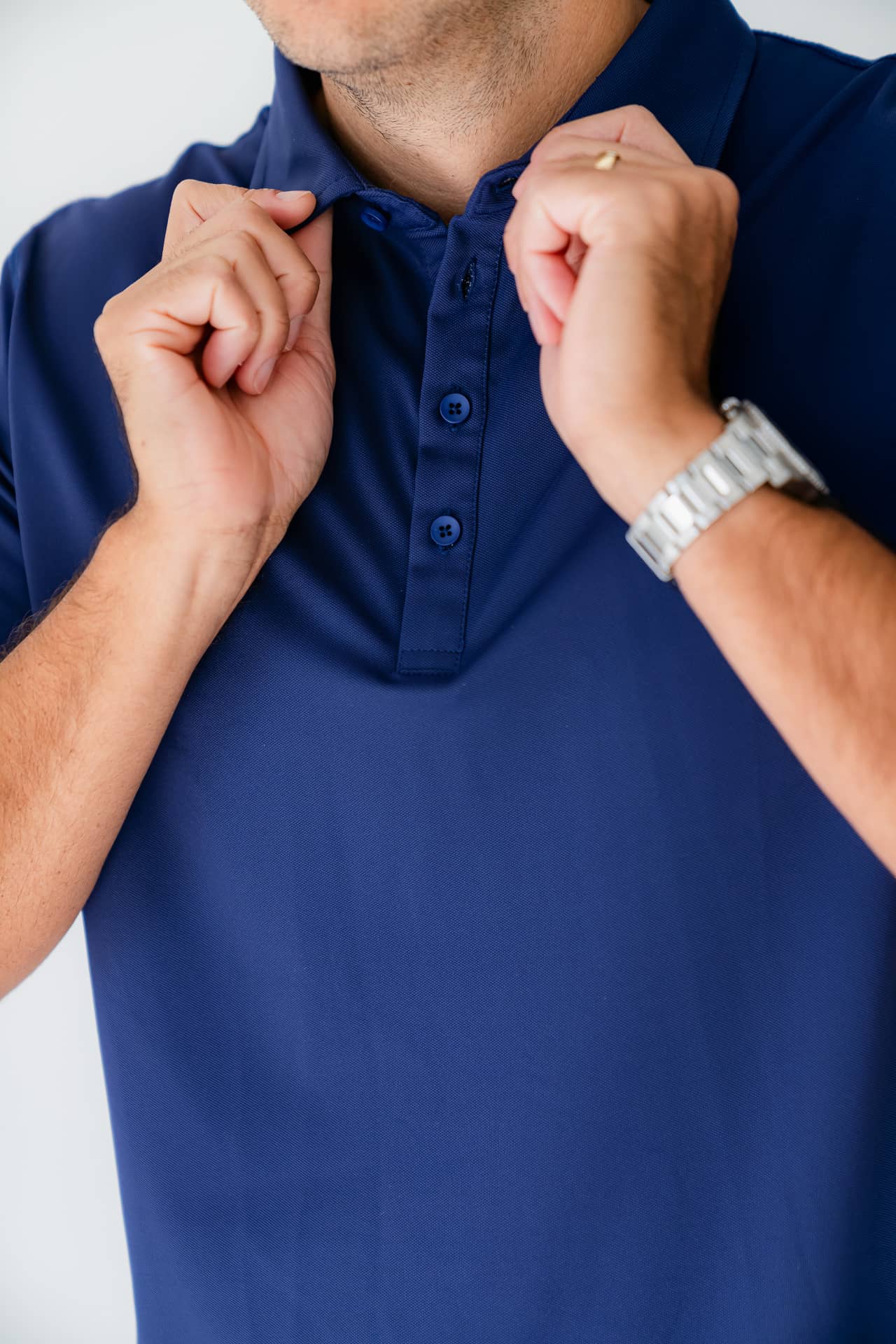
Scale the mark against that collar. A firm's logo wants to be read at the size of the collar rather than at the size of the garment, and once it grows past that it reads as signage.
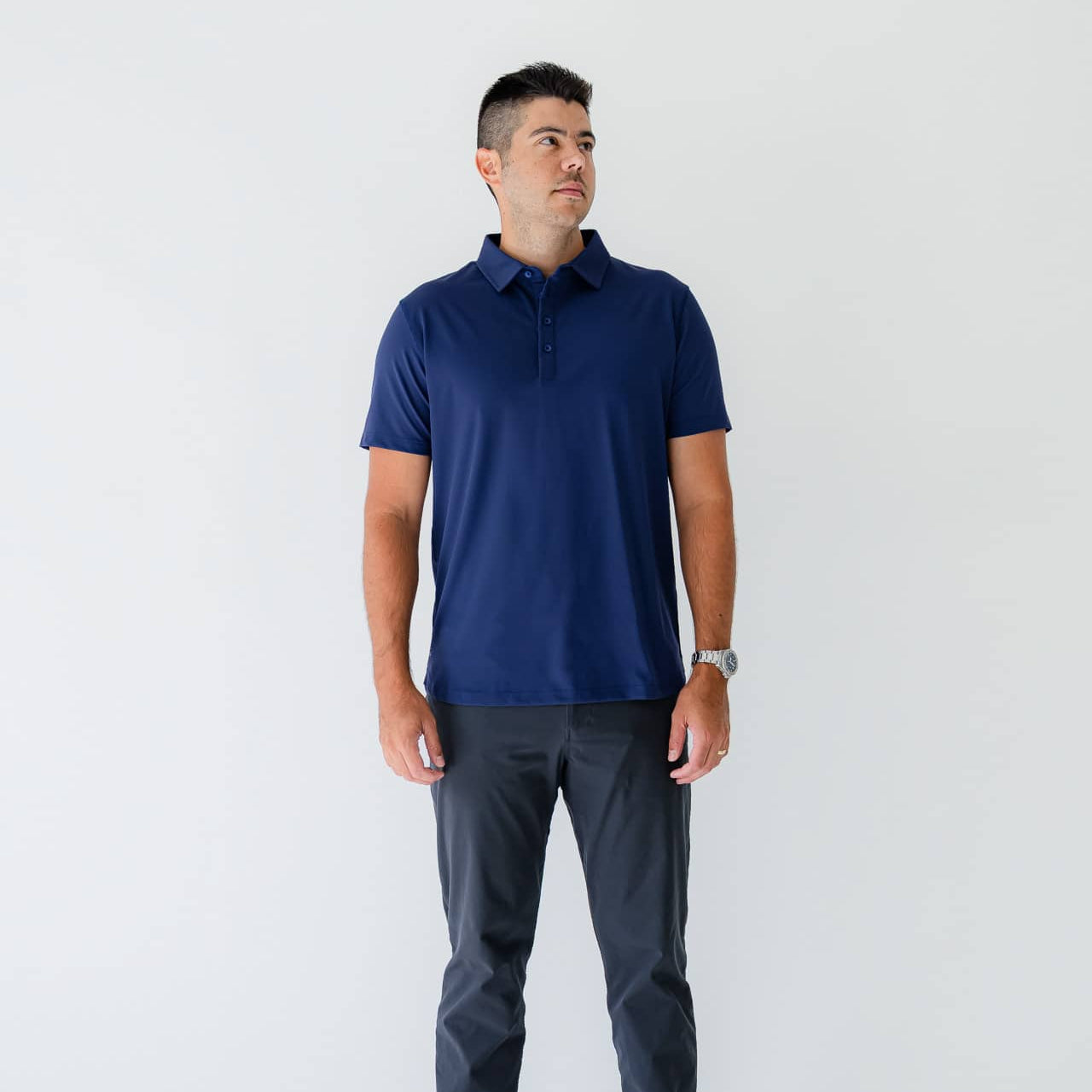
For the group photograph
84 percent nylon, 16 percent spandex, four way stretch, sweat wicking, classic athletic fit, firm collar that holds its shape, U cut hem, pre shrunk. Navy is the ground that holds a line of thirty collars together in daylight.
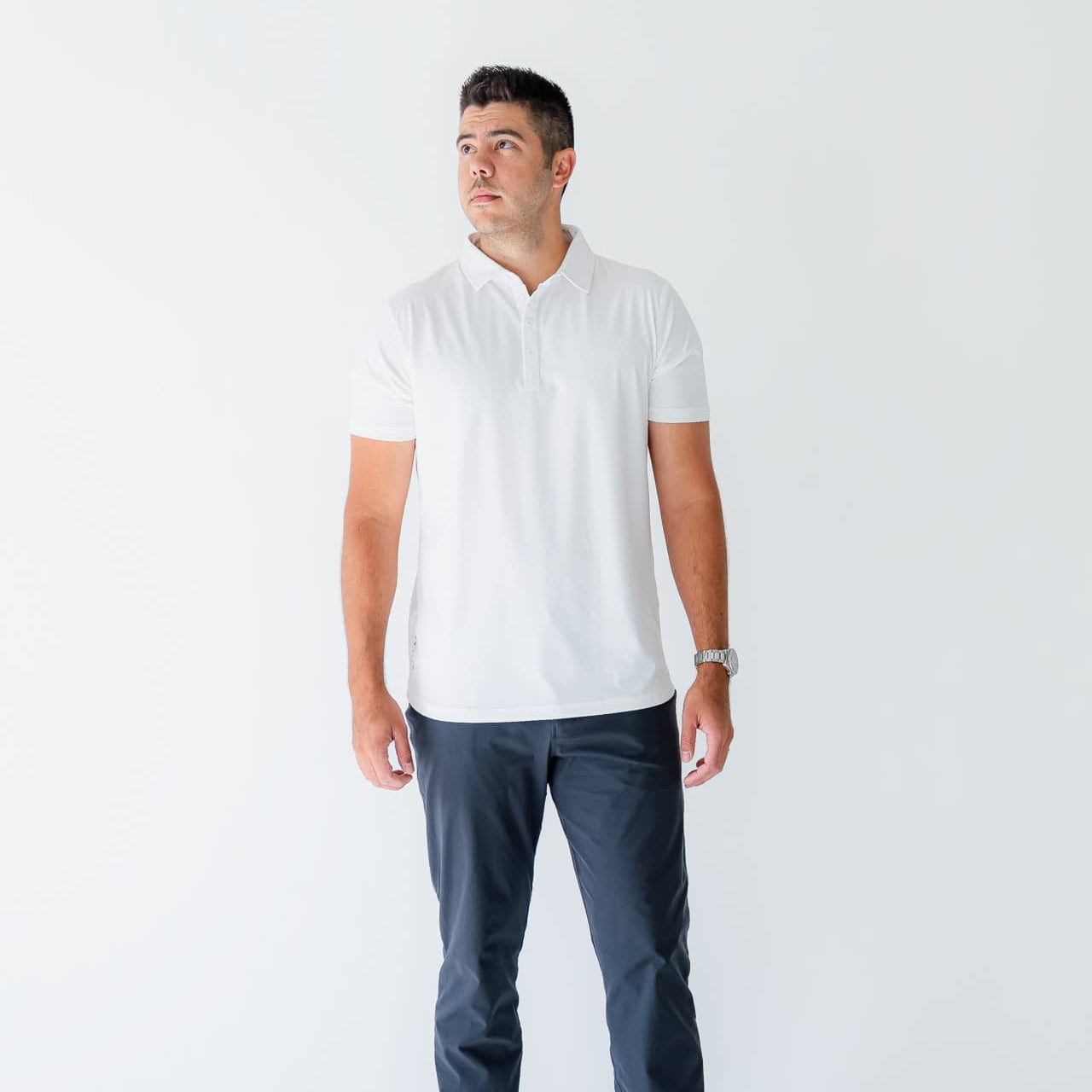
For the charity morning in October
The same polo in White: 84 percent nylon, 16 percent spandex, four way stretch, sweat wicking, classic athletic fit, firm collar that holds its shape, U cut hem, pre shrunk. White is the ground for the outdoor morning where navy sits heavy, and it is the one to pick if the firm's mark needs air around it.
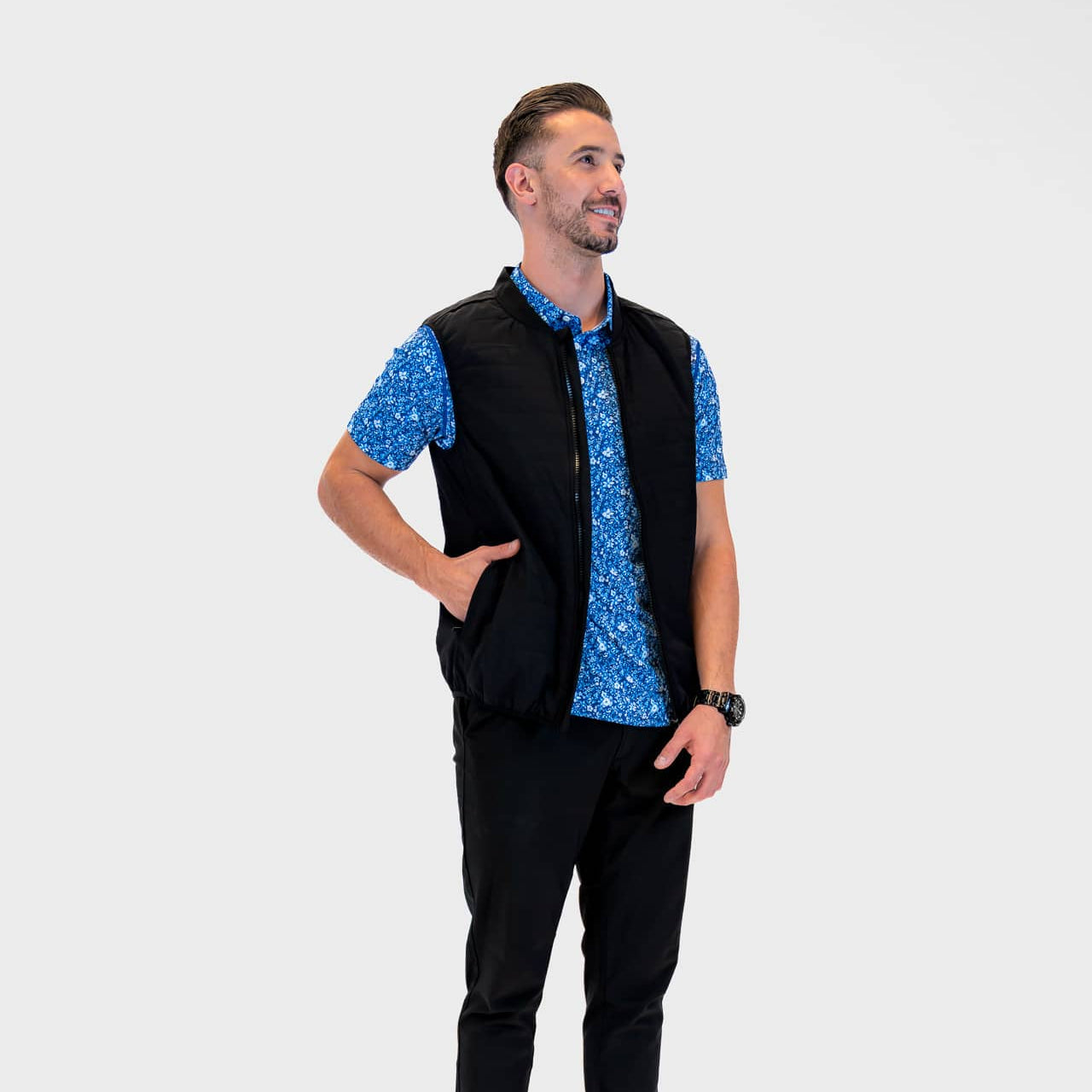
For the client round
The layer for wind rather than for cold, covering the torso and leaving the arms and the swing free. One honest constraint on a firm wide order: the vest runs Small through XXL while the polo runs to XXXL, so check that before you promise the whole firm a matching pair.
The pair for the people who will be outside
PILLAR David Polo in White and PILLAR Kevin Vest in Black
$154.00
This is the pair a firm hands to the people who will be outside: the shirt for the frame and the layer for the wind. Five sizes, because the vest stops at XXL.
The woven shirt
Should a firm order embroidered dress shirts instead
Not for this order, and not first. The polo is the right first garment for a firm because every one of the six occasions it has to cover is either outdoors, on a weekend, or in front of a client who is dressed more casually than the firm is, and a woven dress shirt is specified for none of those.
The woven shirt is a second purchase with its own logic, and it earns its place in a firm that already runs the polo and now wants something for the office and the client meeting. We have argued that case in full in our own post on reading what a logo does to woven cloth, including which cloths take a mark well and which ones should be left alone, so take the woven question there rather than from this page. That post also lands on the same ruling we would: when people are on their feet, in warm weather, or in an office that has stopped wearing jackets, the polo is the better call.
The short clock
Embroidery on stock polos runs on the short clock
Logo embroidery on stock garments is 7 to 10 business days from proof approval. That is the number to put in front of the approval chain, and the words that matter in it are the last three.
The clock covers the production run and nothing before it. Proof approval is the start line: artwork is digitized, a proof comes back showing the mark at the size it will be stitched, somebody at the firm looks at it and says yes, and the 7 to 10 business days begin at that yes. Everything in front of that is yours, and it is where orders actually lose time. Logo files that turn out to be a low resolution image pulled from a website. A partner who is in a deposition for a week. A brand standards document that nobody can find. A size count that was never collected, which is the one failure that cannot be fixed after the run, and the reason sizing a company polo order deserves its own read before you order anything.
Plan backwards from the event and leave room on both ends. Shipping is not part of the 7 to 10 business days, and a firm that wants shirts in hand a clear week before a client golf day should be approving a proof and starting the short clock well before the invitations go out, not after. Get the proof approved early and the rest of it is a delivery question rather than a production question.
The long clock
A garment built from the fabric up is a different purchase
Full custom, built from the fabric up, is about 45 days door to door, and it is not the order a first time buyer should be placing. Those two clocks are not versions of each other. One decorates a garment that already exists, the other makes the garment.
The firm this is for has run the polo twice. It knows its count, it knows which ground it wants, the shirt has been through a photograph and a drawer and come out the way it was supposed to, and now somebody wants a collar, a cloth or a fit that nobody else sells. That is a real want and it is worth about 45 days and a longer approval cycle, because what comes back is a garment specified to the firm rather than a stock garment wearing the firm's mark.
If this is the first order, do not start here. Run the stock polo on the short clock, learn what the firm actually wears, and keep building the cloth before the shirt as the thing you graduate to once the program has a track record. A first time buyer who starts on the long clock is committing 45 days and a development cycle to assumptions nobody has tested yet.
The refusal
Four questions we will not answer for you
Four of the questions a firm brings to this order cannot be answered by anybody outside the firm, and the four below are them. They are internal facts about your people, your approval chain and your clients, and a vendor who gives you a confident number for any of them has produced that number by guessing and is hoping you will treat it as expertise.
How many of your people will wear it
This is a question about your firm and not about the garment. Who turns up to the golf day, who skips the 5K, which practice group treats the retreat as optional: that is culture, and it is readable from inside the building and nowhere else. No garment specification changes the answer.
What the partners will sign off on
The managing partner and the practice group heads are an approval chain nobody outside the firm can read. What gets waved through and what gets sent back is a question of who has an opinion about apparel and how strongly, and the only way to find out is to put a proof in front of them early rather than late.
Whether your brand standards allow it
Your own standards document rules on this, not us. A mark sized for a letterhead or a building sign is often larger than the garment wants it, and whether the firm permits the smaller treatment is an internal decision. Settle it before artwork goes anywhere, because it is cheap to settle and expensive to revisit.
What a client's site allows
That is the client's own policy and it has to come from the client in writing. What a visiting team may wear on a plant floor, a construction site or a trading floor varies by building and sometimes by day, and a confident answer from anyone who does not run that site is worth nothing to you.
Stop asking for those and ask instead for what a vendor can actually be held to, in writing. A proof approved by a named person at the firm, so the sign off has an owner rather than a committee. A ship date and a delivery date written as two separate dates, because the gap between them is where a firm gets surprised. And the artwork kept on record, at the size and in the form it was stitched, so the run you place next year matches the run in the photograph. All three sit inside a vendor's control, which is exactly why they are worth holding anybody to.
Questions a firm asks before the first order
What should a law firm order for branded apparel?
One polo, in one ground, with one small embroidered mark, plus one layer for the outdoor events. A firm's shirt is worn about six times a year, so the order should be specified for a group photograph and for eleven months folded in a drawer rather than for laundering and abrasion. The PILLAR David Polo at $76 with the PILLAR Kevin Vest at $78 over it covers every occasion a firm of this size runs.
How long does a custom polo order take for a firm?
Logo embroidery on stock polos runs 7 to 10 business days from proof approval. The clock starts at the yes on the proof, not at the purchase order, and shipping sits outside it. A garment built from the fabric up is a separate product on a separate clock at about 45 days door to door.
Should the firm order polos or embroidered dress shirts?
Order the polo first. The occasions a firm's shirt has to cover are outdoors, on a weekend, or in front of a client dressed more casually than the firm, and the polo is specified for all three. The woven dress shirt is a sensible second purchase once the polo program has run, and the argument for how a logo behaves on woven cloth belongs to our own post on embroidered dress shirts.
Is one shirt enough for a firm that only uses it a few times a year?
Yes, and the frequency is the reason. A garment worn six times a year is never in the laundry bottleneck that makes a second shirt necessary in a uniform program. The money saved on the second shirt is better spent on a retail grade garment that people will actually put on.
What is the difference between decorating stock polos and building a custom garment?
One puts your mark on a garment that already exists, the other makes the garment. Decorating stock polos runs 7 to 10 business days from proof approval and lets a firm see the product before it commits. Full custom is about 45 days door to door and is the right move only for a firm that has already run the stock polo and now wants a cloth or a fit nobody else sells.
Will the shirts match if we order more next year?
They match if the artwork is kept on record at the size and in the form it was stitched. Ask for that in writing on the first order, along with the garment and the ground named exactly, so a later run is a repeat rather than a fresh interpretation. One garment and one ground on the first order is what makes a second run easy.
Do we need a second color?
No. A second ground turns the shirt into a choice, and a choice turns one order into two counts to forecast, two runs to match and a group photograph with a seam down the middle of it. Pick the ground that reads well in daylight and order that one.
Six wearings a year still deserves a written spec.
Tell us the firm's mark, the events it has to cover and roughly when the first one lands, and we will come back with one garment, one ground and one mark, priced for the run you are actually placing.
