

What Size Polo Am I If I Wear a 16 Neck?
A 16 inch neck lands on Large in two published shirt charts and on Medium in a third, so there is no single polo size to convert to. The conversion men want does exist on paper, and the paper does not agree with itself. So do this instead: measure your chest, or read the tag on a polo that already fits you, and carry the fit word across rather than the numbers. A dress shirt is sized at the throat. A polo is not sized anywhere near it, which is why the two numbers you know cold, your neck and your sleeve, are the two numbers a polo never asks for.
There is no dependable neck to letter conversion, so take the letter your chest gives you and carry only the fit word across from the dress shirt.
The question
What size polo am I if I know my dress shirt size
If you wear a 16 inch neck, you are a Large in most polo lines and a Medium in some, and no chart can narrow it further for you. That is not hedging. It is what the published tables actually say when you lay them next to each other, and the gap between them is wide enough to put a man in the wrong shirt.
Three men's shirt size charts were read on 2026-11-08. ShirtMath puts a 16 inch neck on Large. SizeChartBase puts a 16 inch neck on Large. The Tie Bar, which is a shirtmaker publishing its own guide, puts a 16 inch neck on Medium in both of the two neck tables it prints. Two say Large. One says Medium. There is no majority rule that makes that go away, because the one that disagrees is the one with a garment behind it.
The useful answer is a different answer. Polo sizing runs on the chest, and the fit word printed on your dress shirt label tells you more about which polo letter to take than the neck number ever will. Slim, trim, regular, classic: that word is a statement about how much cloth sits between you and the shirt, which is the only question a polo size is answering too.
The neck
Why the neck number cannot carry across
A dress shirt is sold by the one circumference a polo never fastens. The collar closes at the throat with a button and a tie knot sitting on top of it, so the neck measurement is a hard constraint with a right answer and a wrong one. Half an inch too small and you cannot do the top button. Half an inch too big and the knot floats.
A polo collar spends the entire round open. Nothing is being closed, nothing is being measured against your throat, and nobody is checking whether the top button meets. The collar on a polo is a styling decision and a durability question, not a sizing input. That is why the PILLAR David Polo gets described by its firm collar that holds its shape rather than by a neck number: the collar has a job, and the job is standing up after four hours in the heat, not fitting a measurement.
So when a chart hands you a neck to letter translation, understand what it is doing. It is not measuring you. It is guessing which generic body usually comes attached to a 16 inch throat, and bodies with 16 inch necks come in a range of chests wide enough to cover three letters. The same gap shows up when men move between a button down and a polo for work, which is a separate decision worth reading about in the case for a polo in business casual.
One more reason the neck number travels badly: a dress shirt can move on you after a wash, and a polo built pre shrunk does not. Both PILLAR polos are pre shrunk, which means the chest you measure today is the chest the garment keeps. That is what makes the measurement worth taking once instead of every season.
The charts
Where the three charts stop agreeing
They stop agreeing at 15 inches and they never fully recover. Here is the whole disagreement in one place, and then the three faults worth knowing about.
| Neck size | Chart one | Chart two | Chart three |
|---|---|---|---|
| 14.5 | Small | Small | Small |
| 15 | Medium | Medium | Small or Medium |
| 15.5 | Medium | Medium | Small or Medium |
| 16 | Large | Large | Medium |
| 16.5 | Large | Large | Medium or Large |
| 17 | XL | XL | Large or XL |
| 17.5 | XL | XL | Large or XL |
| 18 | 2XL | 2XL | XL or XXL |
Chart one is ShirtMath's men's dress shirt chart, using its Usual alpha column. Chart two is the men's shirt size reference site SizeChartBase. Chart three is the shirtmaker The Tie Bar's own size guide, which prints two neck tables, so a cell reading two letters means the two tables differ or a single number sits in two bands at once. All three read on 2026-11-08.
Three disagreements are worth stating flatly. A 15 inch neck is Medium on chart one and chart two, and Small on chart three's first table. A 16 inch neck is Large on chart one and chart two, and Medium on chart three in both tables. And chart three shares 16.5 between Medium and Large, so one number sits in two sizes at once on a chart published by the company selling the shirt.
Chart one is honest about this, which is why it is worth quoting. In its own words: "The alpha column is the least reliable column in the table." Its FAQ is just as plain. Asked whether a 15.5 neck is a medium, ShirtMath answers: "Usually. Most US brands put M at a 15-to-15.5-inch neck, with L starting at 16." Usually is the operative word, and ShirtMath publishes no chest measurement for dress shirts at all, so there is nothing on it to cross check against a polo.
Chart two has two faults inside its own document. Its table says Small is a 36 to 38 inch chest, while its prose and its FAQ both say 34 to 36, so the same page gives Small two different chests. And its chest ladder skips: Medium ends at 40 and Large starts at 42, which leaves a 41 inch chest with no size on the chart at all.
Chart three does something the other two do not, and it is the most useful thing on any of the three pages: it gives chest per neck rather than per letter. In standard fit, a 15.5 neck is a 44 inch chest, a 16 neck is a 46, a 16.5 neck is a 48 and a 17 neck is a 50. In trim fit the same necks are 43, 45, 47 and 49. Read that against chart two and the contradiction is complete. Chart two calls a 16 inch neck a Large, and chart two calls a 42 to 44 inch chest a Large, but chart three says a 16 inch neck comes with a 46 inch chest, which chart two's own ladder files under XL. Two charts, one neck, two letters, and the chest is the thing that broke the tie.
You know your neck and your sleeve cold. A polo has never once been sized by either of them.
The label
The one thing on your dress shirt label that does transfer
The fit word transfers. Slim, trim, regular, classic: that word is the one piece of information on a dress shirt label that is also true of a polo, because it does not describe a measurement, it describes how much room sits between the cloth and your chest. That is the same question a polo size answers, which is why the word crosses the gap and the numbers do not.
Here is the map, and it runs opposite to the way most men guess. A man who buys a trim or a slim dress shirt should take the same letter in a classic athletic fit polo, not a size down. The reason is in the cut. A classic athletic fit has already taken the room out of the waist and left it in the chest and shoulders, which is precisely what a trim dress shirt is doing with a different set of seams. Size down on top of that and you end up with a polo that pulls across the back of the shoulders the moment you take a club back.
The reverse holds too. A man who buys a classic or a full fit dress shirt because he wants air in it will find an athletic cut closer to the body than he is used to at the same letter, and that is the cut working, not the size being wrong. If the words themselves are doing the confusing, the differences between athletic, slim and classic are laid out properly in what the fit names on a label actually mean.
What does not transfer is the sleeve. A dress shirt sleeve is measured from the center back to the cuff because it has to reach a wrist bone and sit under a jacket. A polo sleeve ends somewhere on the bicep by design, and no maker sizes it in inches on a tag. The sleeve number you have memorized has nowhere to go.
The tape
Measure the chest, once
Take one measurement and you are done for years. Put a tape around the fullest part of your chest, keep it level front to back, keep your arms down and breathe normally. Do not flex and do not pull the tape tight enough to compress anything. Write the number down.
If you do not own a tape, use a polo you already like. Lay it flat on a table, smooth it out, measure straight across from one armpit seam to the other, and double that number. That gives you the garment's chest rather than yours, which is actually the more useful figure, because it tells you how much room the shirt you already approve of has in it. Then take your number to the chart published by whoever makes the polo you are buying. Not a general chart. Not a dress shirt chart. The maker's own chart for that specific garment, because letters are set by the brand and nobody else.
We will not publish a neck to letter conversion table for PILLAR. PILLAR sells no garment sized at the neck, so a table that turned your 16 into a letter here would be an invention dressed up to look authoritative. A tape around your chest beats a number somebody made up to fill a cell.
That one measurement also holds its value because both PILLAR polos are pre shrunk. The size you measure is the size you keep, so there is no allowance to build in and no second guess after the first wash. If the shape of your chest and shoulders is the thing making the decision hard rather than the number itself, there is a longer treatment in the practical guide to polo fit by body type.
$76
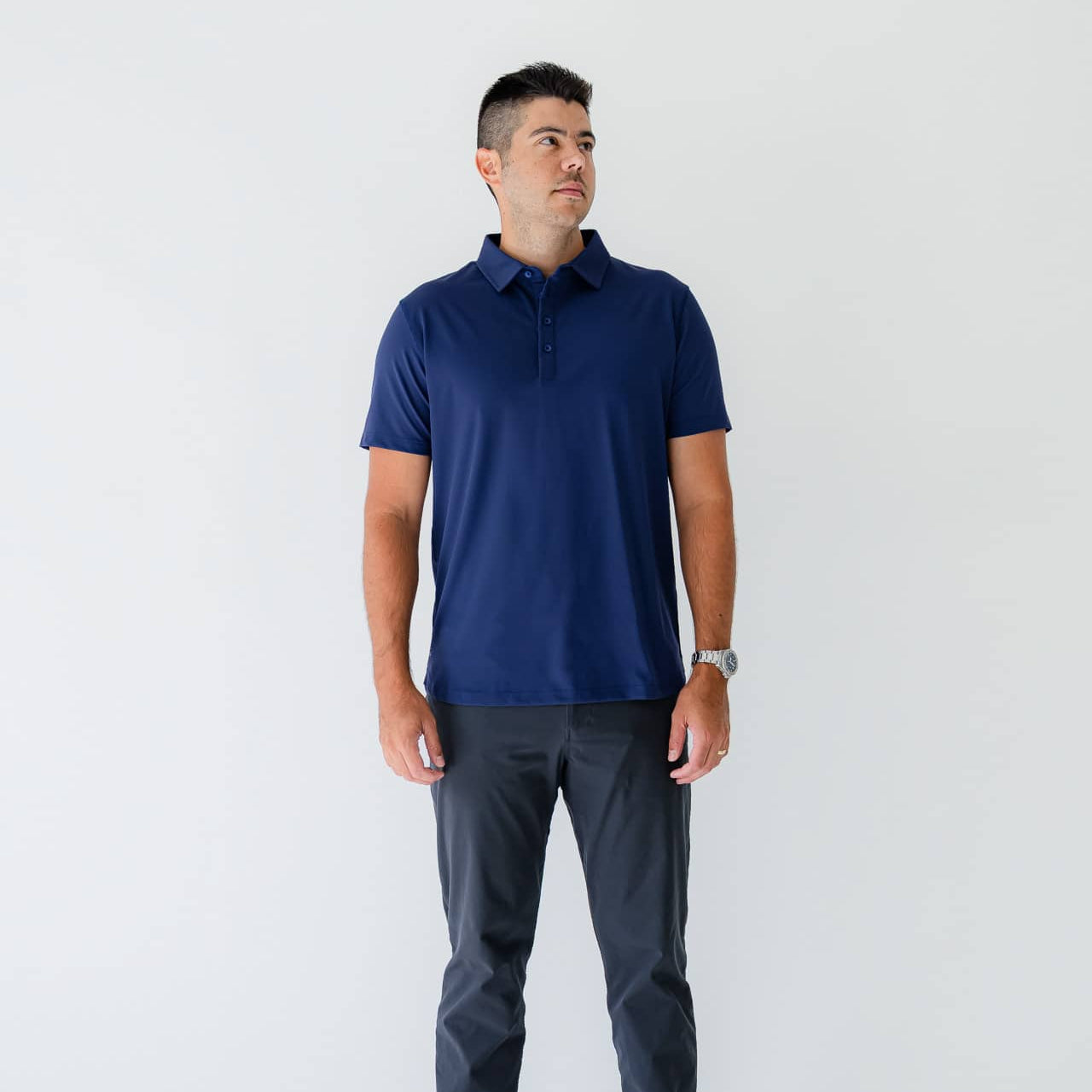
The solid. 84 percent nylon and 16 percent spandex, four way stretch, sweat wicking, classic athletic fit, with a firm collar that holds its shape and a U cut hem. Pre shrunk, so the chest you measured is the chest it stays. The letter you take here is the letter your chest measurement picked, not the one your dress shirt neck implies.
The gap
What to do when you land between two letters
In a classic athletic fit, take the smaller letter when your number sits in the lower half of a band and you intend to tuck, and take the larger letter when you intend to wear it out. That is the rule, and it works because of where the extra letter goes.
A size up in a polo does not only add girth. It adds length, and on a U cut hem the length is the part that decides whether the shirt stays put untucked or rides above your belt line every time you reach for something. If the polo is going into your waistband for work or for a club with a tucked rule, the extra length is wasted and the smaller letter gives you the cleaner line. If the polo is coming off the course and straight to dinner, the longer hem is the whole point.
Two details that change the call. First, where in the band you fall matters more than the band itself. A chest at the bottom edge of a Large band is a different garment than a chest at the top edge of the same band, and the lower you sit, the safer the smaller letter is. Second, an athletic cut has already removed the waist room, so sizing up to buy comfort through the middle tends to buy you a looser chest and a droopier shoulder seam instead, which is not the trade you were after. The full argument on which direction to go, and when the usual advice is wrong, is set out in whether to size up or size down between letters.
$76
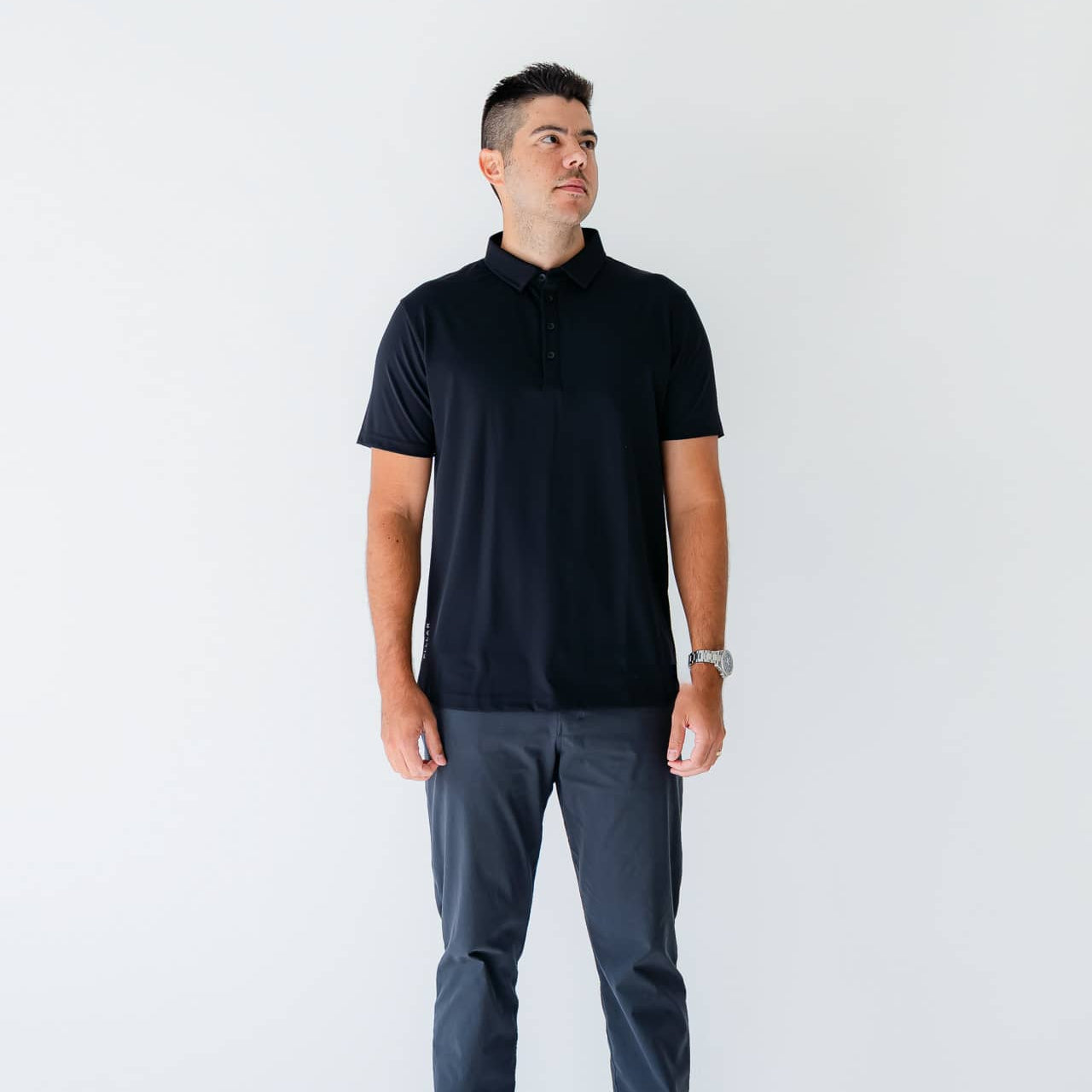
The same solid staple in black. 84 percent nylon, 16 percent spandex, four way stretch, sweat wicking, firm collar, U cut hem, classic athletic fit, pre shrunk. If you are between letters and you tuck, this is the one to take smaller.
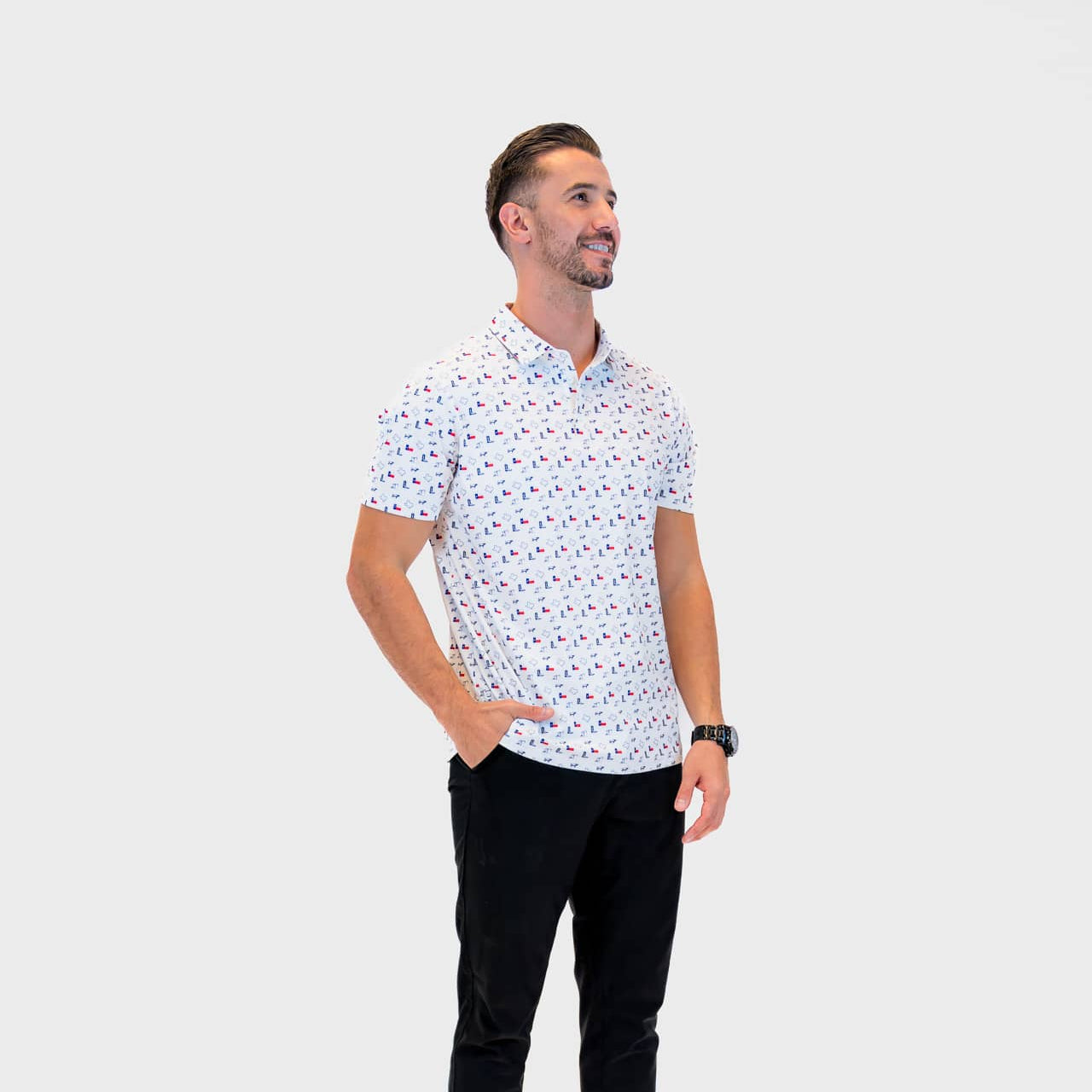
PILLAR Steven Polo, Texas print
$76
The print. 88 percent polyester, 12 percent spandex, a cooling sweat wicking textured knit with four way stretch, U cut hem, classic athletic fit, pre shrunk. Same fit as the David, so the letter does not change when you switch to a print.
The verdict
The two PILLAR polos and which letter to take in each
Take the same letter in both, because both run classic athletic fit. The PILLAR David Polo at $76 is the solid staple, 84 percent nylon and 16 percent spandex, and it is the one with the firm collar that holds its shape, which is what you want when the shirt has to still look like a shirt at the turn. The PILLAR Steven Polo at $76 is the print, 88 percent polyester and 12 percent spandex in a cooling sweat wicking textured knit, which is the one for heat and for the days you do not want another solid.
Both are four way stretch, both have the U cut hem, and both are pre shrunk. That last one is the fact doing the real work in this whole post. If the garment does not move after a wash, then the chest you measured once is the chest that decides your letter permanently, and you never have to run the neck to letter guess again. Measure once, take the letter, buy either polo in it.
Against the wider field of golf polos, PILLAR competes on the stretch and the collar rather than on price, and that comparison is argued properly in this look at the best men's golf polos on and off the course.
One solid, one print, one letter
PILLAR David Polo in Navy plus PILLAR Steven Polo in the Texas print
$152.00 for both
The questions
Questions men ask about polo sizing
What size polo am I if I wear a 16 inch neck dress shirt
Most likely a Large, but a Medium on some brands, and no chart can settle it for you. Of the three charts read on 2026-11-08, two put a 16 inch neck on Large and the third put it on Medium in both of its own neck tables. Measure your chest and use that instead.
Does a dress shirt sleeve length mean anything on a polo
No. A dress shirt sleeve is measured from the center back to the cuff so it reaches your wrist under a jacket, and a polo sleeve ends on the bicep by design. No polo maker sizes a sleeve in inches, so the number you have memorized has nowhere to go.
Is a polo size the same as a T shirt size
Often, but not reliably enough to buy on. Both are sized by the chest, which is why the letters tend to line up, but a polo has a collar, a placket and a shaped hem that a T shirt does not, and a fit word like classic athletic will change where the cloth sits. Compare the chest number on the maker's chart rather than assuming the letter carries over.
How do I measure my chest for a polo
Put a tape around the fullest part of your chest, level front to back, with your arms down and your breathing normal. Do not flex and do not pull it tight. If you have no tape, lay a polo that already fits flat, measure straight across from armpit seam to armpit seam, and double it.
Should I size up in a polo if I am between sizes
Size up if you wear it untucked and size down if you tuck it. The extra letter mostly buys length, and on a U cut hem that length is what keeps an untucked polo sitting where you put it. If your number also sits in the lower half of the band, the smaller letter is the safer call.
Do PILLAR polos shrink after washing
No. Both the PILLAR David Polo and the PILLAR Steven Polo are pre shrunk, so the size you measure is the size you keep. That is why one chest measurement is enough to pick your letter for good.
One tape measure settles what three charts could not
Both PILLAR polos run the same classic athletic fit and both are pre shrunk, so once your chest has picked the letter it holds across the whole line.
