

One shirt for everyone, or two cuts?
Your staff list has two numbers on it. The order form has room for one. Order both cuts when the staff is mixed, keep one style family, one ground and one mark, and let the size run grow instead of the garment count. A unisex garment is not a neutral garment, it is a men's block with the grading opened up, so "one shirt for everyone" is not a simplification of the order. It is a decision about who gets a shirt that fits and who gets a shirt that covers.
- What you are choosing between
- One style number or one fit. The order can hold either of those, and it cannot hold both.
- What changes when you split it
- The per cut, per color minimum. And the collar and placket, which on many catalog women's polos are cut differently and are sometimes left off the garment entirely.
- What does not change
- The mark, the ground and the style family. The logo is digitized once into a single stitch file that runs on either cut, and the same people are still getting one shirt each.
- When the question disappears
- When the garment is built from the fabric up. The cut is then written into the spec rather than chosen off a catalog page.
One style number for the whole staff
Unisex is a sizing convenience. It was never a fit promise. A unisex polo is graded from a men's block with the measurements opened up so that one size covers more bodies, which is a different goal from fitting any one body well, and the grading does nothing about where the shoulder sits or how the body moves through the waist.
That tradeoff is fine on a loose garment nobody is judging. An event tee, a giveaway hoodie, an outer layer worn open over whatever the person already owns. Unisex holds up there because the garment is not doing any shaping. It works worst on the fitted thing people are photographed in, which is almost always the polo, and the polo is almost always the piece a company puts its mark on. If you want the wider view of how a branded program gets built, we covered the whole category in our guide to branded company apparel.
So name the decision honestly. It is not one shirt or two shirts. It is one style number or one fit.
Two patterns behind one style number
A second cut is a second pattern, not a second label. Four things move: the shoulder point, the armhole, the body taper through the waist, and the length. None of those are adjustments to a unisex shirt, they are a different draft, which is why a women's cut has its own style number inside the same style family.
Then the part nobody writes down. Many catalog women's polos are cut with a different placket, and some are made without a collar at all. If the shirt has to clear a golf dress code at a client event, the collar has to be specified and confirmed on the women's cut rather than assumed from the men's one, because the men's cut clearing the code tells you nothing about its counterpart. We set out what a course actually accepts as a collared shirt if you need the standard in front of you before you specify. Our decoration side keeps a short list of which polos we put a company mark on, and the collar is a large part of why that list stays short.
One stitch file across both cuts
The mark is digitized once and the setup is paid once. The same stitch file runs on both cuts, so splitting the order does not split the artwork or double the art cost. That single file is also the thing that holds a program together over time, which is the mechanism behind whether next year's reorder matches this year's shirts.
Placement is set and signed off at proof, on each cut, because the two garments are not the same shape and a mark approved on one is not an approved mark on the other. Two proofs, one file, one signature each. That is the whole of it, and anyone who hands you a placement rule in inches for a garment they have not seen is guessing.
Two size runs and the same number of shirts
The size run doubles in count. It does not double in quantity. The same people are still getting one shirt each, so the order total stays where it was and only the form gets longer.
The honest cost sits in the minimum. A per cut, per color minimum can apply, which means a two cut order in three grounds is six minimums and a two cut order in one ground, meaning one color for the whole staff, is two. That arithmetic is the real argument for one ground, not brand discipline. Pick the color everybody can wear, put both cuts behind it, and the split stops being expensive.
Then do the boring thing that saves the order. Collect the cut choice as a required field alongside the size, not as an optional note, and chase the people who skip it by name rather than guessing on their behalf. Our piece on how to size a company polo order covers the rest of the collection problem.
| The decision | One unisex style | Two cuts in one style family | What actually changes |
|---|---|---|---|
| Who it fits | A men's block with the grading opened up, so it fits men's frames and covers everybody else. | Each cut is graded to the body it was drafted for. | The fit, which is the whole reason the question gets asked. |
| The size run | One run for the whole staff. | Two runs, one per cut, inside the same style family. | The count of sizes on the form. Not the number of shirts. |
| The artwork and setup | One stitch file, one setup. | One stitch file, one setup, confirmed at proof on each cut. | Nothing on the artwork. One more proof to sign. |
| The minimum | One minimum per color. | A per cut, per color minimum can apply. | One ground is two minimums. Three grounds is six. |
| The dress code at a client event | The collar comes with the polo you already specified. | The collar and placket have to be specified on the women's cut. | What you confirm in writing before the order is placed. |
One ground, three pieces. These are the PILLAR garments worth putting a company mark on for a mixed staff, and the rest of the run sits in the polo collection.
The ground
PILLAR David Polo, Navy
$76.00
84 percent nylon, 16 percent spandex, with four way stretch and sweat wicking. Classic athletic fit, a firm collar that holds its shape, a U cut hem and pre shrunk so the second wash does not change the size you ordered.
The front of this shirt carries no chest logo, which is why it takes a company mark cleanly. Navy is the ground to pick when one color has to work across the whole staff.
View the David Polo in Navy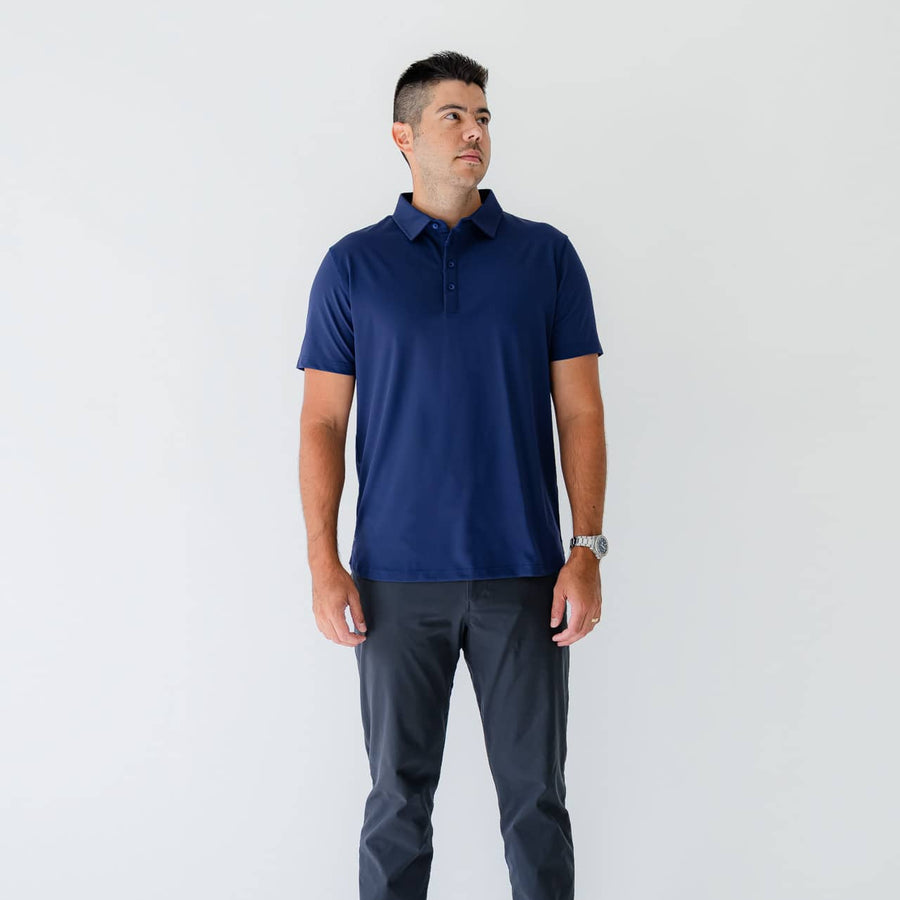
The collar
PILLAR David Polo, White
$76.00
Same fabric and the same build as the Navy. 84 percent nylon, 16 percent spandex, four way stretch, sweat wicking, classic athletic fit, U cut hem, pre shrunk.
The collar and the placket are the part of this garment a dress code actually checks, and they are the part to confirm on a women's cut rather than assume. The chest is clean, so the mark goes where you put it.
View the David Polo in White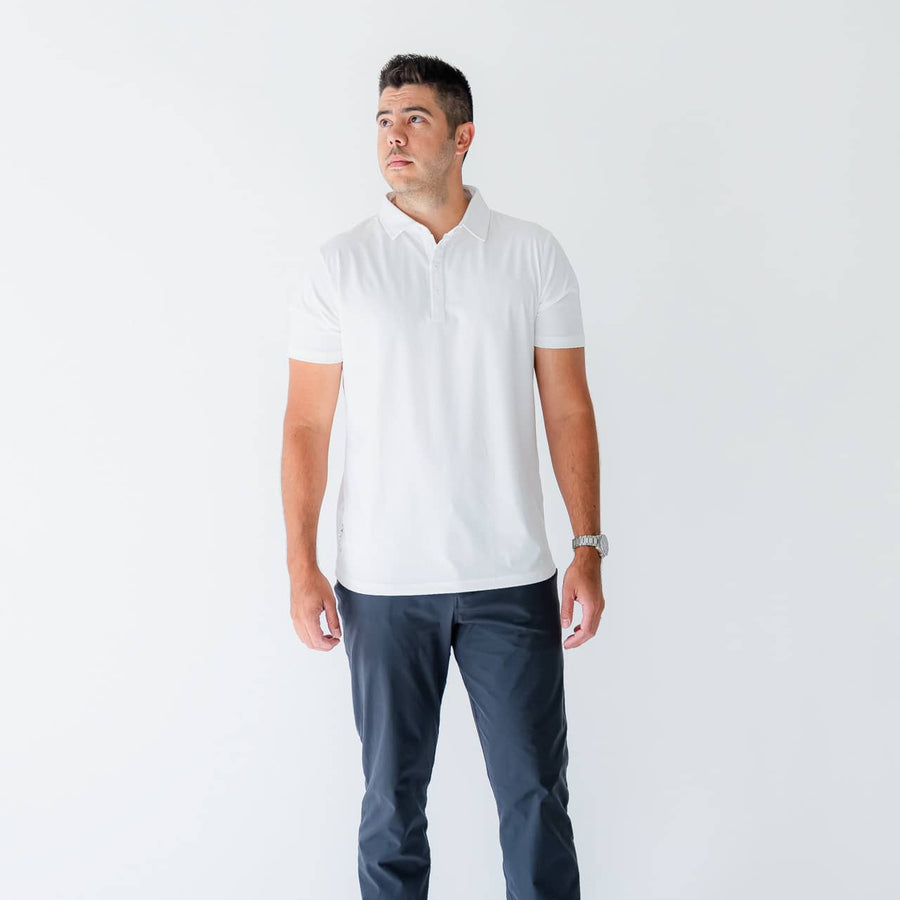
The layer
PILLAR Kevin Vest, Black
$78.00
An outer layer is the one place where one cut for everybody holds up, because the garment is worn open over something else and nothing about it is doing any shaping. This is where a unisex run costs you nothing.
The shirt underneath it in this photograph is not what the card is selling. The size run stops at XXL.
View the Kevin Vest in Black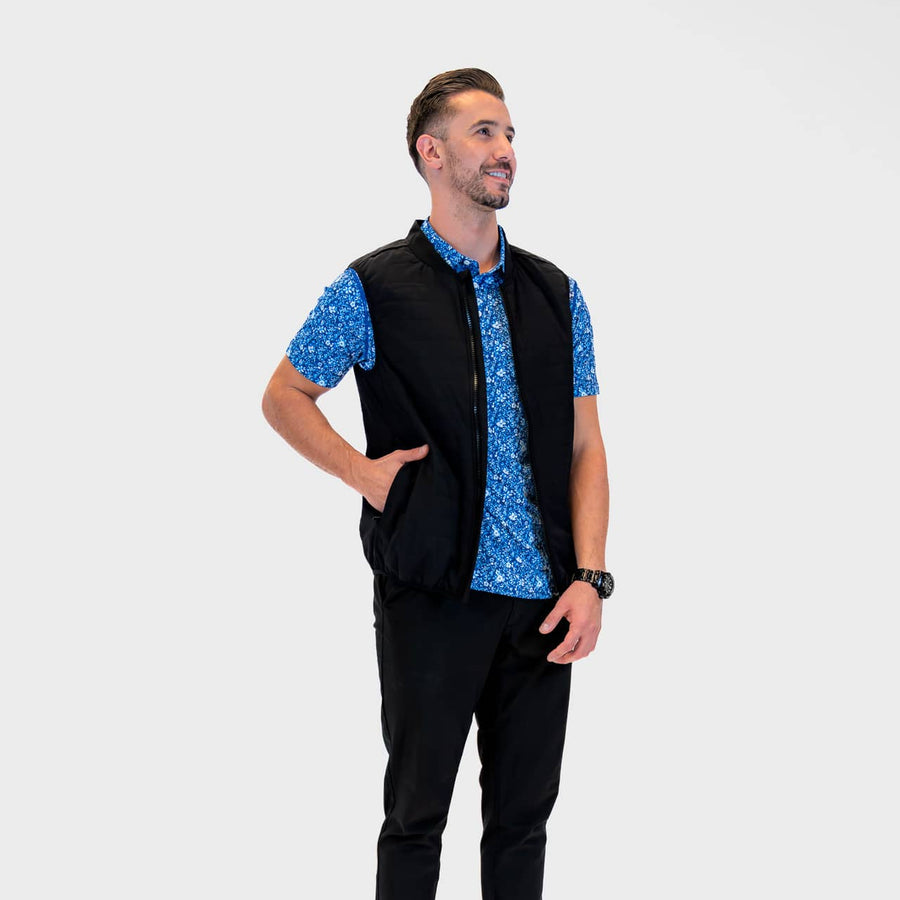
David Polo in Navy with the Kevin Vest in Black. One mark, one color story, the shirt for the room and the layer for the parking lot.
Here is the constraint, said out loud, because a staff wide order runs into it: the vest stops at XXL. The polo runs to XXXL on its own, so anyone past XXL gets the shirt and takes a different layer. Find that out now rather than at the loading dock.
$154.00 together
Seven to ten business days from proof approval
Logo decoration on stock garments runs seven to ten business days from the day the proof is approved. That is the clock, and it starts at the signature rather than at the moment you first send the logo.
What it does not include is everything in front of that signature. Digitizing the mark, the art round trip, your own time collecting sizes and cut choices off the staff, and a stock check on both cuts in the ground you picked. It does not include transit either. If you need a date certain for a client event, count backward from the event through shipping, then through the decoration window, then give yourself room for the proof round trip. Our decoration side sets out how long a stock garment program takes once the proof is signed in more detail.
Forty five days when the cut is written into the spec
A garment built from the fabric up runs about 45 days door to door, and on that route the cut question dissolves. The pattern is made to the order's own spec rather than picked off a catalog page, so there is no men's block to open up and no women's placket to go hunting for in somebody else's product sheet. You specify both cuts, including the collar, and both get drafted.
That route is also where the rest of the garment stops being somebody else's decision. Fabric woven or knit to spec and dyed to an exact color, all over print from an original repeat pattern, chest crests and sleeve hits, chenille and 3D puff, reflective and tonal and metallic heat transfer, private label neck tags, trim, headwear, and packaging down to branded insert cards and name level kitting. PILLAR client work includes AO, the WM Phoenix Open and Progressive Roofing. If you want the boundary drawn plainly, this is where the cut stops being a catalog decision.
We also wrote up what gets decided when we make the polo itself, which walks the specification choices on that route. It does not take up the men's and women's cut question, which is exactly why this post exists.
Three numbers PILLAR will not publish
Three numbers get asked for on every mixed order. We publish none of them, and the reason in each case is that the number would be invented rather than measured.
A men's to women's size conversion
Catalog makers do not agree with each other on this, so any single table is a choice of one maker dressed up as a standard. A conversion built to look authoritative is worse than a tape measure, because it travels further before anyone checks it.
A split percentage
What share of the order should be each cut is a function of a staff list that nobody outside your company has. A published split would be a guess about your people, and you would be ordering against it.
An adoption rate
How often a second cut gets taken up once it is offered is a real and useful number. We have not measured it, so we do not have it, and we are not going to hand you a figure we did not produce.
One action replaces all three. Put the cut choice on the form as a required field, next to the size, and count the answers. That gives you a split measured on your own staff, a size run you can actually order against, and a number you can defend when someone asks why the order looks the way it does.
Seven questions a mixed order raises
The same seven come up every time, so here they are with the short answer attached.
Is a unisex shirt the same as a women's shirt?
No. A unisex shirt is graded from a men's block with the measurements opened up, so it covers more bodies without being drafted for any of them.
Do I pay the setup fee twice if I order two cuts?
No. The mark is digitized once into a single stitch file and that file runs on both cuts. Placement is confirmed on each cut at proof.
Does ordering two cuts double the number of shirts?
No. The size run doubles in count, not in quantity. The same people are still getting one shirt each.
Do women's polos have collars?
Many catalog women's polos are cut with a different placket and some are made without a collar at all. If the shirt has to clear a golf dress code, specify and confirm the collar on the women's cut rather than assuming it from the men's one.
How long does a company polo order take?
Logo decoration on stock garments runs seven to ten business days from the day the proof is approved. A garment built from the fabric up runs about 45 days door to door.
Can I order two cuts in one color?
Yes, and it is the cheapest way to run a split order. A per cut, per color minimum can apply, so two cuts in one ground is two minimums and two cuts in three grounds is six.
What size should a woman order in a unisex polo?
We do not publish a men's to women's conversion, because catalog makers do not agree with each other. Measure a shirt that already fits and compare it to the size chart for the style you are ordering.
Send the staff list and the mark. We will come back with both cuts in one style family, one ground, and one proof per cut to sign.
