

The Person Wearing It Does Not Work for You
The person wearing this shirt does not work for you.
She is an independent contractor. She has her own name on a sign, her own marketing budget, her own following, and very often her own logo in her own colors. A brokerage order is the only corporate apparel buy where the wearer shows up already holding a brand. Everything that follows comes out of that one fact.
The verdict
Spend the budget on the garment and shrink the brokerage mark. A small, clean mark holds up next to a second mark on the same chest. A large one argues with it, and a logo with a solid filled background box is the least forgiving thing you can put beside anything else.
Then stop thinking of this as an order and start thinking of it as a program. Pick a garment you can reorder in the same colorway for years, because the roster will not match the spreadsheet you are looking at right now. Logo embroidery on stock garments runs about 7 to 10 business days from proof approval. A garment built from the fabric up runs about 45 days door to door.
The buyer
The order is placed by a brokerage and the shirt is worn by a contractor.
Answer first: buy as though the wearer gets a vote, because she does. Every other apparel program we spec runs on an employer paying for a garment an employee is expected to wear. Here the brokerage pays for a garment somebody else decides to put on, and nothing in the purchase order compels that decision.
The published guidance on this subject is thin in a specific way. The search results are mostly print shop category pages and marketplace listings, plus one long apparel guide that recommends a quantity of each garment per agent. It counts garments. It never asks who is actually buying them. That question decides the order, and skipping it is how brokerages end up with cartons of unclaimed polos in a storage room.
Our decoration side runs this kind of buy constantly, company apparel carrying a brokerage mark, and the brokerage version behaves differently from every employer version we quote. The spec conversation is longer and the quantity conversation is shorter.
One more thing, said once. Whether a given arrangement makes a person a contractor or an employee is a question for the brokerage's own counsel, not for an apparel buyer, and we are not going to pretend otherwise.
Margin note
An employee order fails quietly. A contractor order fails visibly, because the garment either appears at open houses or it does not.
The storage room is the measurement. Count what left it after ninety days.
Two marks
The chest is shared by two marks that were never drawn together.
Make the brokerage mark smaller than your instinct says. That is the whole ruling, and it is not a style preference. A mark reduced to its cleanest form reads at a glance next to a second mark. A mark pushed up in scale starts competing with the agent's own identity, and the agent is the one who has to stand next to a client wearing it.
Scale is one of the two decisions worth making here. Decoration method is the other. Embroidery holds a small mark better than most people expect, as long as the artwork has been reduced to shapes that survive at size. Fine taglines and hairline type are the first casualties, and a solid filled background box behind a logo is the single most expensive element you can carry into a proof. We wrote up the mechanism in our piece on why a filled background block drives a stitch count up, and it is worth ten minutes before you send artwork, because the same thing that makes a filled box costly also makes it visually heavy beside a second mark.
If the agent's own logo is going on the garment too, the brokerage artwork is the one that should give ground. It is the mark that repeats across the whole roster. It does not need to shout on any single chest.
One chest, two owners, and only one of them signs the purchase order.
The garment
Two shirts that take a small mark well
Both of these are the same polo in two colorways, which is the point. A navy and a white give you a mark that can be rendered one way on a dark ground and another on a light one without redrawing the artwork for a third background.
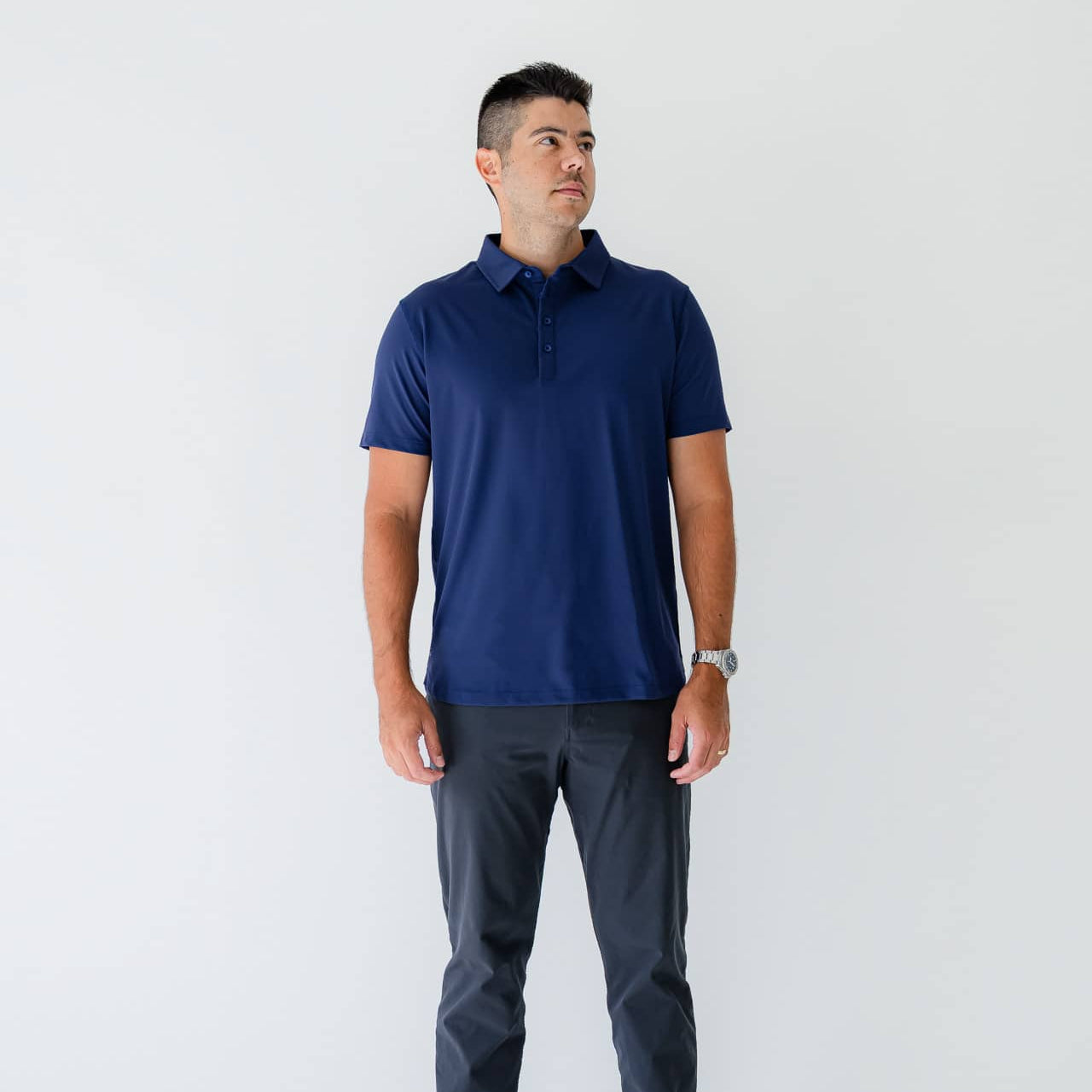
Stock garment, reorderable colorway
David Polo, Navy
84% nylon, 16% spandex, with four-way stretch and sweat-wicking performance. The collar is firm and holds its shape, which matters more than anything else on a shirt that goes from a car to a listing appointment. Classic athletic fit, U-cut hem, pre-shrunk, easy care. Machine wash cold, tumble dry low.
$76
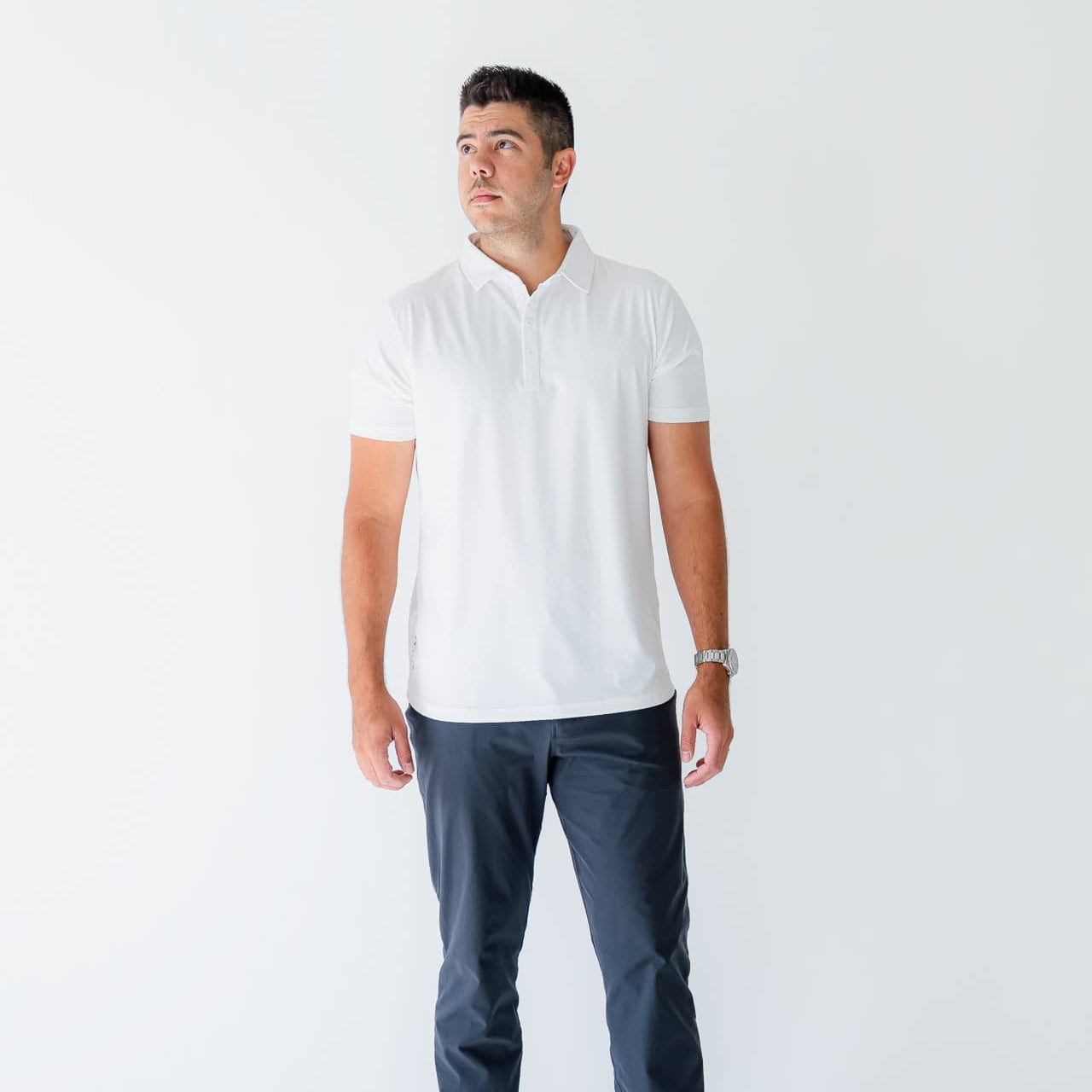
The light ground option
David Polo, White
Same build as the navy. 84% nylon, 16% spandex, four-way stretch, sweat-wicking, firm collar, classic athletic fit, U-cut hem, pre-shrunk, easy care. Machine wash cold, tumble dry low. A white ground is the harder test for a mark, which makes it the proof worth approving first.
$76
The rest of the polo range sits in the men's polo collection if you want to compare colorways before you commit the program to one.
The roster
The quantity is set by a roster nobody ever closes.
Answer first: the quantity is the short decision and the garment is the long one. An employee order has a headcount on a given day and that number is real. A brokerage roster changes every month, agents join and leave, and nobody emails the apparel buyer about it. So the number you order is a guess with a short shelf life, and the garment you pick is a commitment you will be living with for years.
Which means the spec question is: can I reorder this exact garment in this exact colorway in eight months without the new pieces reading as a different shirt? If the answer is no, you have bought a one-time uniform for a roster that will not stay the same size. Pick something stock, stable and repeatable, approve the proof once, and reorder against it.
We argued the exact opposite not long ago, and it is worth naming the contradiction: in the piece on outfitting an incentive trip the roster is a closed, named list and the order ends when the trip does, which is precisely why that buy can take risks a brokerage program cannot. Open roster, opposite call.
On the quantity itself, the usual size curve logic still applies, and our walkthrough on sizing a company polo order covers how to spread a run when you cannot collect a size from every person first. For a brokerage, order light on the first run and keep the reorder path open rather than guessing high.
Margin note
A closed roster lets you buy once. An open roster makes you buy forever. Only one of those should drive the spec.
New agent onboarding is the natural reorder trigger. Tie the apparel to it and the program runs itself.
Who pays
The shirt is paid for a second time by the person wearing it.
Answer first: when any part of the cost lands on the agent, the garment is being bought twice, and the second buyer can say no. Brokerages split this many ways. We are not going to tell you what the split should be or quote a percentage, because we have not measured one and we do not publish numbers we have not measured.
What we will say is what the second purchase does to the spec. A garment somebody chooses to pay for has to be worth paying for on its own terms, before the mark goes on it. That is the argument for putting the money into the piece rather than into the size of the logo. A better shirt with a small mark gets worn. A cheaper shirt with a large mark gets a polite thank you and a shelf.
Two pieces an agent will pick up on her own
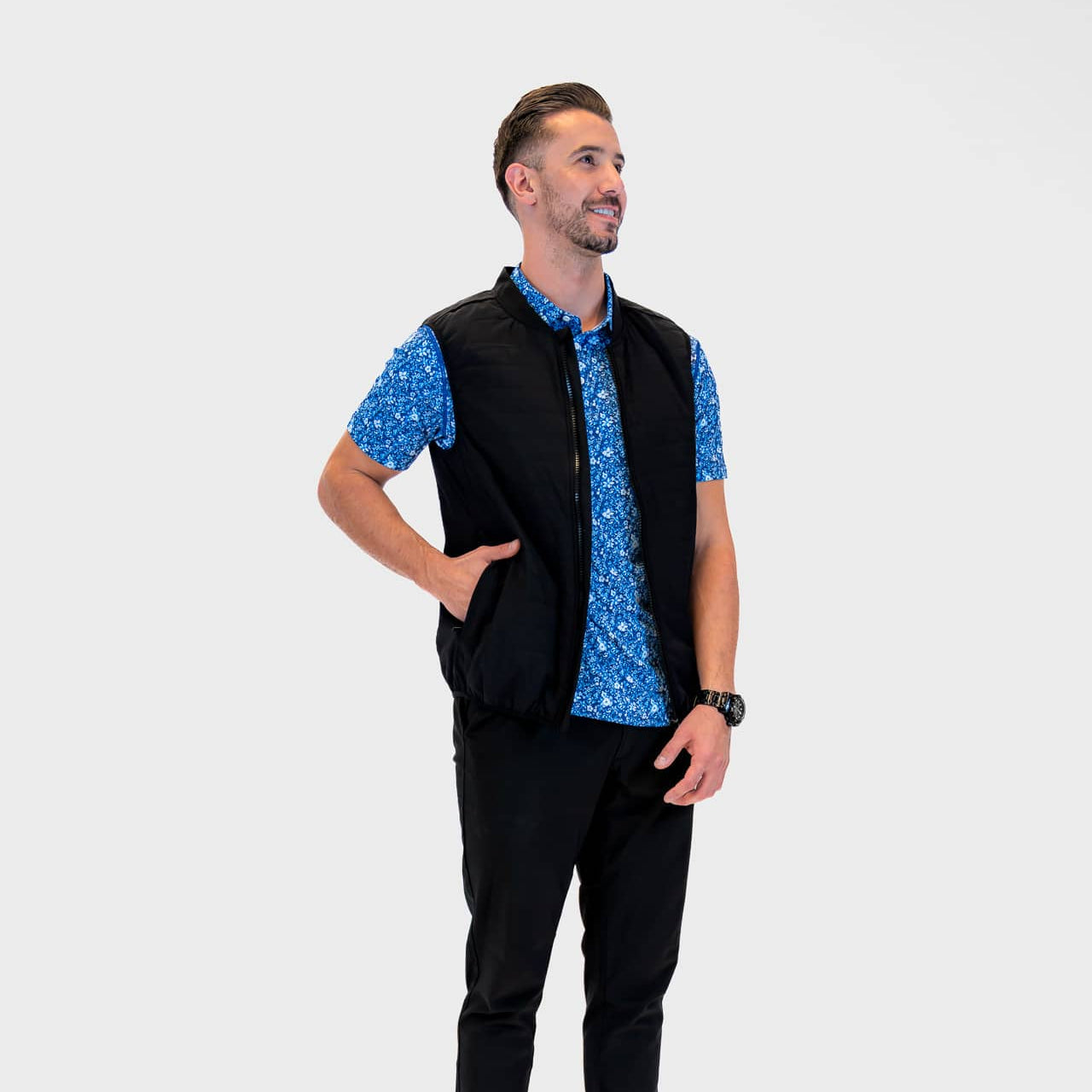
Layer, not uniform
Kevin Vest, Black
A black vest. For an agent who is in and out of a car all day, that is the layer that does the most work: it goes on over the polo for a walkthrough, comes off in the driver's seat, keeps the arms free for a lockbox and a sign rider.
$78
Unisex, mixed roster
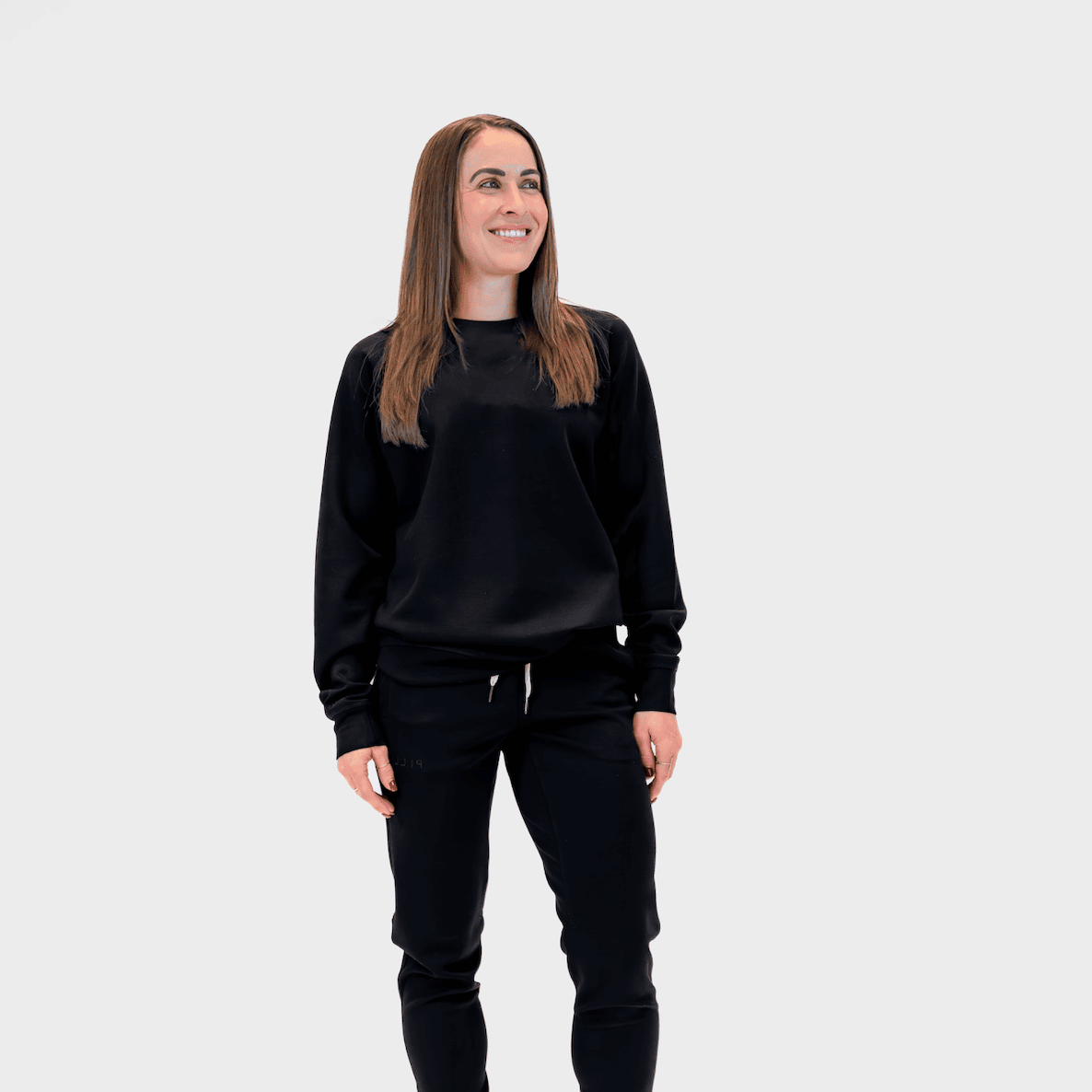
Alec Crew, Black
A unisex crewneck sweatshirt in black. Unisex matters on a brokerage roster, because you are specifying one piece for a group you did not hire and cannot survey, and a single cut in a full size run is the version that actually ships to everybody. This is the office piece, the showing day piece, and the one that takes a small embroidered mark without ceremony.
$85
Polo and vest, one click
The David Polo in Navy with the Kevin Vest in Black is the pair most agents actually reach for, and it is the kit worth sampling before you commit a program to it. Together they are $154.00, which clears the $75 free shipping threshold. Pick a size and both pieces land in the bag.
Sizes below are the five the vest is made in.
Refusals
The durability numbers are withheld by us until a proof is approved.
Answer first: you will not get a performance figure out of us before there is a physical proof of your garment with your artwork on it. Four things get asked for on nearly every brokerage call, and all four get the same answer.
- A wash cycle count We will not tell you how many washes the decoration holds. The honest version of that number comes from testing your decoration on your garment, and until the proof exists there is nothing to test.
- A colorfastness grade Dye behavior is specific to the fabric and the shade in front of us. Quoting a grade for a colorway nobody has produced yet is a guess with a decimal point attached to it.
- An abrasion result Abrasion performance depends on construction, and a brokerage program that layers a vest over a polo puts wear in places a generic figure never accounted for. We would rather you see the sample.
- A thread durability score Thread behavior changes with the artwork, the density and the ground it sits on. A score pulled from a different job tells you about that job.
The reason is the same in all four cases. Any number given before a proof exists was measured on a different garment, and handing it to you would be dressing up somebody else's result as yours.
The clocks
The date is answered by one of two clocks.
Answer first: there is no single turnaround number, and anyone who gives you one is not asking which product you are buying. There are two clocks and you have to say which product the number belongs to.
The first clock covers logo decoration applied to a garment that already exists. That runs about 7 to 10 business days from proof approval, and it is the right answer whenever your date is inside six weeks. If you have a brokerage kickoff, a new agent class or a listing event on the calendar, this is the route, and it is the one our decoration applied to garments we already stock page is built around. The clock starts when the proof is approved, not when the artwork is emailed.
The second clock is a different product entirely. A garment developed from the fabric up runs about 45 days door to door, with production alone taking 30 to 35 of those days. That is the path for a brokerage that wants its own fabric, its own color and its own construction rather than a mark on a stock piece, and the detail of it sits on our apparel developed from yarn and pattern page. Start that one against a season, not against an event.
The program
The program is carried by reorders rather than by a single purchase order.
Answer first: approve one proof, lock the spec, and let new agents trigger reorders against it. That is what a brokerage apparel program is, and it is a different object from an order.
Once the spec is locked, the range of what can hang off it is wide. Custom fabric woven or knit to spec and dyed to an exact color. All over print from original repeat patterns. Embroidery including chest crests, sleeve hits, chenille and 3D puff. Applied graphics in reflective, tonal and metallic heat transfer. Private label neck tags, trim and detail work, headwear, and packaging with branded insert cards and name level kitting, which is the piece brokerages tend to want once they realize a new agent kit can arrive with a name on the box.
We have built apparel programs for AO, the WM Phoenix Open and Progressive Roofing. Different buyers, same structure: one approved spec, repeat production against it.
Two neighboring verticals are worth reading if you want to see the employee version of the same problem. Our write up on golf club staff uniform apparel covers a roster that does close, and the one on front desk and valet polos in hospitality covers what happens when the employer pays for every piece. Both are useful precisely because a brokerage is neither.
Margin note
Name level kitting is the detail that gets a contractor to open the box on the first day instead of the third.
Lock the spec in writing. The person who approved it will not be the person reordering in two years.
Questions
These questions are asked by brokers before the first proof is approved.
How large should the brokerage logo be if the agent has her own?
Smaller than your instinct says. A small, clean mark holds up next to a second mark, and a large one competes with it. Reduce the artwork to shapes that survive at size, and drop fine taglines and hairline type before they become the first casualty.
Does a logo with a solid filled background box cost more to embroider?
Yes. A solid filled area drives a stitch count up more than anything else, ahead of size, outlines and drop shadows. It is also the least forgiving element to place beside a second mark, so it is worth redrawing before the proof stage rather than after.
How long does logo embroidery on a stock garment take?
About 7 to 10 business days from proof approval. That is the answer whenever your date is inside six weeks. The clock starts at proof approval, not when artwork is sent.
How long does a garment built from the fabric up take?
About 45 days door to door, with production alone running 30 to 35 days. That path is for a brokerage specifying its own fabric, color and construction, and it should be started against a season rather than an event.
How many pieces should we order if the roster keeps changing?
Order light on the first run and keep the reorder path open. The quantity is the short decision. Spec a stock garment you can reorder in the same colorway for years, approve the proof once, and let new agent onboarding trigger the reorders.
Our agents are independent contractors. Does that change the order?
It changes who approves the purchase. When the agent pays for any part of it, the garment is being bought twice and the second buyer can decline, which is the argument for spending on the piece rather than on the size of the mark. Whether an arrangement makes someone a contractor or an employee is a question for your own counsel.
Will you give us a wash test or colorfastness number before we order?
No, not before a proof is approved. Any number given before a proof exists was measured on a different garment, and handing it over would be dressing up somebody else's result as yours.
Although the roster will look different by the time the boxes arrive.
Send us the brokerage artwork and the agent artwork together, and we will tell you what the two marks do to each other at size before anything is produced. Then we spec the garment for reorders rather than for one headcount.
