


Embroidery or Print on Company Polos: How to Pick a Decoration Method
PILLAR / Corporate Programs
Embroidery is the right call for most company polos. Thread on a smooth knit reads as a uniform instead of a giveaway, it outlives the wash cycle that destroys a cheap transfer, and on stock polos it runs about 14 days from artwork approval to a packed box.
The mistake is picking the logo treatment before picking the shirt. Decoration is a fabric decision first. A dense needle path wants a smooth, stable face. A heat applied graphic wants a fabric that can take a press without glazing. An all over print is not applied to a finished polo at all, it is printed into the panels before anything is cut and sewn, which means it belongs to a completely different production clock. Choose the garment and the method together or you end up with a beautiful logo on a shirt nobody wants to wear twice.
Everything below assumes you already know your headcount, your date and roughly what you want to spend. If sizing is still open, fix that first with our guide on how to size a company polo order, because the size breakdown changes what is realistic on a short calendar.
The short answer
If your date is inside six weeks, you are embroidering or heat pressing a stock polo. There is no third option that ends well. If your date is more than 60 days out and the shirt is meant to represent the brand rather than the event, you have room for a full custom build with all over print, custom fabric and your own neck label.
Embroidery is the default. Applied graphics are the answer when the art is too fine, too wide or too detailed for a needle. All over print is the answer when the shirt itself is the marketing. Private label is the answer when you do not want anyone else's brand inside the collar.
Embroidery: the default for anything worn after the event
Embroidery wins on longevity, and longevity is the only metric that matters for a company polo. Thread is part of the garment rather than a layer sitting on it, so it does not crack, peel or go milky after a season of washes. It also carries authority. A stitched left chest crest is what people expect on a uniform, and expectations are worth respecting when the shirt is representing a company in front of clients.
The ground fabric decides how good the stitch looks. A smooth face knit gives the needle a flat, stable surface and keeps the edges of the letterforms crisp. A heavily textured fabric fights the thread and small type sinks into the surface. This is why we point most corporate programs at the David Polo for embroidery. The nylon and spandex blend has a smooth face, it holds its shape under a hoop, and it is pre shrunk so the logo does not distort after the first wash.
PILLAR runs more than a flat left chest. Chest crests, sleeve hits, chenille for a heavier collegiate look and 3D puff for a raised logo are all on the table. Puff and chenille read well on a cap or a heavier knit. On a lightweight performance polo, a clean flat stitch almost always looks more expensive.
Where embroidery breaks down is fine detail. Hairline type, gradients, a five color mark with overlapping shapes and anything under about a quarter inch of stroke weight will fill in and turn to mush. If your logo has a tagline set in 6 point type, either drop the tagline for the stitched version or move to an applied graphic.
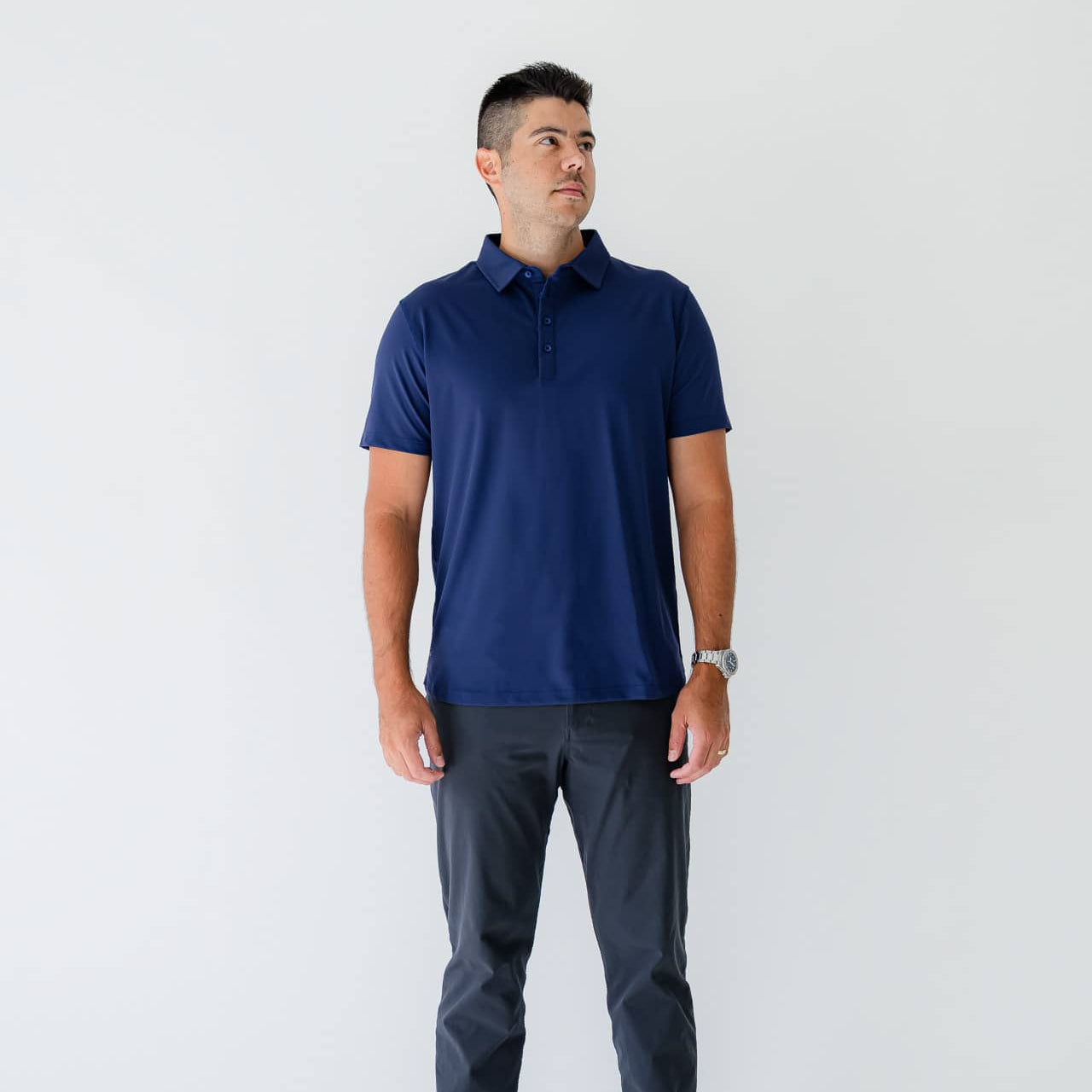
The embroidery ground
David Polo, Navy
$76
Navy is the safest corporate base there is. It reads formal without reading corporate stiff, and it holds a white or metallic thread crest cleanly. The smooth face is the reason this one goes under the needle first.
84 percent nylon, 16 percent spandex. Four way stretch, sweat wicking, classic athletic fit, firm collar, U cut hem, pre shrunk.
View the David Polo in Navy or browse the full polo collection.
Applied graphics: when the art is too fine for a needle
Applied graphics are the answer whenever the logo has detail thread cannot hold. A heat applied film reproduces hairlines, tight registration and exact color, and it adds almost no weight or stiffness to the panel. On a stretch performance fabric that matters, because a dense embroidered block can create a rigid patch in a shirt that is supposed to move.
The finishes are where this method earns its place. Reflective reads flat and quiet in daylight and lights up under a camera flash or headlights, which is why it works so well for event staff and outdoor crews. Tonal is the most underrated option in corporate apparel: same color as the shirt, visible only when the light catches it, so the garment functions as a nice polo first and a branded polo second. Metallic gives you a gold or silver mark that embroidery cannot match for shine.
The tradeoff is honest. An applied graphic sits on the surface. Treated correctly it lasts a long time. Thrown in a hot dryer every week for two years, it will not look like thread does at the same age. It also wants the right base fabric and a correct press, which is a production question, not a shopping question.
Applied graphics run on the same rough clock as embroidery when they go onto stock polos, about 14 days. Custom finishes and unusual film stock can push that. If your date sits near a holiday crunch, read the corporate holiday apparel order deadlines before you commit to anything with a custom finish.
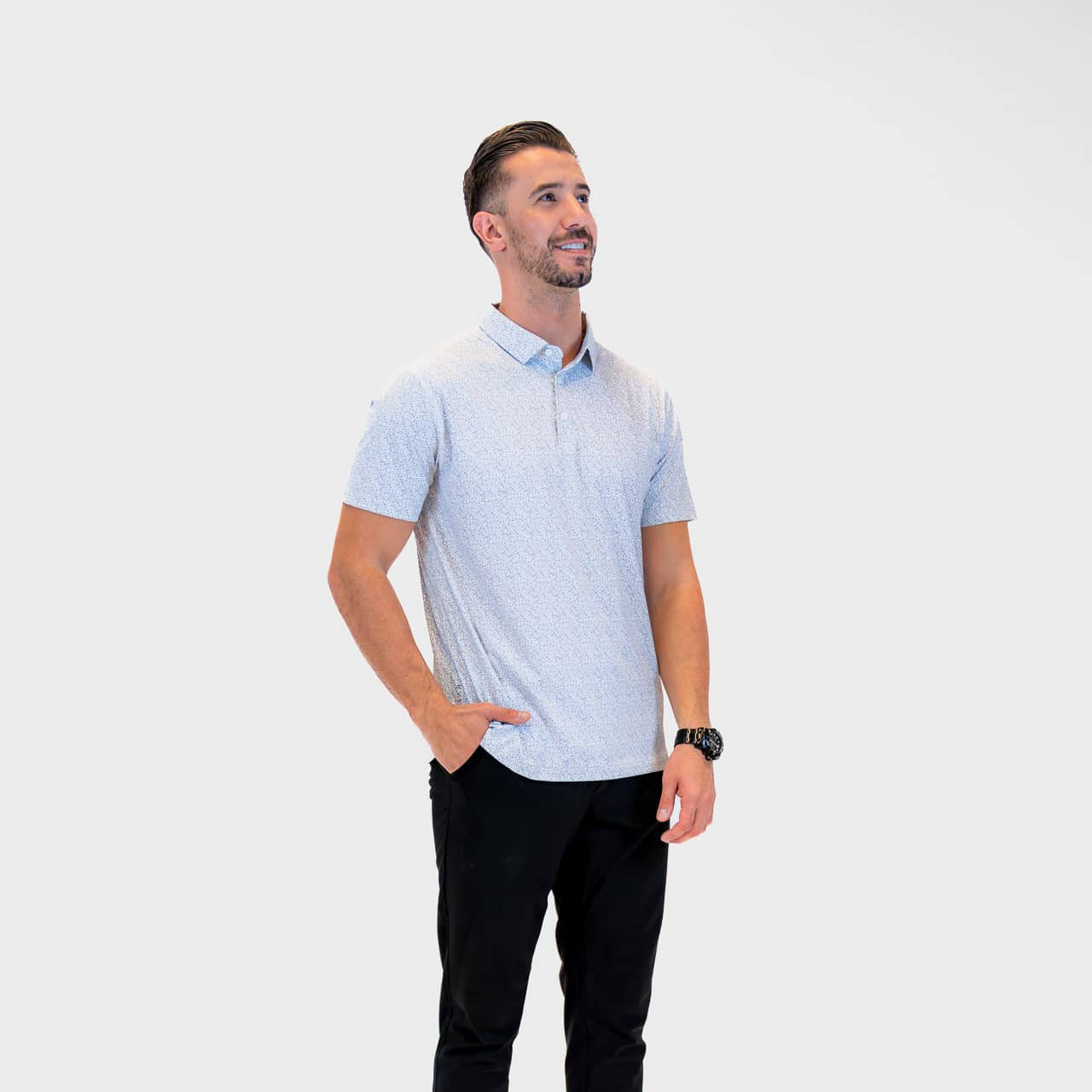
The one that carries a design
Steven Polo, Brew
$76
The textured hand gives a printed or applied graphic something to sit against, so the mark reads as part of the shirt instead of a sticker. Brew is the color to reach for when you want the program to look less like a uniform and more like something bought on purpose.
88 percent polyester, 12 percent spandex. Textured feel, four way stretch, sweat wicking, classic athletic fit, U cut hem, pre shrunk.
All over print: when the shirt is the marketing
All over print is for the moment the garment stops being a carrier for a logo and becomes the message. An original repeat pattern is printed across the panels before the shirt is cut and sewn, so the design runs edge to edge, crosses seams and covers the whole body. Nothing else in apparel gets read from fifty yards away the way this does.
This is how you make a hospitality team, a tournament crew or a client trip instantly identifiable. PILLAR builds these patterns from scratch, which means a repeat can be drawn from your brand marks, your colors, a course map, a skyline or an anniversary year. It is a design project, not a decoration order.
The cost is the calendar. All over print is a full custom build. The fabric is woven or knit to spec, dyed and printed, then cut, sewn, labeled and finished. About 45 days door to door, with production alone at 30 to 35 days. There is a real minimum attached and there is an approval cycle for strike offs. If your event is in three weeks, this is next year's program, not this one's.
Embroidery buys longevity. Print buys expression. The wrong choice is the one that does not match how the shirt will actually get worn.
PILLAR Corporate ProgramsPrivate label and trim: when you do not want another brand in the collar
Private label is the move when the shirt needs to belong to you completely. That means your own woven neck tag instead of ours, your own care label, custom trim, contrast stitching, a zipper pull or collar tape that carries your color, and packaging with branded insert cards. On bigger programs we also kit at the name level, so each box arrives labeled for the person it belongs to.
Companies choose this for three situations. They are reselling the shirt through a pro shop or a merchandise stand. They are building a recurring uniform program and want it to look proprietary. Or they are a brand whose whole point is that nothing else appears on the garment. PILLAR has run this kind of work for AO, the WM Phoenix Open and Progressive Roofing, where the apparel is part of the brand rather than a souvenir of it.
Private label sits on the same 45 day clock as all over print because it is the same build. If you want the full picture of what a ground up program looks like, we broke it down in our guide to custom corporate polos and branded company apparel.
The four methods side by side
Read this by your constraint. If the constraint is the date, look at the last column first. If the constraint is what the shirt has to do, start with best for.
| Method | What it is | Best for | What it costs you | Lead time |
|---|---|---|---|---|
| Embroidery | Thread stitched into the fabric. Left chest crests, sleeve hits, chenille and 3D puff. | Uniforms, client gifts, sales teams, anything worn long after the event. | A digitizing setup step. Fine type and hairline detail fill in. Dense blocks stiffen a stretch panel. | About 14 days on stock polos. |
| Applied graphics | Heat applied film pressed to the surface in reflective, tonal or metallic finishes. | Detailed marks, sponsor rows, quiet tonal branding, outdoor and evening crews. | It lives on the surface, so care matters. Needs the right base fabric and a correct press. | About 14 days on stock polos, longer for custom finishes. |
| All over print | An original repeat pattern printed into the panels before the garment is cut and sewn. | Event shirts, hospitality staff, tournament crews, anything meant to be seen from a distance. | A full custom build with a real minimum and a pattern approval cycle. | About 45 days door to door. |
| Private label and trim | Custom fabric knit or woven to spec and dyed to your exact color, your neck tag, your trim, branded packaging and name level kitting. | Resale programs, recurring uniforms, brands that want no other logo on the garment. | The longest runway and the most decisions to make up front. | About 45 days door to door, production is 30 to 35 of those. |
Decorating outerwear, and why the crest changes
A quarter zip takes a smaller, higher chest crest than a polo does. The zipper placket splits the chest, so a mark centered the way you would center it on a polo ends up crowding the seam or sitting too low under an open collar. Move it up and tighten it. Same logo, different scale, and it is worth approving that placement separately rather than assuming the polo file works everywhere.
Outerwear is also where embroidery earns its cost most clearly. A quarter zip is the piece people keep. It goes in the car, on the flight, over a shirt in a cold conference room. Thread is what survives that life. If you are building a two piece program, put the embroidered crest on the layer and keep the polo underneath simple.
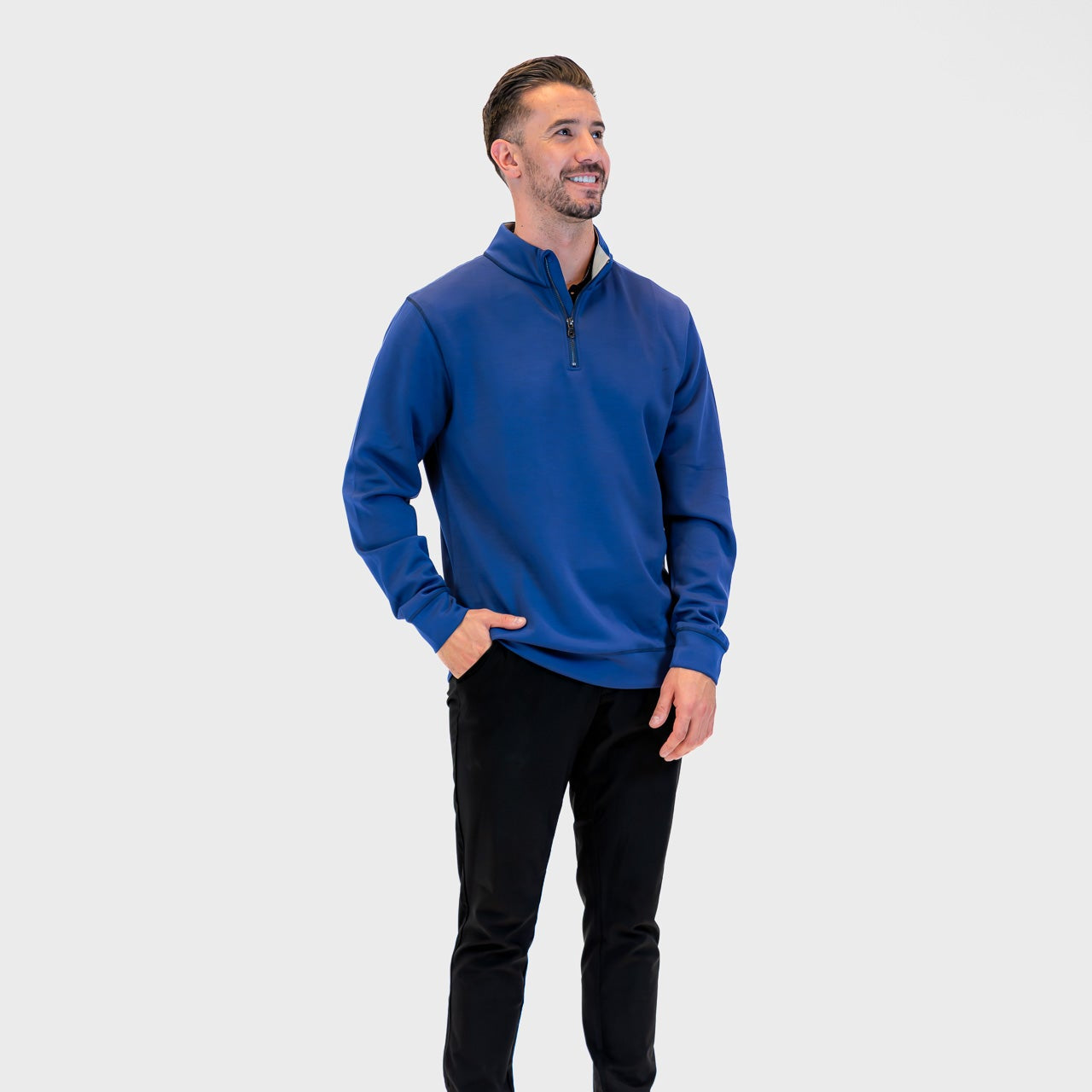
The layer that gets kept
Alec Quarter Zip, Blue
$98
The piece to put the stitched crest on. A quarter zip is the item that outlives the program, which makes it the highest return spot in the whole order for embroidery.
Available Small through XXL. Pair it with a polo underneath for a two piece team kit.
Two clocks, and knowing which one you are on
There is no single lead time for branded apparel, and anyone who gives you one number is quoting the wrong product. There are two clocks.
The first is logo decoration on stock polos, about 14 days. That covers artwork approval, digitizing the file for the machine, running the embroidery or the press, and packing. It is the answer whenever your date is inside six weeks, and it is the answer for most corporate orders placed in a normal year.
The second is a full custom build from the fabric up, about 45 days door to door. Custom fabric, print, trim, private label, finishing and freight, with production alone at 30 to 35 days. All over print lives here. Private label lives here. Custom color matched fabric lives here. That clock does not compress because you asked nicely, so the only way to buy it is to start earlier.
The practical read: if you are inside six weeks, stop shopping for custom fabric and start choosing a color and a placement. If you are more than 60 days out and you want the shirt to carry the brand rather than just wear it, use the runway.
Picking a color, and why white behaves differently
White is the highest contrast ground you can decorate and the most exposed. Every stitch shows, every edge on an applied graphic shows, and any registration issue shows. That is an argument for white when your logo is clean and you want it loud, and an argument against it when your mark is complicated or your crew works outdoors in the dirt.
A useful rule for mixed orders: pick one dark and one light, then run the same crest on both. It gives people a choice without forcing you to approve two separate artwork files, and it photographs better as a group than a single color wall does.
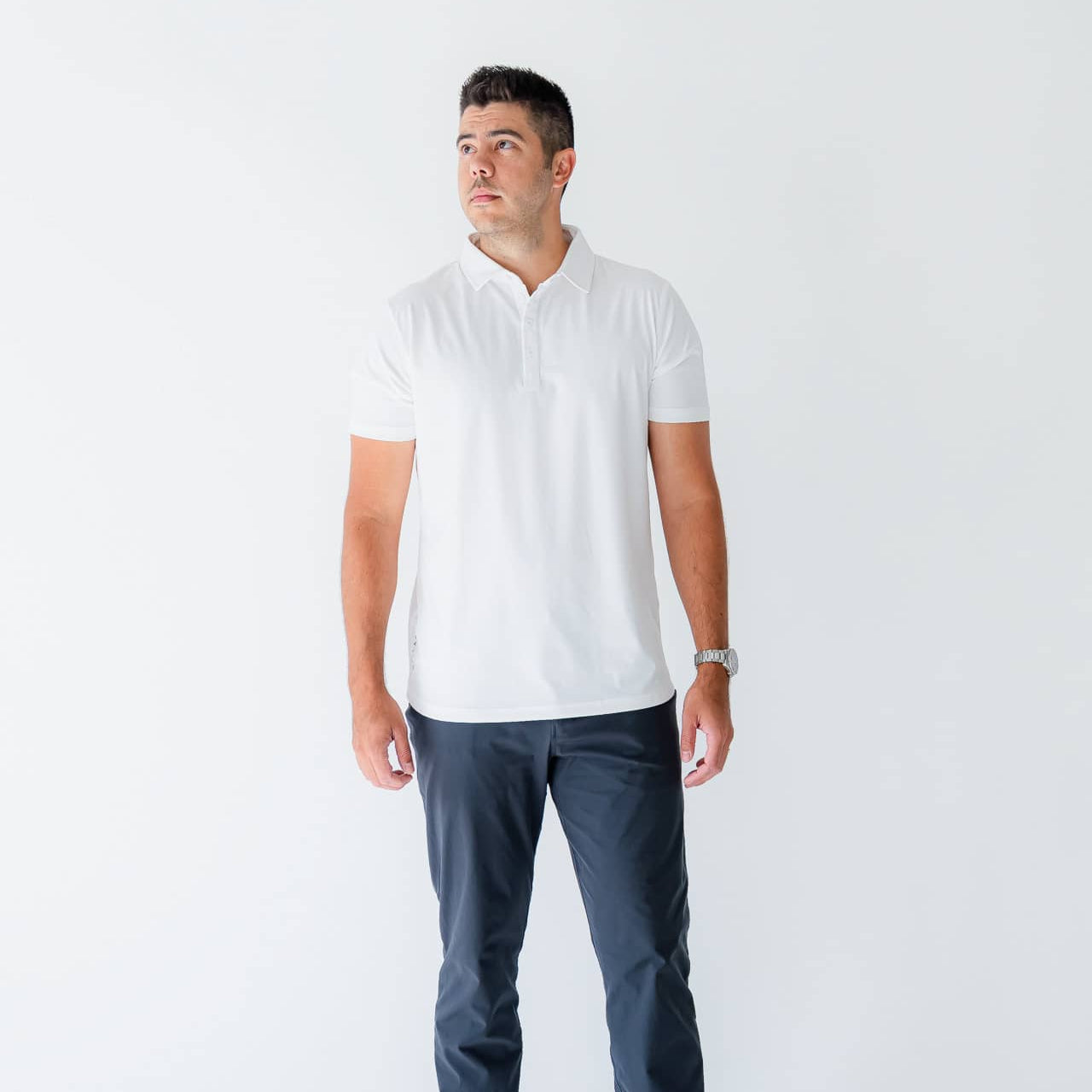
Maximum contrast
David Polo, White
$76
The loudest ground in the lineup. A dark stitched crest on white is the cleanest way to make a logo the first thing anyone sees, and it pairs cleanly with Navy as the second color in a two color program.
84 percent nylon, 16 percent spandex. Four way stretch, sweat wicking, classic athletic fit, firm collar, U cut hem, pre shrunk.
View the David Polo in White or compare it against the Black colorway.
How to brief the decoration so it does not cost you a week
Send vector artwork and the exact placement, and the 14 day clock starts on day one instead of day five. Most delays in a stock polo order are artwork delays, not production delays. A logo pulled off a website at 400 pixels wide cannot be digitized without a redraw, and a redraw is a conversation, and a conversation is three days.
What to send with the order: vector files in EPS, AI or SVG, your brand colors as thread or film references if you have them, the placement you want stated in plain terms (left chest, left sleeve, back yoke), and the finished width you want in inches. If you do not know the width, say so. Left chest crests generally live between 2.5 and 3.5 inches wide, and we will tell you which end of that your mark wants.
Then confirm one thing before anything runs: a digital proof or a sew out. Approving art on a screen is fine for an applied graphic. For a first run of embroidery on a new logo, a physical sew out is worth the day it costs, because thread does things on fabric that a screen will not show you.
Questions we get from companies buying polos
Embroidery or print on company polos, which one lasts longer?
Embroidery. Thread is stitched into the fabric rather than layered on top of it, so it does not crack or peel. A heat applied graphic lasts well with correct care, but on a shirt worn and washed weekly for years, thread outlives film.
How long does embroidery on company polos take?
About 14 days on stock polos, door to door. That covers artwork approval, digitizing, embroidery and packing. Send vector art with the order and the clock starts immediately.
What is the lead time for fully custom polos with all over print?
About 45 days door to door. Production alone is 30 to 35 days, plus custom fabric, print, trim, private label, finishing and freight. It is a different product from a decorated stock polo and it runs on a different clock.
Will embroidery work on a stretch performance polo?
Yes, on the right ground. A smooth face knit like the David Polo holds a stitch cleanly and stays stable under the hoop. Keep the crest to a reasonable size so a dense block does not stiffen a panel that is supposed to move.
How small can a logo get before embroidery stops working?
Once stroke weight drops under roughly a quarter inch, fine detail starts filling in. Taglines in small type are the usual casualty. Drop the tagline for the stitched version or move that mark to an applied graphic.
Can we mix decoration methods across one order?
Yes. A common build is an embroidered crest on the quarter zip and a tonal applied graphic on the polos, so the layer carries the formal mark and the shirt stays quiet. Tell us the split when you send artwork.
Start the program
Tell us the event, the headcount and the date
Those three things tell us which clock you are on and which decoration method actually fits it. We will come back with a recommendation, a placement and a real timeline, not a guess.
Contact PILLAR