

What a Golf Polo Should Cost
Sixty to ninety dollars.
That band is where a performance golf polo stops cutting corners and has not yet started charging you for a name. PILLAR makes the David Polo and the Steven Polo, and both are $76, so you know whose side this is written from before you read another line. The method below works against PILLAR exactly as well as it works against anyone else, which is the only reason it is worth publishing.
The short answer
Pay sixty to ninety dollars for a performance golf polo. The PILLAR David Polo and the PILLAR Steven Polo both sit at $76, in the middle of that band.
Price alone is a weak signal. Two polos at the same number can be built differently, and two polos a hundred dollars apart can be cut from the same cloth. The strong signal is how many construction lines a brand is willing to publish, because a published spec is a spec the brand has decided to be held to. Four of those lines change what the shirt actually does, and you can check all four from a product page before you spend anything.
Where the money goes
The price on the tag does not tell you where the money went.
It tells you what the brand decided to charge, and that is a different fact. A number is set by positioning, by wholesale math and by what the brand thinks you will pay. None of those three touch the shirt. The spec sheet does, and it is the part most brands keep short on purpose, because every line printed there is a line a customer can hold them to later.
So stop reading the price as a quality claim and start counting disclosures. Here are the four that matter.
Line one
The blend and the stretch direction
Percentages are the easy half. The real tell is whether the brand says four way stretch or says nothing about direction at all. A blend with no stretch claim is half a spec.
Line two
A collar claim, or none
The collar is the first part of a polo to fail, the part a dress code is written about, and the cheapest place to save money. A soft unsupported collar photographs the same as a built one.
Line three
A named hem shape
A hem shape is a claim about whether the shirt is meant to be worn out. A brand that names no shape has not decided, and you will be the one who finds out.
Line four
Pre-shrunk, and the care line
Pre-shrunk is a claim a brand has to stand behind, because a shirt that moves in the wash becomes a return. Read the care line underneath it with the same attention.
Of everything printed on the tag, the price is the only line that specifies nothing.
Line one, the fabric
A blend without a stretch direction is not a finished spec.
Four way stretch is the claim to look for, and a brand that lists only percentages has not made it. Four way means the fabric gives across the shirt and up and down it, which is the direction a golf swing actually loads a shoulder. Two way gives in one direction, and on a backswing you will find out which one.
PILLAR publishes the blend and the direction on both polos. The David Polo is 84% nylon and 16% spandex with four-way stretch and sweat-wicking. The Steven Polo is 88% polyester and 12% spandex with four-way stretch, cooling sweat-wicking and a textured feel. Those are different fabrics doing a similar job, which is the point: the number on the tag is identical and the cloth is not. If you want the two set against the wider market, the multi brand comparison lives in its own post, and this one stays out of it.
Line two, the collar
A collar does not fail slowly.
It goes soft, and then it is finished, and a polo with a dead collar is a polo you stop wearing to places that asked for one. This is the single disclosure most worth hunting for, because it is the easiest line to leave off a product page and the hardest thing to judge from a photograph.
So here is PILLAR's own position, stated plainly rather than buried. PILLAR publishes a firm collar that holds its shape on the David Polo, and PILLAR publishes no collar claim at all on the Steven Polo. That is the honest state of it, and the right way to read it is as an absence of a claim rather than a claim about an absence.
The one with the published collar
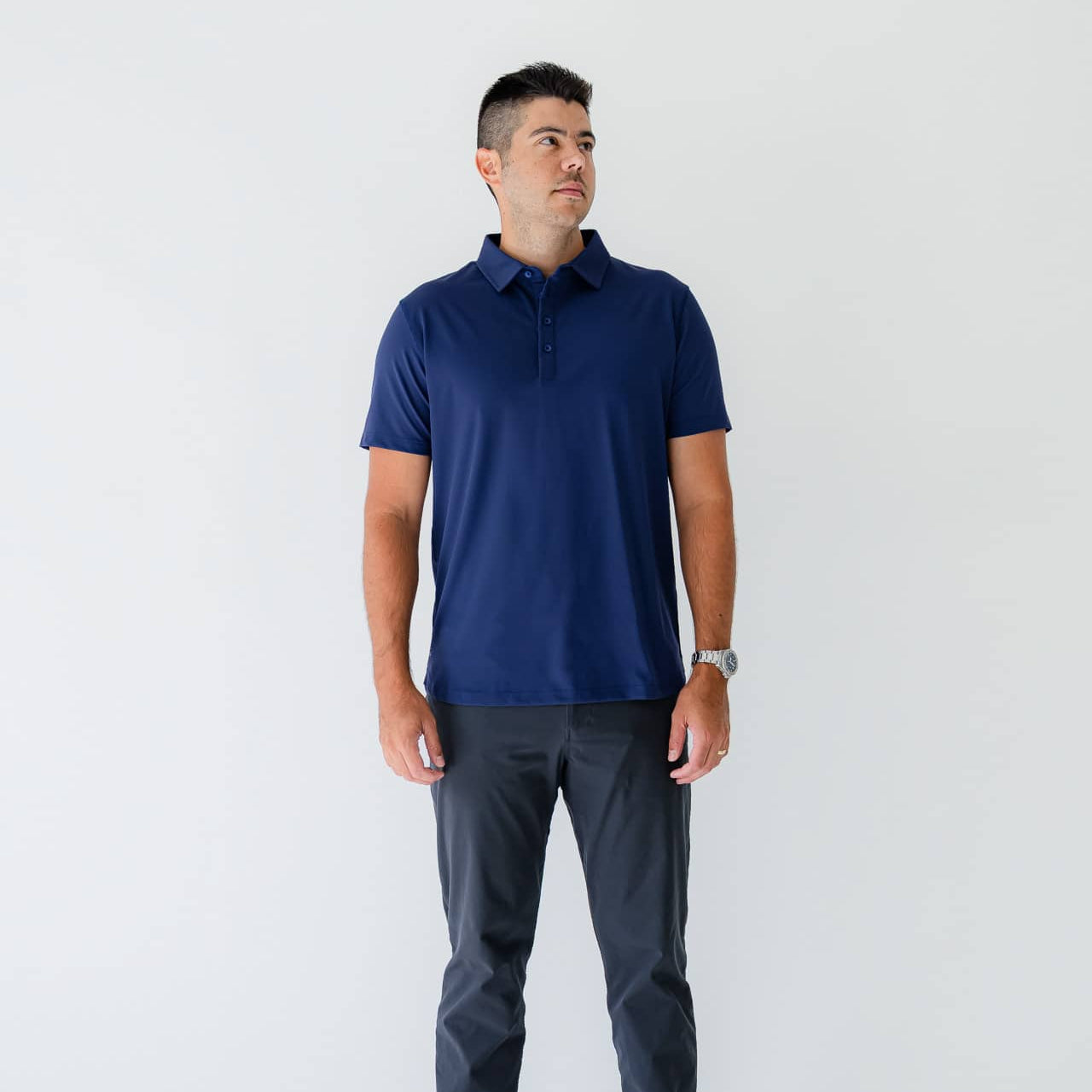
PILLAR David Polo, Navy
$76
Four out of four published lines. A firm collar that holds its shape, four-way stretch, a U-cut hem and a pre-shrunk fabric, at the middle of the sixty to ninety band.
84% nylon, 16% spandex. Sweat-wicking, classic athletic fit, easy care. Care: machine wash cold, tumble dry low.
See the David Polo in NavyLine three, the hem
A hem nobody names is not a shape.
If a brand will not tell you the hem shape, it has not decided what the shirt is for. PILLAR names a U-cut hem on both the David and the Steven, and naming it is the commitment. A named shape says somebody drew the pattern with an intention and signed their name to it. Silence says the hem is whatever the factory block already had.
That is as far as this post goes on hems, because where a hem should sit on you and whether you tuck it is an argument another post already settled. The same goes for choosing a print over a solid and for what belongs under a quarter zip.
Line four, the wash
A long care label is not a worse shirt.
It is usually a more honest one. Pre-shrunk comes first, because a shirt that moves in the wash turns into a return, and a brand that prints pre-shrunk has accepted that risk in writing. Both PILLAR polos are pre-shrunk. Then read what follows it.
The David Polo says machine wash cold, tumble dry low. The Steven Polo says machine wash cold, tumble dry low, do not bleach, do not iron, do not dry clean. The longer line is not a weaker shirt. It is a brand telling you up front what the fabric will not tolerate, instead of letting you discover it on a Sunday night. A care label with almost nothing on it is not confidence, it is an absence of instruction.
The one with the longer care line
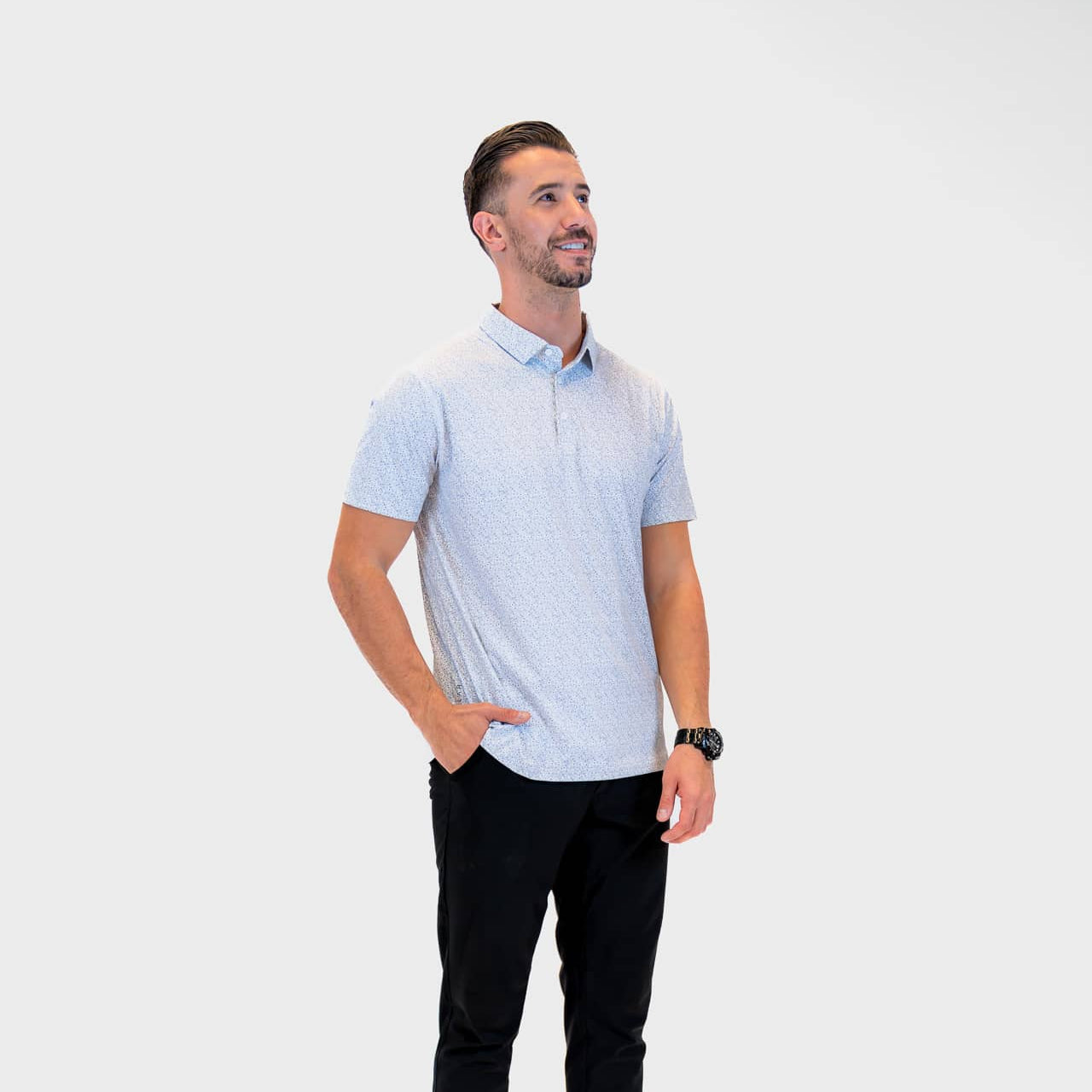
PILLAR Steven Polo, Brew
$76
Brew is a soft gray base with a subtle all over print, the quietest of the Steven prints.
88% polyester, 12% spandex. Cooling sweat-wicking, textured feel, four-way stretch, classic athletic fit, U-cut hem, pre-shrunk, easy care. Care: machine wash cold, tumble dry low, do not bleach, do not iron, do not dry clean.
Steven Polo, Brew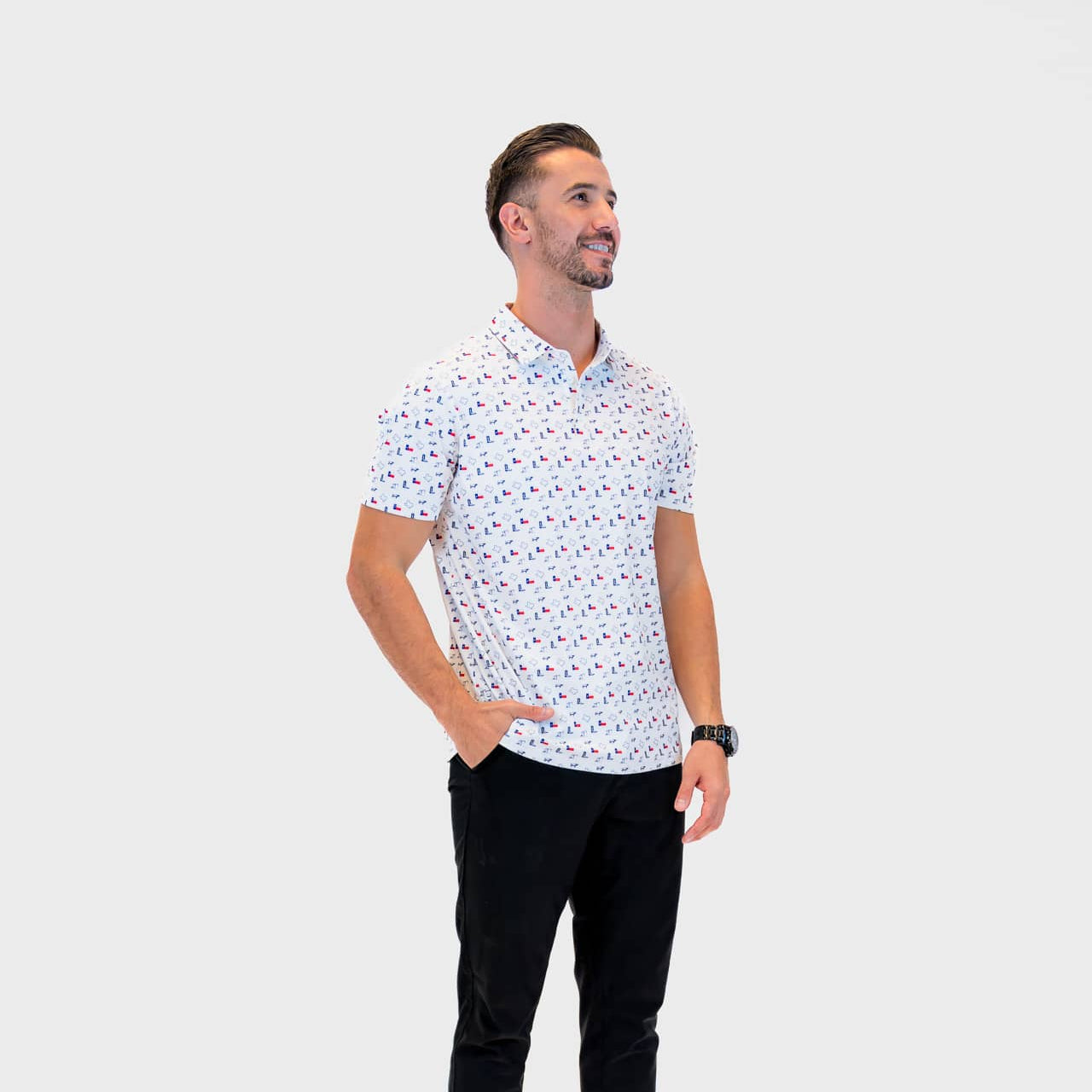
PILLAR Steven Polo, Texas
$76
Texas is a higher contrast print with a small motif. Same fabric and same published lines as the Brew, at the same number.
88% polyester, 12% spandex. Cooling sweat-wicking, textured feel, four-way stretch, classic athletic fit, U-cut hem, pre-shrunk, easy care. Care: machine wash cold, tumble dry low, do not bleach, do not iron, do not dry clean.
Steven Polo, TexasOne click, both fabrics
David Polo Navy and Steven Polo Brew, $152.00
The nylon build and the polyester build in the same bag, so you can judge the two against each other on your own back rather than on a product page. $152.00 clears the $75 free shipping threshold. Pick a size and both go in together.
The honest contradiction
The fifty dollar ceiling does not survive the spec sheet.
One of the larger golf equipment review sites has argued in print that no mass produced synthetic golf polo should cost $100, and that most should not cost more than $50. Half of that is correct and the half that is correct is the important half.
The top of the market is where the argument lands cleanly. There is no mechanism that makes a $120 synthetic polo twice the shirt a $60 one is. Past a point you are paying for a name on a chest, and the review position on that is fair and worth repeating.
The $50 ceiling is where it goes wrong, and the four lines above are the reason. A $35 catalog polo is a real shirt and it will play a round without embarrassing anybody. What it will not do is publish a collar claim or name a hem shape, because it was built to a price and those are the first two lines to go. You are not paying for worse cloth at $35. You are paying for a product page that commits to nothing.
What that means for PILLAR
Seventy six dollars does not get a free pass.
PILLAR charges $76, which sits above that ceiling, which means PILLAR owes you an answer rather than an adjective. The answer is the count. The David Polo publishes four out of four: blend with four-way stretch, a firm collar that holds its shape, a U-cut hem, pre-shrunk with a care line. The Steven Polo publishes three out of four, because there is no collar claim on it, and that is stated here rather than left for you to notice.
So run the count on anything you are about to buy. Four out of four is a shirt somebody specced. Zero out of four at any price is a label. That test costs nothing, it works on every brand including this one, and it is a far better predictor than the number on the tag. Browse the rest of the polo collection with it in hand, or read the separate post on polos that hide sweat if that is the next question.
Four out of four, in black
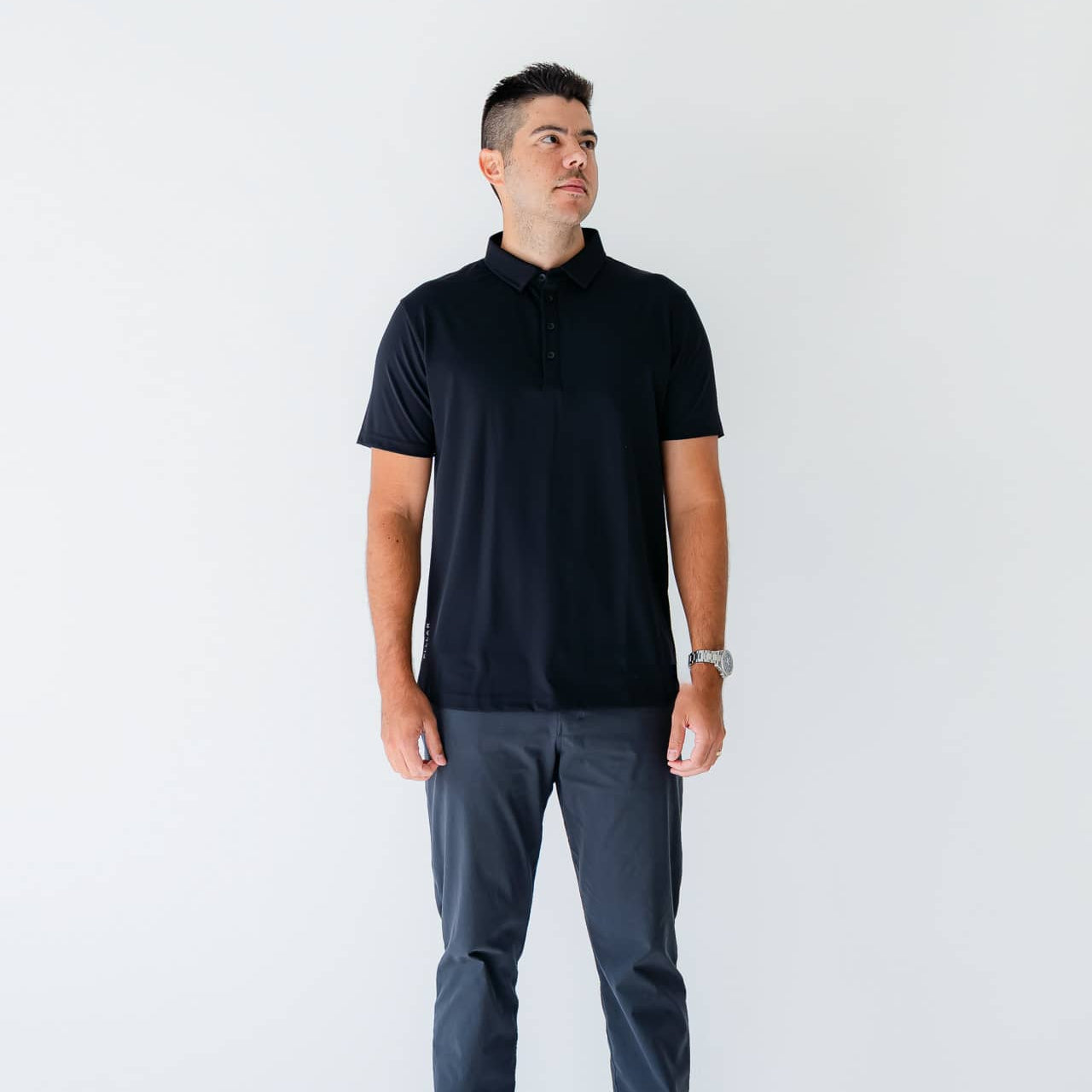
PILLAR David Polo, Black
$76
The same four published lines as the Navy, in the color that answers the most dress codes without being asked twice.
84% nylon, 16% spandex. Sweat-wicking, four-way stretch, firm collar that holds its shape, classic athletic fit, U-cut hem, pre-shrunk, easy care. Care: machine wash cold, tumble dry low.
View the David Polo in BlackCommon questions
These questions do not have complicated answers.
How much should a golf polo cost?
Sixty to ninety dollars for a performance polo. Below that band brands stop publishing the construction lines that matter, and above it you are usually paying for a name. The PILLAR David Polo and the PILLAR Steven Polo are both $76.
Are expensive golf polos worth it?
Past about ninety dollars, rarely. There is no mechanism that makes a $120 synthetic polo twice the shirt a $60 one is. Judge the published spec lines instead of the number on the tag.
What is the best golf polo under $80?
PILLAR sells two at $76, the David Polo and the Steven Polo. Both publish four-way stretch, a classic athletic fit, a U-cut hem and a pre-shrunk fabric, which is more than most product pages at that number will commit to.
Is a $35 catalog polo good enough for a round?
Yes, it will play a round. What it will not do is publish a collar claim or name a hem shape, because it was built to a price and those are the lines that go first.
What should I check before I buy a golf polo?
Four lines. Whether the brand names four way stretch and not just percentages, whether a collar claim exists at all, whether the hem shape is named, and whether the shirt is pre-shrunk plus what the care line actually says.
Does PILLAR publish a collar claim on both polos?
No. The David Polo publishes a firm collar that holds its shape. The Steven Polo publishes no collar claim at all, and that is stated here rather than left out.
What are PILLAR's shipping and return terms?
Free shipping on orders over $75 and thirty day returns on unworn items. The David Polo Navy and Steven Polo Brew pair is $152.00, which clears the threshold.
Run the count yourself
Specced in public, priced in the middle of the band.
Four published lines on the David Polo, three on the Steven Polo, $76 on both, and every one of them on the product page before you spend anything.
