

Branded Apparel for a Company Photo Shoot: What to Order and When
What you are ordering here is a photograph. The shirt is what makes it. Everything else in the frame is already settled for you: the people are who they are, the room is the room, and the photographer will light it the way they light things. The one variable you control is what everybody in the frame is wearing from the collar down, and on a team photo day that is most of the picture.
So treat the order the way you would treat a hire. You are choosing a garment that has to photograph well on one specific morning and then keep being worn for years by people who never thought about a camera at all. Those two jobs rarely fight, but when they do, the camera wins the morning and the wearer wins everything after it. The schedule is the part that catches people out, because the shoot date is the only date in the project that cannot move.
The short version
Count backward from the shoot date, and treat the proof approval rather than the ship date as your real deadline.
Logo embroidery or printing on stock garments takes 7 to 10 business days from proof approval. A garment built from the fabric up takes about 45 days door to door. Pick the product that fits the gap between today and the date on the calendar, then build every other date in the project backward from the shoot.
One fixed date sets every other date in the project
The date
The shoot date is the only date in this project that cannot move. A photographer is booked, a location is held, and calendars were cleared across the business to get everybody into one room at one time. Nothing else in the project enjoys that protection. The garment choice can slide, the logo file can arrive late, the proof can sit in somebody's inbox across a weekend, and a shipment can take an extra day. Every one of those slips eats into the same fixed gap.
That is why this schedule gets built from the right hand side. Start with the shoot date, subtract the production window for the product you actually chose, subtract a round for the proof, and the number you land on is the day the project really begins. Today is Thursday, October 29, 2026. A proof approved today puts decorated stock shirts in hand by Friday, November 13, 2026, counting 10 business days with weekends skipped. If the shoot is Tuesday, December 8, 2026, the proof has to be approved by Monday, November 23, 2026, and that count already steps around the Thanksgiving holiday on Thursday, November 26.
Notice where the deadline actually sits. It is not the ship date and it is not the morning the boxes land at reception. The proof clock sits in front of the production clock, which means the date you have to defend is the proof approval date. Production starts the day you approve the proof and not one hour before. Chase the approval, not the tracking number.
Four details the camera notices before anyone else does
The camera
A camera notices four things that an ordinary apparel order never stops to think about: a fine repeating pattern, a strong sheen, a loose or rumpled fit, and a logo that competes with a face. None of the four is a measurement. All four are judgment calls, so here is the judgment.
Fine repeating patterns are the first thing to drop. A tight check, a thin stripe or a small dense print can confuse a sensor and turn into a shimmer across the chest at the exact size a shirt occupies in a group photograph. Solid colors do not carry that risk, which is most of the reason company photographs end up in solid shirts.
Sheen is the second. A fabric with a hard shine throws light straight back at the lens and collects every highlight the photographer puts into the room. A matte or lightly textured surface gives that light somewhere to go, and it forgives a lighting setup you had no say in.
Fit is the third, and it is the one most often ignored on a bulk order. A shirt bought a size up to be safe reads as rumpled on camera, and a creased shoulder is far more visible in a photograph than it ever is in person. Order the size each person actually wears and let the garment sit where it was cut to sit.
The logo is the fourth. A mark placed high and large on the chest pulls the eye away from the face standing right beside it. A smaller left chest hit stays legible and stays out of the way. Placement is also a function of the garment rather than a free choice, which is the argument of our piece on how a garment's own surface decides where a mark can sit, and it is worth reading before you commit to a position.
Three boundaries, stated plainly, because they come up on every shoot. We do not publish how a given fabric behaves under a specific lighting setup, since that depends on the room and the lights rather than on the shirt. We will not promise that a screen color, a thread color and a photographed color read identically. And we publish no durability figure and no wash cycle figure for any garment on this page.
Two solid options that carry a left chest mark cleanly and photograph without argument.
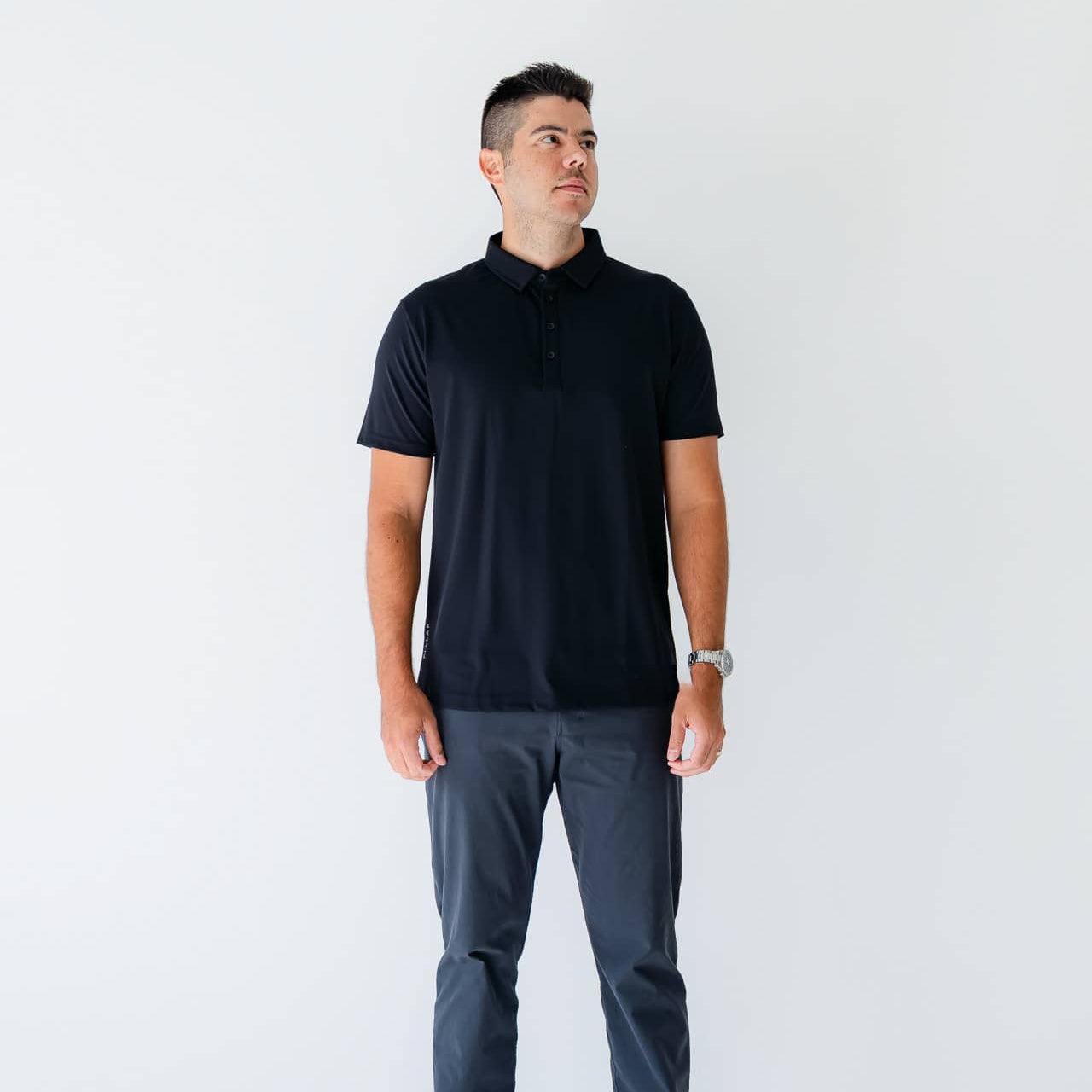
PILLAR David Polo, Black
$76
The solid staple on camera. Black keeps its identity across lighting setups better than almost anything else you can put a team in, and a left chest mark sits on it cleanly at any scale. See the David Polo in Black for the full detail.
84% nylon, 16% spandex, four way stretch, sweat wicking, classic athletic fit, firm collar that holds its shape, U cut hem, pre shrunk.
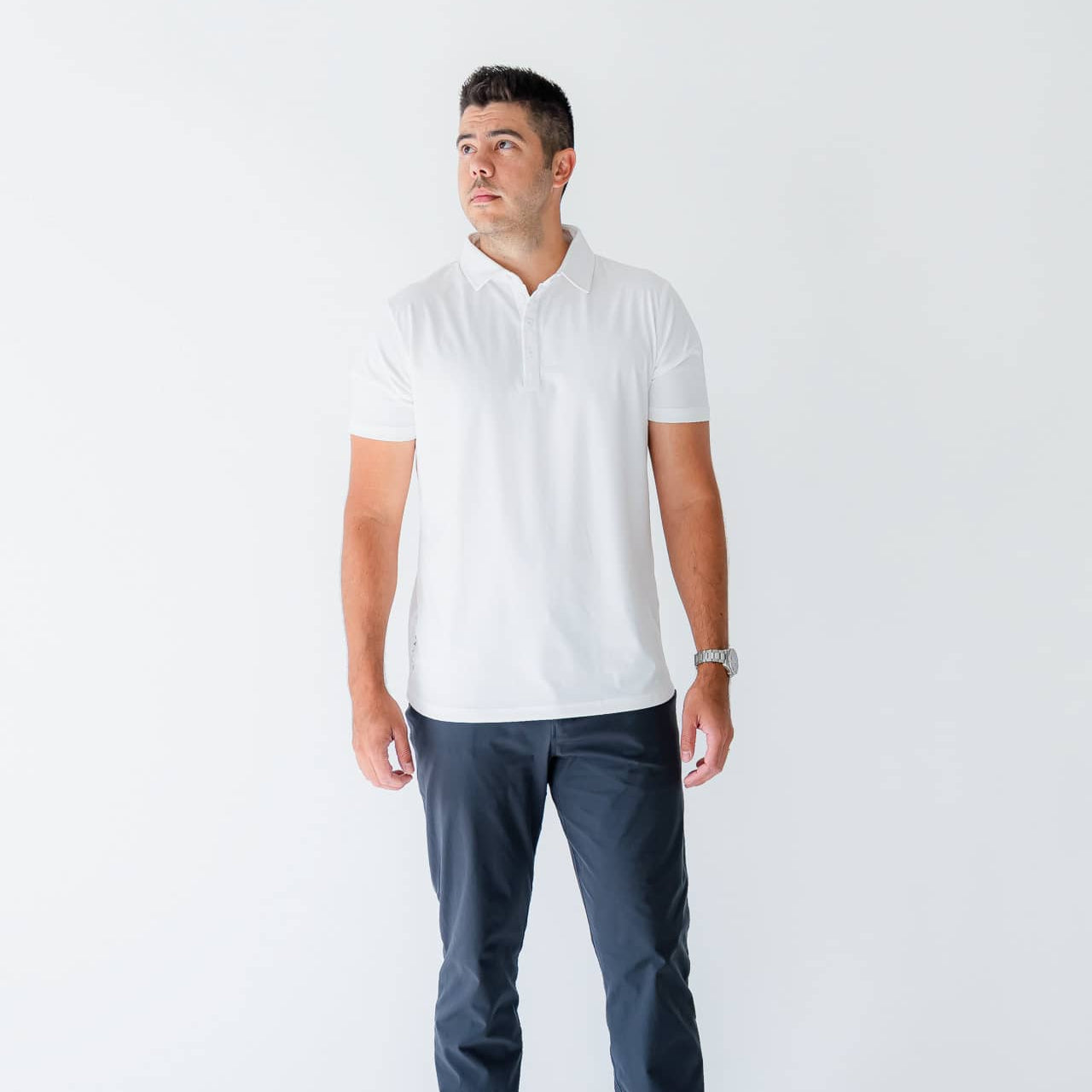
PILLAR David Polo, White
$76
The second look in the same fit. White gives the photographer a brighter frame without changing the silhouette, so a leadership group can be split across two colors and still read as one team. See the David Polo in White for the full detail.
84% nylon, 16% spandex, four way stretch, sweat wicking, classic athletic fit, firm collar that holds its shape, U cut hem, pre shrunk.
Ten shirts go in front of the lens, not ninety
The count
The headcount is not the roster. Only the people who will stand in front of the lens on that date need a shirt by that date, and that list is almost always far shorter and far more exact than the company. Take a ninety person business. It shoots a leadership photograph with eight people in it, three department groups of six, and a dozen individual headshots. Build the list frame by frame, not from payroll.
Then get a size for every name on that list. Not a guess, not a shirt size from a form filled in two years ago, a size each person gives you this week. Sizes are where a short order goes wrong, because a run of ten cannot absorb one wrong size the way a run of two hundred can. Our note on how to size a company polo order sets out the method, and it takes an afternoon rather than a week.
Add a buffer, and keep it small. Two spares in the middle sizes covers the person who spills coffee at breakfast and the person who turns up in the wrong shirt anyway. Twelve shirts for ten people is sensible. Thirty shirts for ten people is a storage problem you will be looking at next year.
A short, exact run then collides with a decorator's minimum order quantity, and that is worth understanding before you ask anyone for a price. A minimum reflects setup cost rather than demand, which is exactly why a decorated stock garment is the right instrument for a run this size. Our piece on what a minimum order actually commits you to lays out that arithmetic in full.
One color now has to survive three surfaces
The color
One color now has to survive three surfaces, and most brand guidelines only account for two of them. A brand color lives first as a value on a screen, then as a thread or an ink on fabric, and now as light bouncing off that fabric into a lens. Our earlier piece on matching a brand color to a company polo works through the screen against thread problem in detail. The photograph is the third surface, and it is the one nobody budgets for.
Here is what changes. A photograph is made under a specific set of lights with a specific white balance, and the color of the shirt in the final file is a product of the shirt and the room together. A navy that is correct in thread can read almost black under a hard key light. A mid gray picks up whatever color is bouncing off the nearest wall. That is not a defect in the thread or in the garment. That is what photography is.
So choose a color with some tolerance built into it. Black, white and deep neutrals hold their identity across lighting setups better than a mid tone sitting close to a second brand color. If the exact brand value matters more than the photograph does, you are no longer running a decoration job, you are running a custom build with fabric dyed to an exact color, and that carries a different clock.
And ask the photographer for one test frame before the shoot day, on a real person under the real lights. One frame answers more than any specification sheet will.
The shirt is on camera for one morning and on the website for the next three years.
Two clocks run backward from the shoot date
The clocks
Two clocks run backward from the shoot date, and quoting the wrong one either loses the job or breaks the promise. Say which product the number belongs to, every single time.
The first clock is decoration, which in practice means a logo stitched onto garments already in stock. That takes 7 to 10 business days from proof approval. That is the clock for almost every photo shoot order, because the garments already exist and the only work left is the mark. Counting 10 business days from today, Thursday, October 29, 2026, puts shirts in hand by Friday, November 13, 2026.
The second clock is construction. A garment built from the fabric up runs about 45 days door to door, with production alone taking 30 to 35 days of that. Started today, a build like that lands around Sunday, December 13, 2026. Which is the whole reason a December shoot is a decoration job and a spring shoot can be a custom build. If you are weighing the two against each other, our read on stock against custom company polos is the shorter way in.
| Stage | Who decides | What is fixed after it | Days before the shoot |
|---|---|---|---|
| Garment and color chosen | You, with us | The garment and the colorway for this run and for every reorder after it | 15 or more |
| Artwork supplied | You | The file the proof gets built from, and the method the mark is applied with | 12 or more |
| Proof approved | You | Placement, scale, thread colors, and the moment production starts | 10 |
| Shirts in hand | Nobody, by then | Nothing, the shoot date arrives on its own | 0 to 3 |
The day counts above are business days, not calendar days. The proof approval row is the only one with no slack in it.
One more time, because this is the sentence most buyers skip. The proof clock sits in front of the production clock. The ship date is downstream of a decision that has not been made yet, so the ship date is not your deadline. Approve the proof and the production clock starts. Sit on the proof for four days and you have spent four days of a 10 day window on an email.
One garment gets judged twice by two different audiences
The afterlife
One garment gets judged twice, by a camera on one morning and by the people wearing it for years afterward. Those are two different juries with two different standards. The camera cares about surface, fit and contrast. The wearer cares about whether the collar still stands up after a wash, whether the sleeve binds reaching for a seatbelt, and whether this is the shirt they reach for on an ordinary Tuesday.
This is where photo shoot orders go quietly wrong. A shirt chosen only to photograph well ends up in a drawer, and then the company spends the rest of the year wearing something else in every real interaction it has. The photograph becomes a costume, and anyone who meets the team in person notices the gap. Buy the garment people will keep wearing and the photograph takes care of itself, because a shirt somebody likes is a shirt that gets worn correctly and worn pressed.
The practical test is one question. Would you put this garment on a new hire in March with no camera anywhere in the room? If the answer is no, pick a different garment. That is the entire basis of the company polo program we build around a garment people keep wearing, and it is why the pieces in our men's polo collection are built as performance garments rather than photo props.
A second layer earns its place on both counts. A quarter zip over the same polo gives the photographer a change of frame inside one session, and it gives the wearer something to put on in January.
One reorder is already certain before the first box ships
The reorder
The reorder is already certain before the first box ships, and planning for it changes which decisions you treat as permanent. The photographs taken this quarter will be on the website, in the pitch deck, in the job listings and on the wall for years. Anyone hired after the shoot who appears in a new photograph has to match the people standing in the old ones. That is a reorder, and it is not optional.
So the garment and the color are the long decisions and the quantity is the short one. Order exactly what the frames need now, and choose a garment and a colorway you are content to buy again in eighteen months. Keep the approved proof, the thread colors and the placement measurements on file, because a repeat order built from an approved proof is a much faster job than a first order was.
If the garment itself is the long term decision, that is the case for a piece developed from the yarn up to your own spec, with fabric knit or woven to your requirement and dyed to an exact color, private label neck tags and trim work to match. A garment built from the fabric up carries the longer clock, so it belongs to a shoot that is months away rather than weeks. Start one now and it is ready for the spring session, not for this one.
The layering piece below is the one that survives the shoot into winter.
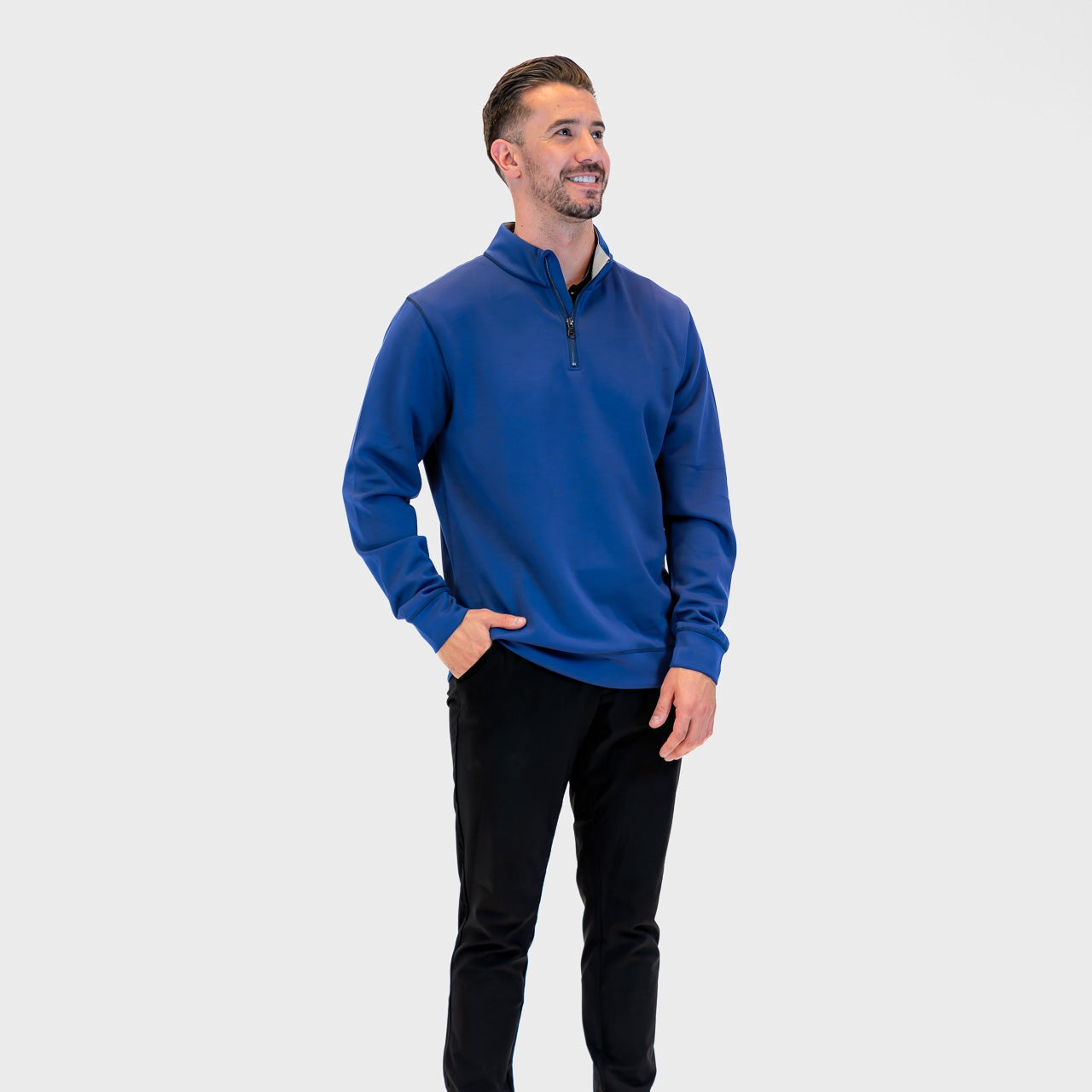
PILLAR Alec Quarter Zip, Blue
$98
The second layer for a shoot that needs more than one look, and the piece that outlasts the shoot into winter. Pulled on over the polo it gives the photographer a different frame without a different order, and it stays in rotation long after the photographs are published. Runs Small through Large right now. See the Alec Quarter Zip in Blue for the full detail.
Carries a left chest mark or a sleeve hit cleanly. Available Small, Medium and Large.
Two looks, one order
The David Polo in Black with the Alec Quarter Zip in Blue. Two looks in one order, which is what gives a photographer a change of frame without a second purchase. The quarter zip runs Small through Large right now, so these three pairings cover those sizes.
$174.00
Five questions get answered before the proof goes out
The brief
Five answers get a proof moving, and until all five exist there is nothing for anyone to approve. Here they are, in the order they usually arrive.
The garment and the color, chosen as a long decision rather than a seasonal one. The size list, one size per person who will be in a frame. The logo file, which has to be a vector file or artwork clean enough to be digitized properly, and our note on the right logo file for company embroidery explains what that means in practice. The placement, stated as a position and a width rather than as a feeling. And the date the shirts have to be in hand, which is not the shoot date, it is a few days earlier so somebody can try one on while there is still time to act on it.
Send those five and a proof comes back showing thread colors, placement and scale on the actual garment. Read it like a contract, because that is what it is. Check the spelling of the company name. Check that the mark is the current version and not the one retired in the last rebrand. Check the stated width against something physical on your desk rather than against the screen, since a screen will lie to you about size every time.
Then approve it. Approval is the starting gun, and the clock you are trying to beat does not begin until you fire it.
Questions buyers ask before a photo shoot order
How far ahead of a company photo shoot should we order branded shirts?
Work backward from the shoot date and treat the proof approval as the deadline. Decorated stock garments take 7 to 10 business days from proof approval, so a proof approved today puts shirts in hand by Friday, November 13, 2026. A shoot on Tuesday, December 8, 2026 needs the proof approved by Monday, November 23, 2026.
How many shirts do we actually need for a team photo day?
Only the people who will be in the frame need a shirt on the shoot date. Count the faces, get a current size for each one, then add two spares in the middle sizes. That number is usually far smaller than your headcount.
Can you tell us how a fabric will look under our photographer's lights?
No. We do not publish how a given fabric behaves under a specific lighting setup, and we will not promise that a screen color, a thread color and a photographed color read identically. We publish no durability figure and no wash cycle figure either. Ask your photographer for one test frame and judge the garment in the room.
Should we order stock garments or build something custom for a shoot?
A shoot inside the next two months is a decoration job on stock garments. A garment built from the fabric up runs about 45 days door to door, with production alone taking 30 to 35 days of that, so a build started today lands around Sunday, December 13, 2026. A spring shoot can be a custom build. A December shoot cannot.
What should the team wear for company headshots?
One garment, one color, in the fit that suits the most bodies. Solid beats a fine repeating pattern, matte beats a sheen, and a shirt that fits beats a shirt bought a size up to be safe. A quarter zip over the same polo gives the photographer a second look without a second order.
What do you need from us before a proof goes out?
The garment and the color, a size for every person who will be in a frame, a usable logo file, the placement you want, and the date the shirts have to be in hand. Five answers, and the proof follows.
Will we be able to reorder the same shirt later?
Plan on it. The photographs will be in use for years, and anyone hired later who appears in a new photograph has to match, so treat the garment and the color as long decisions and the quantity as the short one.
Which date are you counting back from?
Send us the shoot date and the number of people who will be in the frame, and we will tell you which clock you are on and what has to happen this week. Our decoration side handles the proof, the placement and the production schedule. Past work includes AO, the WM Phoenix Open and Progressive Roofing.
