

Should Managers Wear a Different Shirt?
A customer who walks in cold needs the shirt to tell them who works here. A customer standing at the counter with a cracked part and a receipt needs it to tell them which of those people can sign off on an exchange.
Yes, make the lead identifiable, and do it with a garment rather than with a color. Keep one shirt for everybody, the lead included, and put a layer on the lead.
- The short answer
- Identify the lead. Do it with a layer worn over the team shirt, not with a second shirt color.
- The differentiator
- The garment itself. A polo plus a crew or a vest over it reads as a structure, which is what a customer is trying to read.
- What not to change
- The shirt. One garment, one colorway, one size run, one reorder, for the whole team.
- The clock
- Logo embroidery or printing on stock garments runs 7 to 10 business days from proof approval. A garment built from the fabric up is about 45 days door to door.
The customer holding something broken
That customer is the only person this decision has to serve. A uniform solves a simple problem for a stranger. It tells somebody who walked in with no context which of the people in the room are paid to be there. A lead tier solves a harder problem, and it is a different problem, not a bigger version of the same one. The person at the counter has already found an employee. They have found three. What they cannot find is the one who can authorize the exchange, and three identical polos give them nothing to go on.
That is the job, and it explains why the usual framing of this question goes wrong almost immediately. Nobody on the team needs a different shirt as a reward. Nobody needs one to signal rank to the rest of the staff, because the rest of the staff already know who the lead is. They work next to them every shift. The only person in the room who does not know is the customer, and the customer is the one the shirt has to speak to.
Treat it as a wayfinding problem and every downstream decision gets easier, because wayfinding has rules that a brand guideline does not. It wants one obvious signal instead of two competing ones. It wants that signal readable at distance, at an angle and under the lighting you actually have. It wants to survive a staffing change without a redesign. Those are the tests a second tier has to pass.
One question sits right next to this one and belongs somewhere else. Whether a name goes on the shirt at all is a separate call, because a name identifies a person while a tier identifies a role. Our post on employee names on company shirts takes that one.
The people already on the floor
Everybody on the floor wears the same shirt, and the lead wears it too. One garment, one colorway, one size run, one reorder cycle. That is the shirt program, and it should still be the whole shirt program after you add a tier, because the moment you introduce a second colorway you have not added a tier. You have added a program.
Count the second colorway in work rather than in money. Two colorways is two SKUs to keep straight, two size runs to hold, two reorder cycles to remember and two piles of stock to count when somebody leaves in a size you only carry on one side. It is also two dye lots to worry about instead of one, and a lead shirt that comes back half a shade off looks worse on a floor than no tier at all, because now the tier reads as a mistake. We argued the matching problem on its own page, so take it from the piece about whether an apparel reorder matches rather than from me.
A single shirt program also sets a higher bar for the shirt, which is the point. The garment everybody wears has to handle the hardest version of the day: the eight hour shift, the stockroom, the heat by the window, the customer who shows up four minutes before close. Pick for that and let the lead inherit it. If you are choosing the shirt now rather than retrofitting a tier onto one you already run, compare the polo options for a full team and choose the one that still looks like a uniform at 6pm.
Stock garments make this easier than a custom build does, because the size run already exists and so does the reorder. Our men's collection is where the shirt program on this page starts.
A second color is a second program
Two colorways means two SKUs, two size runs, two reorders and two dye lots that have to agree with the first order. A layer over the same shirt keeps one shirt program and adds one piece to it.
Promotion breaks a color
Somebody gets promoted in March. A color tier means buying one person a whole new set of shirts in a size you may not hold, while a layer means handing them a layer.
Contrast reads faster than hue
Two shades of the same polo on one floor read as an inconsistent uniform. A polo with a layer over it reads as a structure, and the distinction a customer needs is that somebody is dressed differently.
The mark should not do the work
Making the lead's logo bigger, louder or different does not help anybody find them across a room. Legibility belongs to the whole team rather than to one tier inside it.
The one person who can fix it
Put a layer on them. The layer works because it is additive: the lead is wearing everything the team wears plus one more piece, and that is exactly the relationship you want a stranger to read off a room in a second and a half. Nobody has to decode a hue. They see a shape that none of the other ten people have, and they walk toward it.
The choice between a sleeve and no sleeve is a question about where the lead stands all day, not a question about taste. A crew or a quarter zip over the polo is the one for a counter, a front of house, a showroom or an office floor, because a sleeve reads as finished rather than as outdoor gear brought inside. A vest is the one for a lead who crosses a threshold all day, between a shop and a lot, a desk and a yard, a trailer and a site. It leaves the arms free, it does not fight a radio or a clipboard, and it reads at thirty feet. The retail version of that argument lives in our post on wearing a vest over a polo.
Either way the layer carries the same mark as the shirt, embroidered with your logo and stitched to your spec, so the tier never looks like a garment somebody brought from home. That is the part people get wrong when they try to improvise a tier with whatever jacket the lead already owns. Check the quarter zips and vests before you decide which side of the threshold your lead actually lives on. The pullovers and layers we stock sit in the pullover collection.
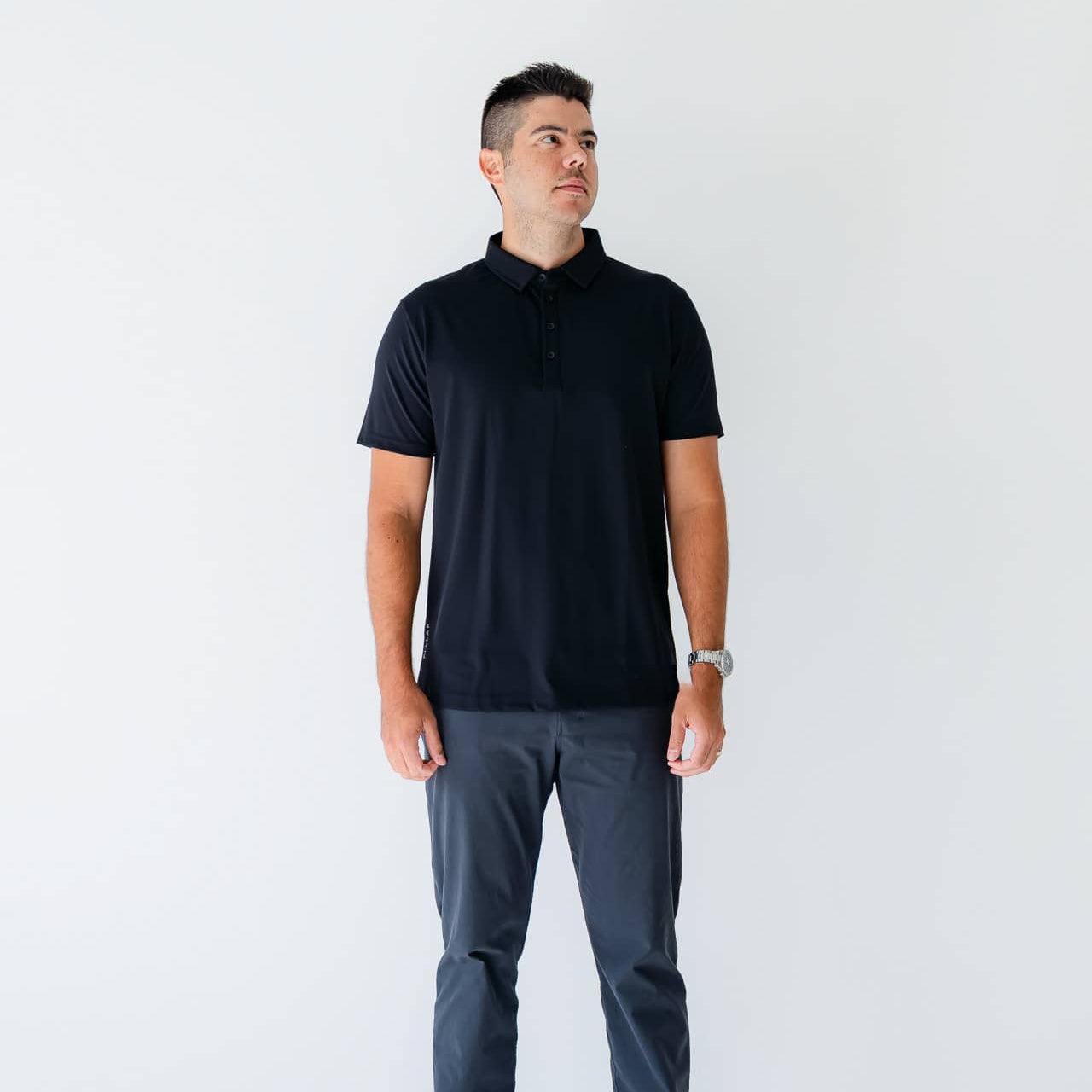
David Polo
The shirt everybody wears, lead included. 84 percent nylon and 16 percent spandex, four way stretch, sweat wicking, with a firm collar that holds its shape through a shift that does not go to plan. Classic athletic fit, U cut hem, pre shrunk. Six sizes, all available.
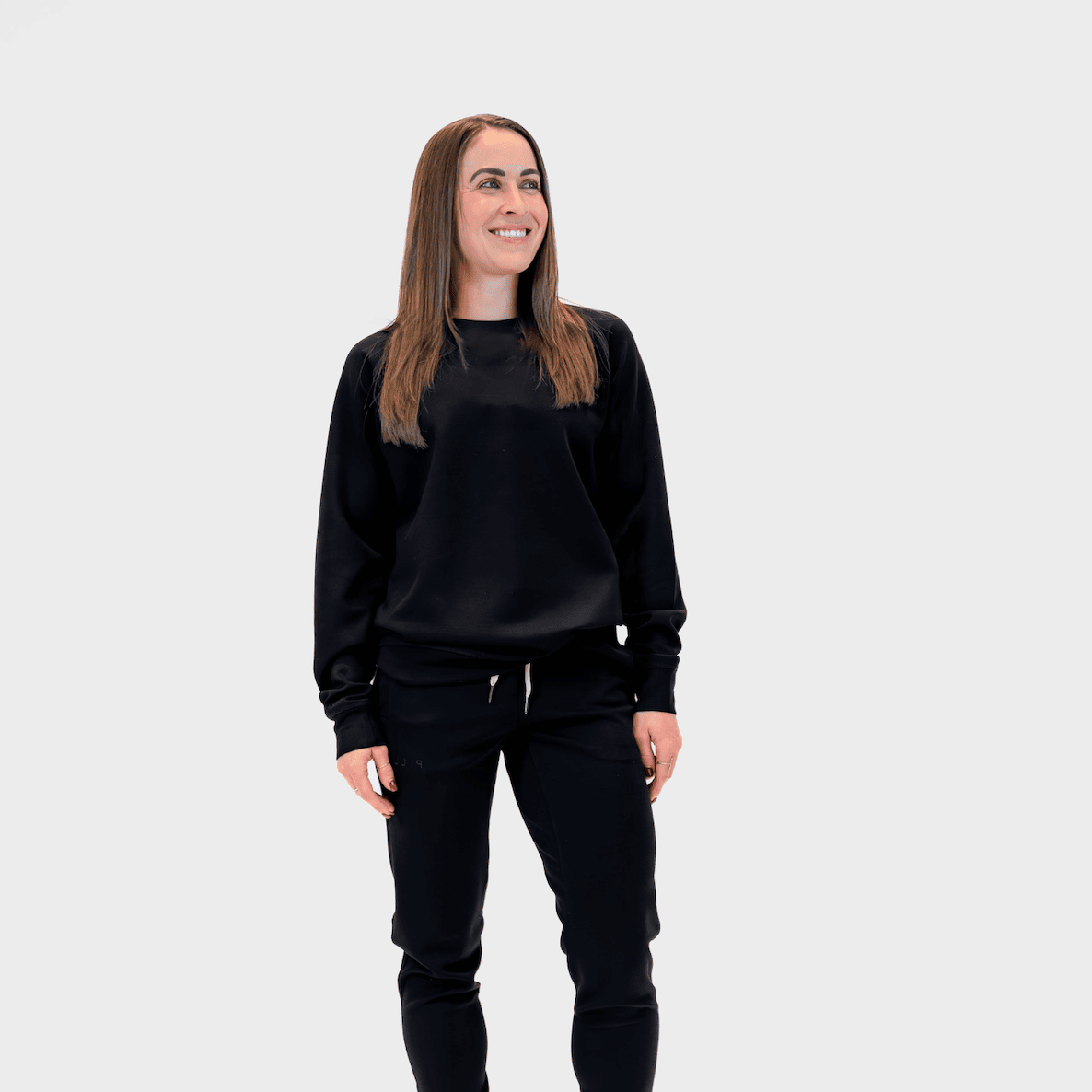
Alec Crew
The layer that goes over the same shirt. This is the differentiator for a counter, a front of house or an office floor, where a sleeve reads as finished rather than as outdoor gear. Seven sizes, all available, which is a wider run than anything else on this page and the reason a promotion in an odd size stops being a problem.
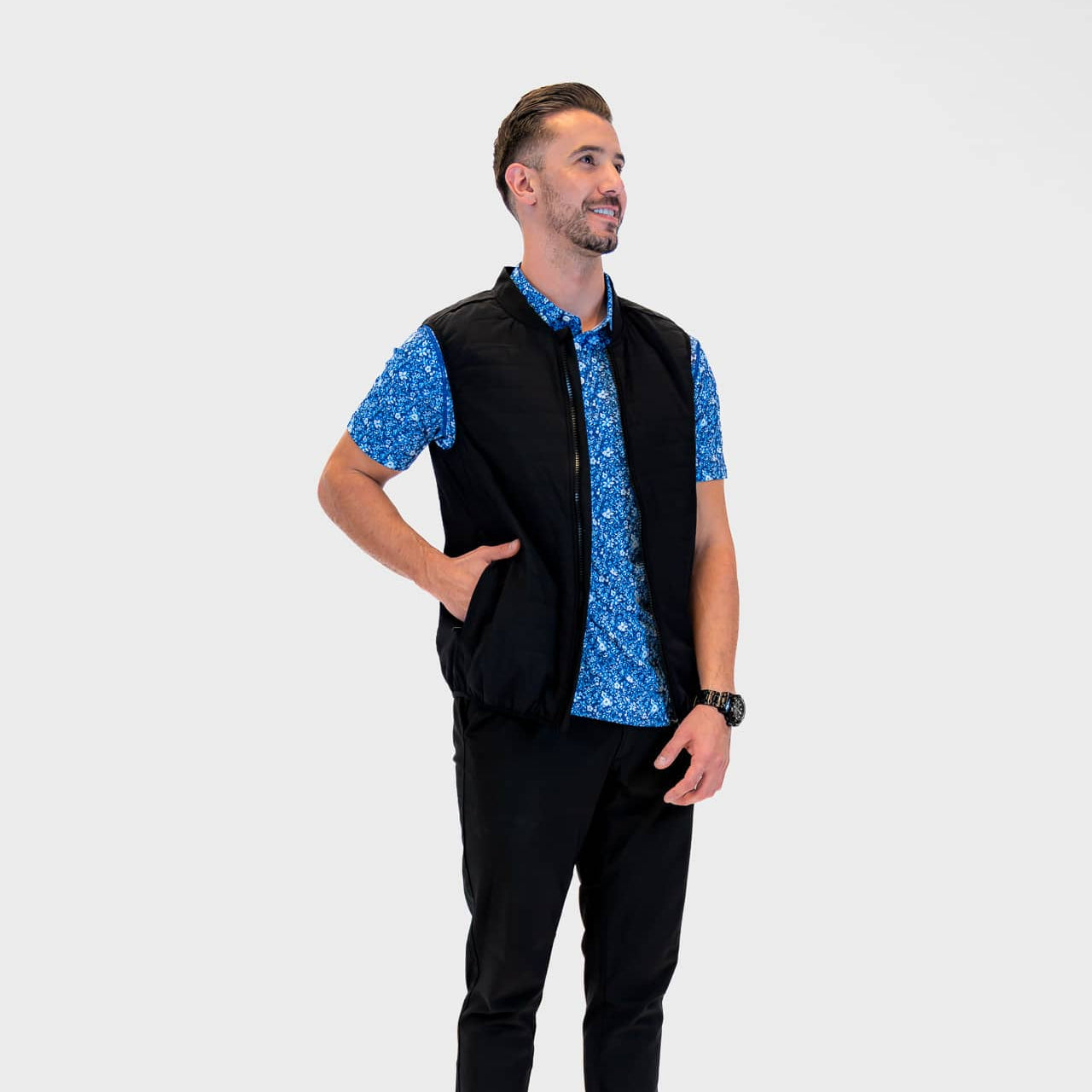
Kevin Vest
The other layer, and the right one when the lead moves between inside and outside all day, across a lot or a yard or a site. It leaves the arms free and it reads at thirty feet. Five sizes, all available, and XXL is the top of the run.
The team shirt with the layer over it
David Polo in black with the Alec Crew in black over it, which is the whole tier in two garments. Total $161.00. Pick the size and both pieces land in the cart together.
A customer does not need to know who is senior. A customer needs to know who to walk toward.
The lead who got promoted in March
Hand them a layer and the question is closed in a minute. That is the whole argument for keeping the tier in a garment rather than in a color, and it is the argument that only shows up after the program has been running a while. Nobody plans a uniform around March. Programs get planned around a launch, a season or a remodel, and then somebody good gets moved up on a Monday in the middle of a quarter and the program has to absorb it without a purchase order.
A color tier cannot absorb it. A promotion means buying one person new shirts in their size, and if their size is not the size you stock deep, you are waiting on it while they work the floor in the shirt that now says the wrong thing. Do it twice in a year and the tier has quietly become the most expensive and most annoying part of the program. A layer absorbs it because the layer is one piece, and because the shirt in their drawer still works. It worked yesterday as a team shirt and it works today under a crew.
It also runs the other way, which matters more than people expect. Roles move back, people step down from a lead shift for a term, somebody covers for six weeks. A layer handles a reversible change without anybody having to hand back a wardrobe.
Adoption is a separate subject with its own post, but one line of it belongs here: a layer tends to get worn more willingly than a different colored shirt, because it adds something to what somebody already has rather than marking them out from the people they work with. The rest of that question is in our post on why employees do not wear the company shirt.
The new hire on a Tuesday
They read contrast, not hue, and so does every customer who comes through the door behind them. On their first shift a new hire has to work out who to ask before they know anybody's name, from across a room, usually while somebody is already talking to them. A layer tells them. It is one piece of information with one obvious shape, and it needs no induction to explain.
Two shades of the same polo do not survive that test. They lose in bad lighting, they lose at an angle, they lose when a shirt is half covered by an apron, a lanyard or a counter, and they lose completely from the far side of a space. Worse, when they fail they do not fail neutrally. A floor with two near shades of the same shirt on it reads as a uniform program that is not being maintained, which is the opposite of the impression the program was bought to create. A polo and a layer over it cannot fail that way, because the difference is structural. There is a piece there or there is not.
This is also where the temptation to solve the problem with the logo comes in, and it should be resisted. A bigger mark on the lead, or a louder one, or a differently placed one, does not make the lead findable, because a mark is small and a garment is not. All a tiered mark does is break the consistency of the thing a customer scans for first. We made the same case from the other end, and you can weigh the case for a tonal mark there: thread that matches the fabric suits people who are already known in the room and fails for anybody who has to be spotted. Both halves of that point to one conclusion. Legibility is a property of the whole team's shirt, not a lever you pull on one tier. If you want numbers on tonal work, they are on that page and not on this one.
The person who places the order
Adding a lead layer to a program you already run is a stock decoration order, so it is on the short clock. Logo embroidery or printing on stock garments runs 7 to 10 business days from proof approval, and production starts the day you approve the proof. That is the number to plan the tier around, because the shirt program is not moving, the size run is not changing and the only new thing in the order is a run of layers carrying a mark you have already approved once. If the layer is the whole project, start an embroidery order on stock garments and the tier can be on the floor inside the month.
Changing the program's garment is a different job on a different clock, and it is next quarter's job. A garment built from the fabric up runs about 45 days door to door, which is the right amount of time for a decision about what the whole team wears every day and the wrong amount of time for a decision about identifying one of them. Keep those two separate in your own planning. If the team shirt itself needs to change, build a garment from the fabric up and give that project the calendar it needs, then layer the tier onto it afterward on the short clock.
The sequencing is the actual advice. Settle the one shirt first, run it long enough to know what it does on a real floor, and add the tier as a small order on top. Done the other way around, the tier dictates the shirt, and you end up choosing a team garment because it came in two colors.
The questions for somebody who is not us
Two questions on this page are not ours, and it is worth saying which. We are also not going to tell you that a lead layer lifts morale, sharpens motivation or makes a team pull harder, because we have run no study on it and we have no source for it, and a claim about team psychology dressed up as a product benefit is what a supplier reaches for when the practical argument has run out. The practical argument above is enough on its own. We are not putting decoration pricing on this page either, in any form, because a per piece figure quoted without your garment count, your artwork and your layer in front of us would be a guess, and a guess is worth less to you than a real quote.
That belongs to an employment attorney, working from your own agreement with your staff. It is a question about what you can compel and what you can recover, not a question about garments, and we will not give you an answer to it on a blog.
That belongs to our post on how to size a company polo order, which handles the size run and the extended sizes question properly. Count from there rather than from a rule of thumb.
The buyer with six more questions
Short answers, in the wording buyers use when they ask.
Should managers wear a different color shirt than staff?
No. Keep one shirt and one colorway for the whole team, lead included, and identify the lead with a layer worn over it. A second colorway is a second program, with its own size run, its own reorder cycle and its own chance of a dye lot that does not match the first order.
How do you make a supervisor identifiable without changing the uniform?
Hand them a layer. A crew or a vest over the same polo reads as a structure rather than as an inconsistent uniform, and a customer picks up that contrast across a floor faster than they pick up a difference in shade.
Is it better to give managers a different shirt or a jacket?
A layer, every time. A layer is one add on to a shirt program that already exists, while a different shirt is a second program you have to choose, size, store and reorder for as long as the tier exists.
What happens to a manager's uniform when someone gets promoted?
With a layer, you hand the new lead a layer and the shirt in their drawer still works. With a color tier, you are buying one person new shirts in the middle of a quarter, in a size you may not currently hold.
How long does it take to add a layer to an existing apparel program?
Logo embroidery or printing on stock garments runs 7 to 10 business days from proof approval. A garment built from the fabric up is a different product on a different clock, about 45 days door to door.
Do manager shirts need a different logo?
No. Making the lead's mark bigger or louder does not help a customer find them, because legibility belongs to the whole team rather than to one tier. This page does not rule on where a logo sits.
Tell us the shirt your team already wears and the layer you want over it, and we will come back with a proof. Production starts the day you approve it.
