

What Men Should Wear to Play Golf at Primland
Shirts have to carry a collar and sleeves, the only legal bottoms are slacks or golf shorts, and denim, T-shirts, tank tops, cut-offs, sweat pants, bathing suits and other athletic shorts are banned by name. That is the published dress code for the Highland Course, which belongs to Primland Resort in Meadows of Dan, Virginia, and the second half of the same code reads like a different document: any non-heeled athletic shoe can be worn. One half names the garments you may not put on. The other half waves through the trainers in your trunk. So the answer for the night before is short. Wear a collared golf polo with sleeves, wear golf slacks or golf shorts, leave the jeans and the gym shorts and the T-shirt in the room, and play in any flat athletic shoe you already own.
That lopsidedness is the interesting part. The code is specific to the point of listing fabrics and cuts on the top half, then hands the bottom half straight back to you. It is telling you where the decision is, and the decision is not the shoe. It is not really the shirt either, because the collar settles itself in about four seconds. The decision at Primland is the mountain.
A collar and sleeves are required. No T-shirts, no tank tops.
Slacks or golf shorts. No denim, no cut-offs, no sweat pants, no other athletic shorts.
Any non-heeled athletic shoe is allowed, which is looser than the shirt rule.
Meadows of Dan averages a 57.7 degree high and a 33.9 degree low in November, per NOAA, and the course sits higher than the weather station.
The PILLAR David Polo at $76.00 for the collar, the Alec Quarter Zip at $98.00 for the first nine, the Kevin Vest at $78.00 when the ridge opens up.
Collars and sleeves are required
Collars and sleeves are required, and that is the entire sentence. Primland's own golf page publishes it as "Shirts with collars and sleeves are required. Slacks or golf shorts must be worn." There is no qualifier about knit against woven, no note on collar height, nothing about what the collar has to be made of. A standard golf polo clears it. A long sleeve golf polo clears it. A sleeveless top does not, and neither does a T-shirt, because the very next published sentence bans both by name.
So treat the collar as solved and spend the thinking elsewhere. The one thing worth getting right is that the collar still looks like a collar on the ninth hole. The PILLAR David Polo in navy at $76.00 is the version we would pack for a Blue Ridge round, with a firm collar built to hold its shape and a U cut hem that stays put when you reach. Its warm month sibling, the PILLAR Steven Polo at $76.00, is a printed polo built for heat, which makes it the wrong call for a 45 degree mountain morning. If you want the range rather than one pick, the full men's polo collection is there. And if the word collar is doing a lot of quiet work in your head right now, we took that apart in our piece on what counts as a collared shirt for golf.
Denim is banned by name
Denim is banned by name, so jeans are out and there is no reading of the page that saves them. The published line is "No tank tops, denim, T-shirts, cut-offs, sweat pants, bathing suits or other athletic shorts are permitted." Read that list twice. It bans a fabric. It bans a cut. It bans a category of gym wear. It bans a swimsuit. What it does not do is ask politely for proper golf attire and leave the rest to your judgment.
Lists that specific get written after somebody turns up in the thing, which is exactly why you can trust this one. It is a closed list, not a mood. Anything not on it, and not excluded by the collar requirement above it, is fine. Golf slacks are fine. Golf shorts are fine. A quarter zip over the polo is fine. A vest over the polo is fine. A dark denim trouser that is technically a five pocket pant is not fine, and nobody at the first tee is going to run a fiber test to find out, because denim looks like denim from twenty feet.
Golf shorts are permitted and no length is given
Golf shorts are permitted, and the code never says how long they have to be. The published requirement is that slacks or golf shorts must be worn, and the published ban covers cut-offs and other athletic shorts. That is a rule about type, not a rule about length. There is no inseam figure on the page, no hem guidance, nothing about where the short should sit relative to your knee. If you came looking for a number, there is not one, and we are not going to invent one.
What a type rule means in practice is that the garment is the test, not the tape measure. A tailored golf short in a performance fabric passes. Basketball shorts read as athletic shorts and are banned by name. A chino somebody took scissors to reads as a cut-off and is banned by name. The judgment call, if there is one, is fabric and construction, not length. In the middle of November on a mountain course you will want the slacks anyway, which makes this the least consequential rule on the page.
Any non-heeled athletic shoe is allowed
Any non-heeled athletic shoe is allowed, which is the loosest clause in the document. The resort publishes it as "Any non-heeled athletic shoes can be worn." Golf shoes are obviously welcome. So are trainers. So is the flat pair you drove up in. The only footwear the sentence excludes is a heel, and you were not bringing one.
Sit with the asymmetry for a second, because it is the whole argument of this post. The shirt clause names a required feature and then bans four separate shirt styles. The shoe clause is one sentence of permission with a single carve out. A code written that way is not being careless about feet. It is being explicit about where it cares, and it cares about your top half. Primland publishes no spike rule, so we are not going to pretend to know one. What the page does tell you is that if you spend your decision anywhere, spend it above the belt.
The morning is not described by the forecast
The morning is colder than the number you looked up, because the number you looked up was measured lower down the mountain. NOAA's monthly climate normals for 1991 to 2020, from the station that identifies itself as Meadows of Dan 5 SW, VA US, put November in town at an average high of 57.7 degrees, an average low of 33.9 degrees and an average mean of 45.8 degrees. For scale from the same station, October runs 68.0 and 43.9, and December runs 48.1 and 28.8. The middle of November sits on the slope between those two, falling.
Here is the catch that the forecast app will not tell you. That station sits at about 2,225 feet. Golf press reports the Highland Course at roughly 3,000 feet, a figure the resort itself does not publish, which puts the first tee something like 775 feet above the thermometer those normals came from. So attribute the numbers to the town of Meadows of Dan, never to the tee box, and then plan on colder than the town. A 57.7 degree average high is a mid layer afternoon anywhere. A 33.9 degree average low, measured below the course, is a vest in the bag and no argument about it.
Season helps a little and hurts a little. November is a published, priced shoulder season month on the resort's own rate table, the November rate is lower than the peak rate, and the course is open. We are not quoting a green fee, because the resort's own rate tables carry year labels that do not agree with each other. What shoulder season buys you is a quiet round in fall foliage, at the cost of a genuinely cold start.
Then there is the cart. No caddie program is advertised and the resort publishes no walking policy either way, so we are not going to tell you that walking is banned or that riding is required. But if you ride, and on a course routed along ridge tops most people do, you are sitting still in moving air for four hours. Sitting still is colder than walking. That is the whole argument for a layer you can take off over a heavier shirt you are stuck inside, and we made the long version of that case in our guide to what to wear golfing in cold weather.
Cold, and colder than the figure you checked, because the station that produced the figure sits below the tee.
The sun is up, the sheltered holes feel generous, and the layer comes off.
The light goes early in November and the temperature follows it straight down.
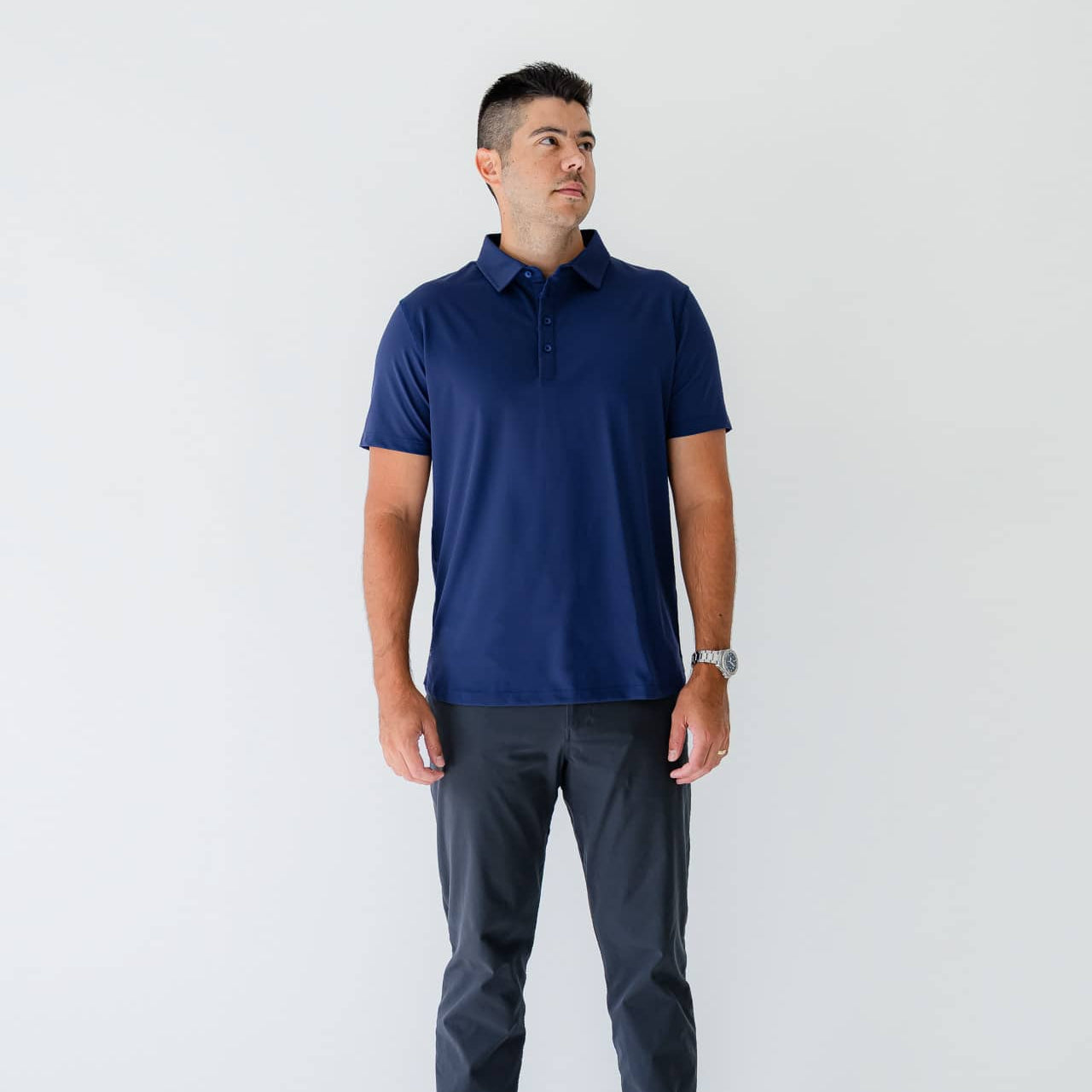
The code rules on your collar, and this one is built to hold its shape rather than fold over by the fourth hole. It is 84% nylon and 16% spandex with four way stretch and a U cut hem, so the collar stays firm while the shirt moves with a full turn.
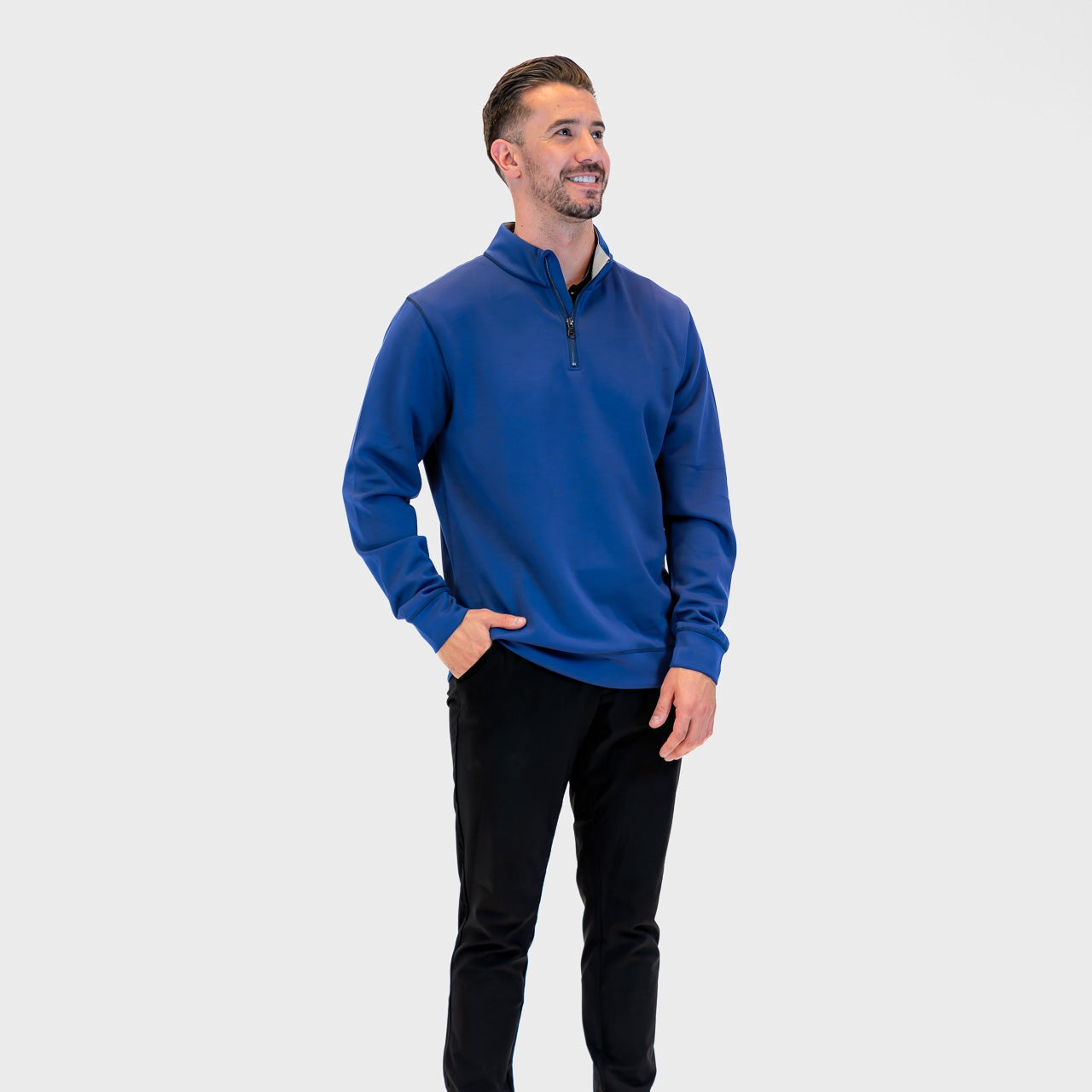
A mountain start at a 33.9 degree average low needs a mid layer, and a zip is a dial instead of a switch. The 51% polyester, 43% modal and 6% spandex blend is mid weight and breathable, so the sheltered holes do not cook you out of it.
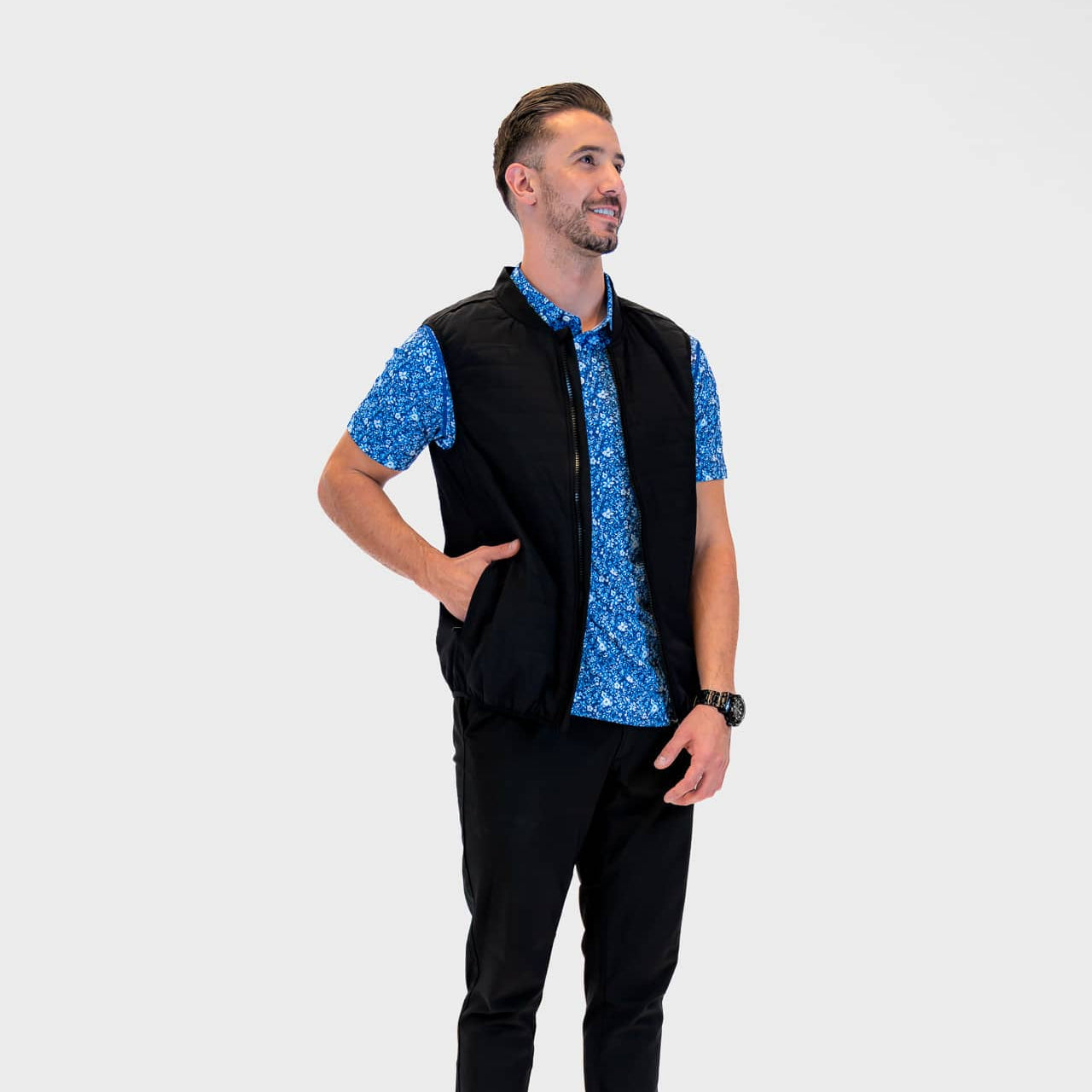
On the holes cleared for cliff-side views there is nothing at all between you and open air, and a vest covers the core while leaving the swing alone. It is 88% nylon and 12% spandex, lightweight and water resistant, with a blade collar that sits flat under a zip.
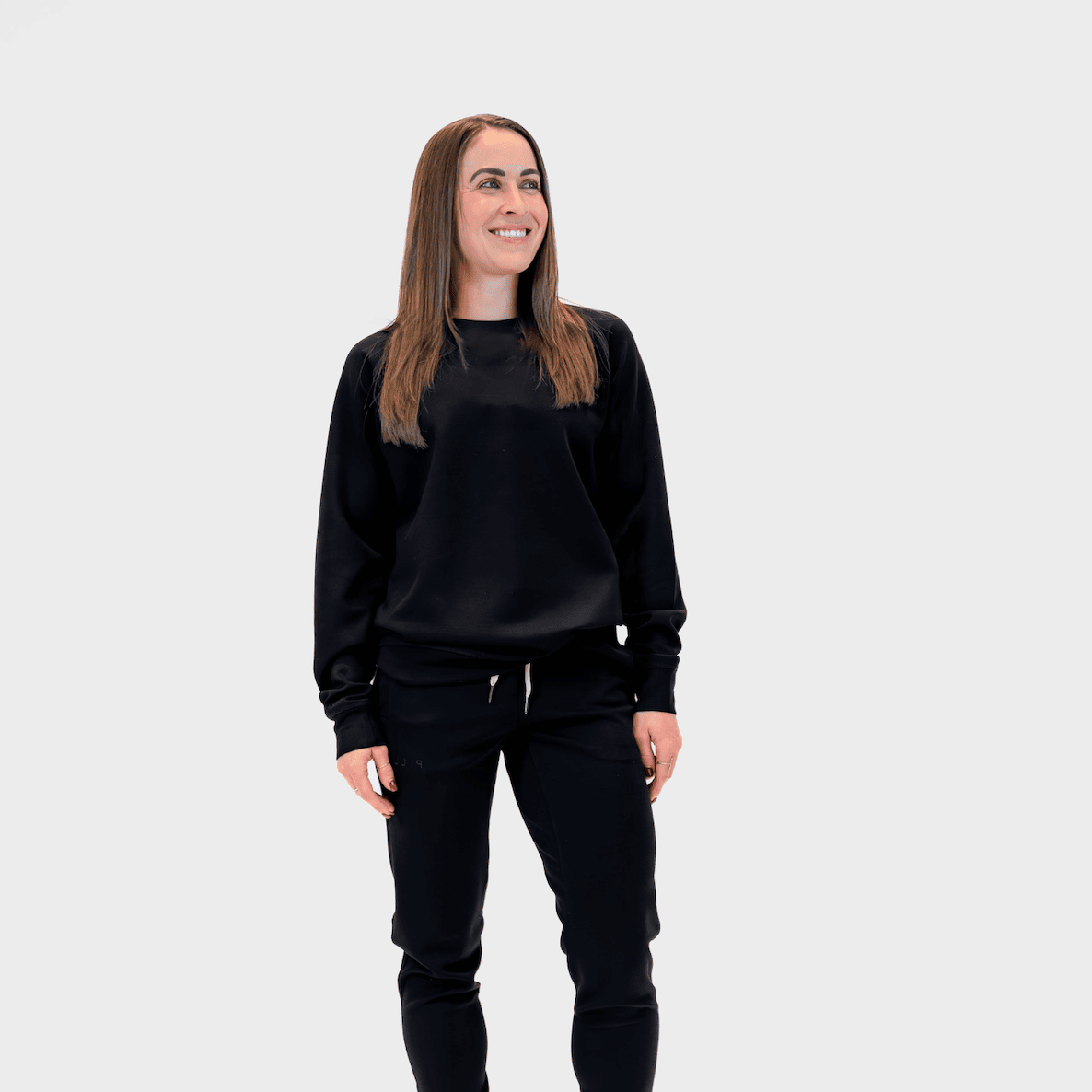
The round ends and the mountain does not warm up, so something has to go over the polo for the drive back down. This is the same mid weight polyester, modal and spandex blend as the quarter zip, pre shrunk and unisex, and it is the simplest thing in the bag to pull on over a collar.
The two pieces that actually settle a Primland tee time are the collar and the mid layer. David Polo Navy plus the Alec Quarter Zip in blue is $174.00 together. Three sizes only, because the quarter zip is out above Large.
The ridges are left open and the valleys are not
Your exposure changes hole to hole, and that is the real layering problem here rather than anything in the code. The Highland Course is routed along the tops of ridges and down through valleys on a 12,000 acre private mountain estate perched above the Dan River Gorge, in the southern Blue Ridge. Several holes were cleared for cliff-side views and sit completely open. The rest is tree-lined, with land that falls away steeply into wooded valleys on either side of you. So you are not playing one set of conditions for eighteen holes. You alternate between sheltered and fully exposed, over and over, with emerald fairways and bentgrass greens threading between old-growth hardwood forest, trout streams and gorge rock faces.
That alternation is why a vest beats a jacket on this course. A jacket is a decision you make once on the first tee and then regret on every sheltered hole. A vest covers the core, leaves the arms free and simply stays on through both kinds of hole. A quarter zip solves the same problem from the other end, because a zip adjusts by degrees instead of all at once. Ideally you carry both and take the vest off at the turn. If you are picking only one, the layers collection is where to start, and we argued the specific case in our piece on whether you can wear a vest over a polo. None of this is exotic mountain equipment. It is a polo, a zip and a vest, and the full property description is published by the resort itself.

Mock necks are left unruled
A men's mock neck is not ruled on, and that is a gap on the published page rather than a gap in our reading of it. The women's clause permits "collared or mock collared shirts" in those words. The men's clause says only that shirts with collars and sleeves are required, and it does not mention mock necks in either direction. So on the record as published, a men's mock neck is neither permitted nor banned. It is unruled, which is a different thing from allowed and from prohibited.
We are not going to tell you it passes and we are not going to tell you it fails, because Primland has not said. What we will tell you is the safe play, and the safe play is a collar. You give up nothing by wearing one. The collar clause is unambiguous, a golf polo is not a compromise garment, and no starter anywhere has ever stopped a man for having a collar on. Pack the mock neck for the drive and for dinner if you like it. Tee off in the polo.
Nothing above is ruled on by us
No ruling is offered here on hats or how you wear one, on metal or soft spikes, on cargo pockets, on tucking, on how long your shorts are allowed to be, or on whether a men's mock neck gets waved through, because Primland publishes none of it. Six pages of the property's site were checked and there is no separate dining or clubhouse dress code anywhere on them either. That is unusual, and the consequence is worth stating plainly: the golf dress code is the only published dress code in the entire operation, so the shirt that passes on the first tee is also the shirt you eat in. We are not going to manufacture a dining rule to fill that silence, and you should be suspicious of anyone who does.
If any of it matters to you, call the pro shop before you drive up. They are the only people who can tell you how one specific item will be received, and a short phone call beats any blog post, including this one. For the record, PILLAR has no relationship, sponsorship or affiliation with Primland or with Auberge Resorts Collection. We read the resort's own golf page, quoted what it publishes and named NOAA for the climate normals, and everything beyond that is our opinion about clothes. The Highland Course is a Donald Steel design, with his design partner Martin Ebert credited by some of the golf press for the fairways, so both names stand. If you want golf polos compared across the market rather than inside our own line, that belongs in our rundown of the best men's golf polos on and off the course.
A shirt with a collar and sleeves, plus slacks or golf shorts. The published Highland Course code bans tank tops, denim, T-shirts, cut-offs, sweat pants, bathing suits and other athletic shorts by name, and it allows any non-heeled athletic shoe.
No. Denim is listed by name in the ban on the resort's own golf page, so jeans do not pass on the Highland Course. Wear golf slacks instead, which is the first of the two bottoms the code names as acceptable.
Yes, golf shorts. The code says slacks or golf shorts must be worn, and separately bans cut-offs and other athletic shorts. It regulates the type of short, not the length, and no inseam or hem figure is published anywhere.
No. The published code says any non-heeled athletic shoes can be worn, so trainers are acceptable. Golf shoes are still the better choice on a mountain routing with real slopes, but the code does not require them.
None is published. Six pages of the property's site were checked and the golf dress code is the only dress code the resort publishes, so the shirt that clears the first tee is the shirt you eat in. Call the pro shop if a specific evening matters to you.
Meadows of Dan averages a high of 57.7 degrees and a low of 33.9 degrees in November, per NOAA monthly normals for 1991 to 2020. The course sits higher than that weather station, so plan on colder than the town figures.
A collared golf polo with a quarter zip over it and a vest in the bag. The morning starts near the town's 33.9 degree average low and the course is above the station that measures it, so dress to shed layers rather than to add them.
One polo clears the code. The layers are what get you from the first tee to the last four holes.
Blog reader perk: 20% off sitewide when you enter code BLOG20 at checkout.
